
Anne’s Master Definitions 3-11-22 at 1-30PM (6-29-24 at 9-55AM)
Page 1 of 128 (142 6-25-24 at 8:54 AM)
– This is the collective list we are coming across as we learn more about dissociation personally and professionally … the list is in ongoing process …
– Thank you very much for the following resources. The significant collections in this Master collection are:
- APA Dictionary of Psychology~(https://dictionary.apa.org/) (2020). Over 25,000 authoritative entries across 90 subfields of psychology
- APA PsycNet~ https://psycnet.apa.org (2022). APA PsycNet – American Psychological Association
- Dissociation and Dissociative Disorders #: DSM-V and Beyond (Dell & O’Neil (2011). (https://www.amazon.com/Dissociation-Dissociative-Disorders-DSM-V-Beyond-ebook-dp-B004OBZX1W/dp/B004OBZX1W/ref=mt_other?_encoding=UTF8&me=&qid=
- Gold, S. N. (Ed.).(2017). _APA handbook of trauma psychology: Foundations in knowledge._ American Psychological Association. [https://doi.org/10.1037/0000019-000](https://psycnet.apa.org/doi/10.1037/0000019-000%5B)%5D(%3CGold, S. N. (Ed.). (2017). APA handbook of trauma psychology: Foundations in knowledge. American Psychological Association. https://doi.org/10.1037/0000019-000%3E)
- Multiples/Plurals Known to have collected definitions
- Astraea(http://astraeasweb.net/plural/glossary.html#median)
- Dark Personality(http://www.darkpersonalities.net/content/?p=4)
- Fuzzyjayling(https://plural-magic.dreamwidth.org/6467.html)
- Plures(http://www.exunoplures.org/main/articles/sticky-terms/)
- We also use _Merriam-Webster’s Unabridged Dictionary_, Merriam-Webster, https://unabridged.merriam-webster.com/unabridged/Accessed 8 Feb. 2022[.] AND, _Merriam-Webster’s Medical Dictionary_, Merriam-Webster, https://unabridged.merriam-webster.com/medical/ Accessed 8 Feb. 2022[.]
– Please let us know if you know other collections, primarily “Dissociation” or anything else psychology-related or other, at aynetal3@aol.com.
0-9
[[80% of maltreated infants (vs. 20% to 40% of controls) exhibit such behaviors or attachment disorganization]] ~Carlson, Cicchetti, Barnett, Braunwald (1989). Up to [[80% of maltreated infants (vs.
Anne’s Master Definitions 3-11-22 at 1-30PM
Page 2 of 128
20% to 40% of controls) exhibit such behaviors or attachment disorganization]] ~Carlson, Cicchetti, Barnett, Braunwald (1989). 3.2.3 NORMATIVE DISSOCIATIVE PROCESSES by Carlson, Yates, Sroufe (2011). 3. Dissociation and Development of the Self. Dissociation and the Dissociative Disorders: DSM-V and Beyond. Dell and O’Neil Editors. Taylor and Francis. Kindle Edition. (pp. 43-46).
A
[[abandonment]] ~APA, VandenBos, G. R. Editor-in-Chief. (2015). APA Dictionary of Psychology, second edition. n. desertion or substantial leave-taking by a parent or primary caregiver of custodial and other responsibilities to a dependent. Dependents are usually children but may also be adult individuals who are ill. —abandon vb. pp. 1. *
[[abandonment reaction]] ~APA, VandenBos, G. R. Editor-in-Chief. (2015). APA Dictionary of Psychology, second edition. A feeling of emotional deprivation, loss of support, and loneliness experienced by children who have been deserted or neglected by a parent or primary caregiver. Abandonment reaction is also experienced by adults who have lost a loved one on whom they have depended. pp. 1. *
[[aberrant response]] ~APA, VandenBos, G. R. Editor-in-Chief. (2015). APA Dictionary of Psychology, second edition. Abnormal or atypical behavior is commonly targeted during a behavioral intervention. pp 2. *
[[ability]] ~(https://dictionary.apa.org/ability) (2020). _n._ existing competence or skill to perform a specific physical or mental act. Although ability may be either innate or developed through experience, it is distinct from the capacity to gain competence (see [aptitude](https://dictionary.apa.org/aptitude)). *
[[ability level]] ~(https://dictionary.apa.org/ability-level) (2020). an index [Ann – MWU – a list (as of bibliographical information or citations to a body of literature) usually arranged in alphabetical order of some specified datum (such as author, subject, or keyword)] of achievement or performance that reports the absolute or relative ability concerning the trait or characteristic being assessed. *
[[ability test]] ~(https://dictionary.apa.org/ability-test) (2020). **1.** A norm-referenced standardized test designed to measure competence or capacity to perform a physical or mental act. **2.** A test measuring achievement. *
Anne’s Master Definitions 3-11-22 at 1-30PM
Page 3 of 128
[[ableism]] ~APA, VandenBos, G. R. Editor-in-Chief. (2015). APA Dictionary of Psychology, second edition. n. discrimination against individuals with disabilities or the tendency to be prejudiced against and to stereotype them negatively as, for example, less intelligent, nonproductive, or dependent on others. —ableist adj. pp. 2. *
[[abnormal]] ~(https://dictionary.apa.org/abnormal) (2020). _adj._ relating to any deviation from what is typical, usual, or healthy, particularly if the deviation is harmful or maladaptive. In statistics, for example, abnormal scores are outside the usual or expected range. The term, however, is most often applied to behavior that differs from a culturally accepted norm, especially when indicative of a mental disorder. **—abnormality** _n._ **—abnormally** _adv._ *
[[abnormal behavior]] ~ (https://dictionary.apa.org/abnormal-behavior) (2020). behavior that is atypical or statistically uncommon within a particular culture or that is maladaptive or detrimental to an individual or to those around that individual. Such behavior is often regarded as evidence of a mental or emotional disturbance, ranging from minor change problems to severe mental disorders. *
[[abnormal psychology]] ~(https://dictionary.apa.org/abnormal-psychology) (2020). The branch of psychology is devoted to studying, assessing, treating, and preventing maladaptive behavior. See also [psychopathology](https://dictionary.apa.org/psychopathology). *
[[absent-mindedness]] ~APA, VandenBos, G. R. Editor-in-Chief. (2015). APA Dictionary of Psychology, second edition. n. a state of apparent inattention marked by a tendency to be preoccupied with one’s thoughts and not external conditions. See also mind-wandering. pp. 3.*
[[absolutism]] ~APA, VandenBos, G. R. Editor-in-Chief. (2015). APA Dictionary of Psychology, second edition. n. the philosophical position that there are absolute ethical, aesthetic, or epistemological values. Phenomena are believed to have a fixed reality; thus, what is true in one circumstance will be true in all others. For example, a particular action will always be deemed immoral, regardless of its outcome or other individual or subjective considerations. Such a position involves a rejection (in whole or part) of relativism. pp.4.*
[[abstract idea]] ~APA, VandenBos, G. R. Editor-in-Chief. (2015). APA Dictionary of Psychology, second edition. An idea or concept with no specific material referent, such as justice, or one that applies to many instances, having a meaning apart from any, such as a dog. See also universals. pp. 4.*
Anne’s Master Definitions 3-11-22 at 1-30PM
Page 4 of 128
[[abstract learning]] ~APA, VandenBos, G. R. Editor-in-Chief. (2015). APA Dictionary of Psychology, second edition. We gain knowledge of general or intangible material, such as the meanings of concepts and propositions and the logical and systematic relations between them.
- 5. *
[[abstract thinking]] ~APA, VandenBos, G. R. Editor-in-Chief. (2015). APA Dictionary of Psychology, second edition. Using general ideas or concepts characterizes thinking. Compare concrete thinking. See also abstract attitude and definite thought. pp. 5. *
[[abulia (aboulia)]] ~APA, VandenBos, G. R. Editor-in-Chief. (2015). APA Dictionary of Psychology, second edition. n. extreme loss of initiative and willpower, resulting in an inability to decide or start voluntary actions. —abulic adj. pp. 5.*
[[abuse]] ~(https://dictionary.apa.org/abuse) (2020). **1.** _n._ interactions in which one person behaves in a cruel, violent, demeaning, or invasive manner toward another person or an animal. The term most commonly implies physical mistreatment but also encompasses sexual and psychological (emotional) mistreatment. **2.** _vb._ to subject a person or animal to such treatment. **3.** _n._ see [substance abuse](https://dictionary.apa.org/substance-abuse). **4.** _n._ colloquially, the misuse of a substance if it causes the individual difficulty, whether it meets a formal diagnosis or substance abuse. **—abuser** _n._ *
[[abuse excuse]] ~(https://dictionary.apa.org/abuse-excuse) (2020). experience of prior abuse (e.g., physical, mental, or sexual) used as a defense for a person’s violent acts. *
[[abusive punishment]] ~APA, VandenBos, G. R. Editor-in-Chief. (2015). APA Dictionary of Psychology, second edition. Use of excessive physical force to discipline a child that results in bodily injury, including noticeable marks, bruises, cuts, or welts; such punishment includes beating, burning, or tying up a child. Compare corporal punishment. pp. 5. *
[[academic]] ~APA, VandenBos, G. R. Editor-in-Chief. (2015). APA Dictionary of Psychology, second edition. Adj. Relating to formal learning with conventional or theoretical study at a school or other educational institution. pp. 5.*
[[academic achievement]] ~APA, VandenBos, G. R. Editor-in-Chief. (2015). APA Dictionary of Psychology, second edition. 1. any identifiable success in the areas of scholarship or disciplined study. 2. in educational psychology, a level of proficiency in academic work or a specific skill, such as arithmetic or reading. Evidence of future academic achievement is usually based on the results of standardized ability tests and performance assessments by a teacher or other supervisor. pp. 5. *
Anne’s Master Definitions 3-11-22 at 1-30PM
Page 5 of 128
[[academic aptitude]] ~(https://dictionary.apa.org/academic-aptitude) (2020). competence or capacity to perform an academic or mental act, such as learning quickly in scholarship or disciplined study. Academic aptitude may be either innate or gained by education and practice. See also [aptitude](https://dictionary.apa.org/aptitude). *
[[academic failure]] ~APA, VandenBos, G. R. Editor-in-Chief. (2015). APA Dictionary of Psychology, second edition. For example, any marked insufficiency or inadequacy in scholarship or study when a learner does not achieve an expected competence. Contributing factors may include home environment and family, peers, economic context, learning environment and instruction attributes, and individual characteristics. pp. 5. *
[[academic freedom]] within an institution of learning, the liberty of a teacher to educate, of a student to study, and of both to express opinions, particularly regarding controversial topics (e.g., morals, religion, politics), without interference from or punishment by government, school officials, teachers, or community groups. pp. 5*
[[academic intelligence]] ~(https://dictionary.apa.org/academic-intelligence) (2020). the intellectual skills that, according to some theories, are important to success in school environments (e.g., analysis, evaluation, judgment, recognition). See also [analytical intelligence](https://dictionary.apa.org/analytical-intelligene). [originally described in 1974 by Ulric Neisser *
[[academic intelligence tasks]] ~APA, VandenBos, G. R. Editor-in-Chief. (2015). APA Dictionary of Psychology, second edition. A task that requires academic skills and knowledge, such as solving arithmetic problems or verbal analogies. Compare practical intelligence tasks. pp. 5. *
[[academic intervention]] ~APA, VandenBos, G. R. Editor-in-Chief. (2015). APA Dictionary of Psychology, second edition. The active involvement of school officials and teachers in developing and implementing an effective plan for preventing or remedying inappropriate student behavior or assisting students with academic difficulties. Successful intervention programs are most often individualized, child-focused, and minimally restrictive. Educational intervention is the antithesis of reactive strategies, such as loss of privileges and time out. pp. 5*
[[academic overachievement]] ~APA, VandenBos, G. R. Editor-in-Chief. (2015). APA Dictionary of Psychology, second edition. 1. academic performance that exceeds the expected level for a particular
Anne’s Master Definitions 3-11-22 at 1-30PM
Page 6 of 128
individual, or the usual predicted attainment level, as shown by norm-referenced and standardized intelligence or aptitude tests. 2. the act of relentlessly driving oneself to reach a difficult scholastic goal. pp. 5. *
[[academic problems]] ~APA, VandenBos, G. R. Editor-in-Chief. (2015). APA Dictionary of Psychology, second edition. Learning problem in a schoolchild who does not gain grade-level knowledge. pp. 5. *
[[Academic self-concept]] ~APA, VandenBos, G. R. Editor-in-Chief. (2015). APA Dictionary of Psychology, second edition. Academic self-concept is an individual’s evaluation of success in academic or educational studies. The two aspects of this evaluation are (a) a general academic self-concept in which students assess their overall learning skills and performance and (b) a specific academic self-concept of their prowess in mathematics, social science, or language studies. A major consideration for any individual is whether a positive self-concept aids academic achievement. Another consideration is whether academic achievement enhances a positive self-concept. pp. 6. *
[[academic underachievement]] ~APA, VandenBos, G. R. Editor-in-Chief. (2015). APA Dictionary of Psychology, second edition. 1. performance below a particular person’s predicted capacity, especially as shown by norm-referenced and standardized intelligence or aptitude tests. 2. lack of drive in pursuit of educational goals. Causative factors can include unstimulating curriculum and instruction, negative attitudes of parents or teachers, changes in the student, and individual choices that militate against learning. pp. 6.*
[[Academy of Certified Social Workers (ACSW)]] ~APA, VandenBos, G. R. Editor-in-Chief. (2015). APA Dictionary of Psychology, second edition. A professional organization founded in 1960 by the National Association of Social Workers to provide certification of competence for social workers for independent, self-regulated practice and to ensure high standards of practice. pp. 6. *
[[acceleration]] ~APA, VandenBos, G. R. Editor-in-Chief. (2015). APA Dictionary of Psychology, second edition. n. 1. An increase in speed of movement or rate of change. Compare deceleration. 2. in mathematics and statistics, the rate of change in the slope of a function or the rate of change in one variable is a function of an increase in a second variable. pp. 6. *
[[accentuation theory]] ~APA, VandenBos, G. R. Editor-in-Chief. (2015). APA Dictionary of Psychology, second edition. The proposition is that the classification of items produces encoding biases that individuals exaggerate (accentuate) the similarities among items placed in the same category and the differences among items placed in different categories. This accentuation effect is an important
Anne’s Master Definitions 3-11-22 at 1-30PM
Page 7 of 128
component of a social identity theory. [proposed in 1959 by Polish-born British social psychologist Henri Tajfel (1919–1982)] pp. 6. *
[[acceptance]] ~(https://dictionary.apa.org/acceptance) (2020). _n._
**1.** A favorable attitude toward an idea, situation, person, or group. In psychotherapy and counseling, therapists or counselors’ receptive, nonjudgmental attitude conveys an implicit respect and regard for their clients as individuals. **2.** willing acknowledgment of validity or correctness. In recovery from substance abuse and other addictions, a person needs to accept that they have a problem before any interventions can be effective. *
[[acceptance and commitment therapy (ACT)]] ~APA, VandenBos, G. R. Editor-in-Chief. (2015). APA Dictionary of Psychology, second edition. A form of cognitive behavior therapy based on the premise that ineffective verbal strategies to control one’s thoughts and feelings lead to problem behaviors. It helps clients to abandon these restrictive strategies and instead experience and accept their difficult thoughts (conceived as just words put together in a certain way) and feelings as a necessary part of a worthy life. Clients then clarify their values and goals, learn to make life-enhancing behavioral changes accordingly and develop new, more flexible ways of thinking about and responding to challenges. ACT (pronounced act, not A-C-T) has been applied to a wide variety of problems, including depression, anxiety, stress, and substance abuse. It is based on the relational frame theory of U.S. psychologist Steven C. Hayes (1948–), proposing, among other concepts, that verbal behavior is a contextually situated, learned ability to relate events arbitrarily; seen within ACT’s framework, verbal behavior, once developed, can create relational rules so extensive that they restrict behavioral repertoires and promote negative psychological outcomes for the individual pp. 7. *
[[acceptance sampling]] ~APA, VandenBos, G. R. Editor-in-Chief. (2015). APA Dictionary of Psychology, second edition. A process in which a random sample is chosen from a larger group of items and used to decide the quality of the items in that group. It is often used in commerce to test the quality of merchandise in a batch: A random sample from the batch is inspected, and the results are used to determine whether the batch meets desired standards or cannot meet standards and should be rejected as defective and also called lot acceptance sampling. pp. 7. *
[[acceptance stage]] ~APA, VandenBos, G. R. Editor-in-Chief. (2015). APA Dictionary of Psychology, second edition. Elisabeth Kübler-Ross describes the last of the five stages of grief. It is characterized by some degree of emotional detachment, objectivity, or resignation by oneself or an important other to the reality of impending or actual death, other great loss, or trauma. pp. 7.*
[[access]] ~(https://dictionary.apa.org/access) (2020). _vb._ to retrieve or recall a memory. *
Anne’s Master Definitions 3-11-22 at 1-30PM
Page 8 of 128
[[accessible]] ~(https://dictionary.apa.org/accessible) (2020). _adj._**1.** receptive or responsive to personal interaction and other external stimuli. A client in psychotherapy, for example, is thought to be accessible if they respond to the therapist in a way that facilitates the development of rapport and, ultimately, fosters the examination of cognitive, emotional, and behavioral issues. **2.** retrievable through memory or other cognitive processes, as in [attitude accessibility](https://dictionary.apa.org/attitude-accessibility).[[Dissociative Definitions/Working Dissociative Definitions]] **3.** of a building or other site and its facilities and fixtures: easy to approach, enter, or use, particularly by people with disabilities. **4.** in a tissue, reachable, employing standard surgical or diagnostic procedures. *
[[accident]] ~APA, VandenBos, G. R. Editor-in-Chief. (2015). APA Dictionary of Psychology, second edition. n. an unexpected or unintended event, especially one resulting in human injury or death, system damage, or system loss. —accidental adj. pp. 7. *
[[accidental chaining]] ~APA, VandenBos, G. R. Editor-in-Chief. (2015). APA Dictionary of Psychology, second edition. Learning, by reinforcement, is a sequence of two or more actions that includes an act unnecessary to get reinforcement (see also chaining). This occurs because of an accidental temporal conjunction between the unnecessary act and a stimulus circumstance that precedes a reinforced response. An accidental group is any self-organizing group that enters existence gradually as individuals repeatedly interact with the same subset of individuals. Commuters who ride the same daily trains to and from work are an example. Such a group will not normally have a formal group’s defined goals, procedures, and structures. pp. 7. *
[[accidental reinforcement]] ~APA, VandenBos, G. R. Editor-in-Chief. (2015). APA Dictionary of Psychology, second edition. The accidental occurrence of a reinforcer after an act may inadvertently strengthen the likelihood of the occurrence of that act. Superstitious behavior is often a result of accidental reinforcement. For example, a golfer might lean as a putt nears the hole. Such leaning has been followed in the past by the ball going in the hole (the reinforcer), so even though leaning has no causal effect on whether the ball goes in, the accidental, contingent relationship between leaning and the ball being holed leads to reinforcement of leaning. Also called [[adventitious reinforcement]], determine the causes of an accident to reduce the likelihood that such an accident will occur again. The most frequently used accident analysis methods include failure modes, effects, and fault tree analysis. pp. 7. *
[[accident behavior]] ~APA, VandenBos, G. R. Editor-in-Chief. (2015). APA Dictionary of Psychology, second edition. Behavior that could cause injury to the individual or people or physically damage equipment or the environment. Such behavior may arise from personal factors, such as inattention or risk-taking, but may also reflect situational factors, such as long work hours or poorly designed work systems. See accident prevention. Accident-path model, a model used in accident analysis to illustrate the antecedents and causes of an accident using a chronological or otherwise ordered
Anne’s Master Definitions 3-11-22 at 1-30PM
Page 9 of 128
pattern. The accident prevention goal is to determine the types and extent of interventions necessary to prevent accidents. pp. 7. *
[[accident prevention]] ~APA, VandenBos, G. R. Editor-in-Chief. (2015). APA Dictionary of Psychology, second edition. They were using scientifically tested methods to reduce the number and severity of accidents. These include the systematic study of accidents and the circumstances in which they occur (see accident analysis); the identification and control of workplace hazards (see job-safety analysis); the evaluation and redesign of systems and processes (see safety engineering); and the use of training programs, instruction, and other forms of safety education. pp. 8. *
[[accident proneness]]~APA, VandenBos, G. R. Editor-in-Chief. (2015). APA Dictionary of Psychology, second edition. A chronic susceptibility to accidents. This concept has been heavily debated since its introduction around 1920, and many question the existence of a fixed accident-prone personality. However, several individual variables and sociological and situational factors have been identified as important predictors of accident involvement, including aggressiveness, impulsiveness, thrill and adventure seeking, workload and cognitive demand, and stress. For accident reduction, see Accident Prevention. pp. 8. *
[[acclimatization]] [~](https://dictionary.apa.org/acclimatization) 2020. _n._ change or adaptation to new circumstances or environmental conditions, particularly the physiological changes that improve an individual’s ability to tolerate environmental alterations. Also called acclimation. **—acclimatize** _vb._ *
[[accommodation]] [~] (https://dictionary.apa.org/accommodation) (2020). _n._** 1.** change or modification. For example, regarding individuals with disabilities, it refers to [reasonable accommodations](https://dictionary.apa.org/reasonable-accommodations) made to meet their needs. In bargaining and interpersonal negotiations, it refers to changing the various parties’ demands or actions to agree on a mutually beneficial outcome. *
[[accommodative coping]] [~](https://dictionary.apa.org/accommodative-coping) (2020). a stress-management strategy in which people adjust their preferences and orientations to suit given situational forces and constraints. Involving a devaluation of, or disengagement from, blocked goals and a lowering of personal performance standards and aspirations, accommodative coping thus represents a neutralization rather than an active solution to a particular problem. Accommodative processes appear following repeated unsuccessful attempts to change the situation through assimilative coping. Accommodative processes are considered more prominent in later life when individuals experience an increasingly unfavorable balance of developmental gains and losses. [identified in 1990 by Jochen Brandtstädter and Gerolf Renner, German psychologists] *
Anne’s Master Definitions 3-11-22 at 1-30PM
Page 10 of 128
[[accountability]] ~(https://dictionary.apa.org/accountability) (2020). _n._ **1.** the extent to which an individual is answerable to another (e.g., a supervisor, official review body, a group of peers) for their behavior, decisions, or judgments. In groups, accountability is influenced by anonymity and the extent to which the contributions of each member of the group are identifiable. **2.** In health care, individual providers, clinics, or hospitals document their efforts, resource utilization, and the outcome of their services and reporting this information to insurance companies or state or federal agencies. **—accountable** _adj. *
[[accreditation]] ~APA, VandenBos, G. R. Editor-in-Chief. (2015). APA Dictionary of Psychology, second edition. n. the formal process in which an agency or organization evaluates and approves an institution or program of study as meeting predetermined standards. Accreditation applies to institutions as certification applies to individuals. —accredited adj. pp. 8. *
[[Across developmental patterns and pathways, whether normal or disordered, relations among successive adaptations are probabilistic and multi-determined]] ~Thelen (1992). 3.2.1 DISSOCIATION WITHIN THE FRAMEWORK OF DEVELOPMENTAL PSYCHOPATHOLOGY by Carlson, Yates, and Sroufe (2011). Dissociation and the Dissociative Disorders: DSM-V and Beyond (pp. 41-42). Taylor and Francis. Kindle Edition. *
[[acculturation]] ~(https://dictionary.apa.org/acculturation) (2020).
_n._ the processes by which groups or individuals adjust their origin’s social and cultural values, ideas, beliefs, and behavioral patterns to those of a different culture. Psychological acculturation is an individual’s attitudinal and behavioral change to another culture, which typically varies concerning degree and type. Compare [deculturation](https://dictionary.apa.org/deculturation); [enculturation](https://dictionary.apa.org/enculturation). **—acculturate** _vb._ *
[[acculturation strategies]] ~APA, VandenBos, G. R. Editor-in-Chief. (2015). APA Dictionary of Psychology, second edition. In cross-cultural psychology, a framework proposing four ways in which members of a non-dominant group (e.g., immigrants, racial or ethnic minorities) may experience acculturation and manage their contact with and participation in the culture of a larger, dominant group. Include assimilation strategy, separation strategy, integration strategy, and marginalization strategy. *
1. the [[assimilation strategy]] is one in which individuals do not wish to maintain their original cultural identity and prefer to seek daily interaction with the dominant group.
2. The [[separation strategy]] involves individuals holding on to their original culture and avoiding interaction with the dominant group.
Anne’s Master Definitions 3-11-22 at 1-30PM
Page 11 of 128
- A third strategy is [[integration strategy]], in which individuals maintain their original culture while still seeking to become integral parts of the more extensive social network.
4. The fourth strategy, [[marginalization strategy]], describes individuals’ unwillingness or inability to identify with and take part in either their culture of origin or that of the dominant group.
These strategies are partly determined by how the dominant group forces a non-dominant group to adapt to its cultural man-dates or constraints (e.g., through discrimination). pp. 8.*
[[accuracy]] ~APA, VandenBos, G. R. Editor-in-Chief. (2015). APA Dictionary of Psychology, second edition. n. 1. lack of error or bias in a measure; the more accurate the measure, the closer the measurement is to the true score for an individual. 2. a performance measure on a task, usually defined as the proportion of correct responses. 3. exactness or freedom from error. See also precision. —accurate adj. pp. 9. *
[[achieved status]] ~(https://dictionary.apa.org/achieved-status) (2020). social standing and prestige gained using one’s accomplishments. *
[[achievement]] ~(https://dictionary.apa.org/achievement) (2020). _n._ **1.** the attainment of some goal, or the goal attained. See also [need for achievement](https://dictionary.apa.org/need-for-achievement). **2.** acquired knowledge (especially in a particular subject), proficiency, or skill. The term is most often used in this sense to mean [academic achievement](https://dictionary.apa.org/academic-achievement).*
[[achievement ethic]] ~(https://dictionary.apa.org/achievement-ethic) (2020). a personal or cultural standard that requires high accomplishment in both work and leisure activities. See also [work ethic](https://dictionary.apa.org/work-ethic). *
[[achievement goal theory]] ~(https://dictionary.apa.org/achievement-goal-theory) (2020). a conceptualization of motivation that identifies two types of achievement goals: task-oriented (see [task orientation](https://dictionary.apa.org/task-orientation)) and ego-oriented (see [ego orientation](https://dictionary.apa.org/ego-orientation)), and that relates these to differences in individuals’ perceived ability for the task and their achievement behavior. This theory emerged from the work of educational psychologists and subsequently was changed to sports psychology. *
Anne’s Master Definitions 3-11-22 at 1-30PM
Page 12 of 128
[[achievement level]] ~(https://dictionary.apa.org/achievement-level) (2020). **1.** Proficiency attained in academic work or a specific educational skill, such as arithmetic. **2.** An evaluation of individual or group performance on a task or activity (e.g., a chess match or athletic event), particularly following training[.] *
[[achievement measures]] ~(https://dictionary.apa.org/achievement-measures) (2020). tasks, instruments, or systems designed to show a student’s level of proficiency and to find out the value, strength, or quality of performance compared with a peer standard. *
[[achievement motivation]] ~(https://dictionary.apa.org/achievement-motivation) (2020). **1.** The desire to perform well and be successful. In this sense, the term is often synonymously with [need for achievement](https://dictionary.apa.org/need-for-achievement). **2.** The desire to overcome obstacles and master tough challenges. High scorers in achievement motivation are likely to set higher standards and work with greater perseverance than equally gifted low scorers. David McClelland found a significant relationship between high achievement motivation and early independence in childhood; in addition, there is a positive correlation between high achievement motivation and actual achievement in later life. [first described by Henry Alexander Murray]*
[[achievement potential]] ~(https://dictionary.apa.org/achievement-potential) (2020). **1.** The capacity of a person to develop certain skills or traits to attain a certain projected level of proficiency. **2.** Academic skills or abilities may develop through education and practice.*
[[achievement quotient (AQ)]] ~(https://dictionary.apa.org/achievement-quotient) (2020). a measure got by dividing an individual’s results on an achievement test (i.e., the actual performance) by the results expected based on the person’s capacity (i.e., the potential performance, as assessed by an intelligence test). The achievement quotient formerly was called the accomplishment quotient[.] achievement quotient (AQ), a measure got by dividing an individual’s results on an achievement test (i.e., the actual performance) by the results expected based on the person’s capacity (i.e., the potential performance, as assessed by an intelligence test). The achievement quotient formerly was called the accomplishment quotient. *
[[achievement test]] ~(https://dictionary.apa.org/achievement-test) (2020). any norm-referenced standardized test intended to measure an individual’s current level of skill or knowledge in a subject. Often, the distinction is made that achievement tests emphasize ability gained through formal learning or training, whereas [aptitude tests](https://dictionary.apa.org/aptitude-tests) (usually as intelligence tests) emphasize innate potential. *
Anne’s Master Definitions 3-11-22 at 1-30PM
Page 13 of 128
[[achievement-oriented leadership]] ~(https://dictionary.apa.org/achievement-oriented-leadership) (2020). in the [path–goal theory of leadership](https://dictionary.apa.org/path-goal-theory-of-leadership), a style in which the leader encourages excellent performance and continuous improvement by showing high confidence in followers and setting challenging goals. *
[[acquaintance rape]] ~APA, VandenBos, G. R. Editor-in-Chief. (2015). APA Dictionary of Psychology, second edition. See date rape. pp. 11. *wait for date rape*
[[acquiescence]] ~APA, VandenBos, G. R. Editor-in-Chief. (2015). APA Dictionary of Psychology, second edition. n. agreement or acceptance, typically without protest or argument. —acquiesce vb.—acquiescent adj. pp. 11. *
[[acquired]] ~APA, VandenBos, G. R. Editor-in-Chief. (2015). APA Dictionary of Psychology, second edition. Adj. Denoting a response, behavior, idea, or information learned or developed based on specific experience forms. pp. 11. *
[[acquired characteristic]] ~(https://dictionary.apa.org/acquired-characteristic) (2020). a structural or functional characteristic or a psychological feature (e.g., a trait or behavior) of an organism that arises from experience or interactions with the environment rather than primarily from genetic factors. Also called gained character[.] *
[[acquired response]] ~APA, VandenBos, G. R. Editor-in-Chief. (2015). APA Dictionary of Psychology, second edition. A response that has been learned, such as a classically conditioned or an instrumentally rein-forced response. It is also called learned response. pp. 11.
[[acquisition]] ~APA, VandenBos, G. R. Editor-in-Chief. (2015). APA Dictionary of Psychology, second edition. n. the attainment by an individual of new behavior, information, or skills or the process by which this occurs. Although often used interchangeably with learning, acquisition is defined somewhat more concretely as the period during which progressive, measurable changes in a response are seen. —acquire vb. pp. 11.
Anne’s Master Definitions 3-11-22 at 1-30PM
Page 14 of 128
[[acquisitiveness]] ~APA, VandenBos, G. R. Editor-in-Chief. (2015). APA Dictionary of Psychology, second edition. n. the tendency or desire to gain and accumulate objects or possessions. Compare hoarding. —acquisitive adj. pp. 11.
[[acquisitive stage]] ~APA, VandenBos, G. R. Editor-in-Chief. (2015). APA Dictionary of Psychology, second edition. See Schaie’s stages of cognitive development. pp. 12.
[[act]] ~APA, VandenBos, G. R. Editor-in-Chief. (2015). APA Dictionary of Psychology, second edition. n. a complex behavior, as distinct from a simple movement. pp. 12.
[[acting in]] ~APA, VandenBos, G. R. Editor-in-Chief. (2015). APA Dictionary of Psychology, second edition. In psychoanalysis, resistance occurs within the therapy hour, in which the patient defends against repressed wishes, memories, or both by using actions (e.g., getting up and walking about) to impede the flow of free association. pp. 12.
[[acting out]] ~APA, VandenBos, G. R. Editor-in-Chief. (2015). APA Dictionary of Psychology, second edition. 1. the behavioral expression of emotions that serves to relieve tension associated with these emotions or to communicate them disguised or indirectly to others. Such behaviors may include arguing, fighting, stealing, threatening, or throwing tantrums. 2. in psycho-analytic theory, the reenactment of past events as an expression of unconscious emotional conflicts, feelings, or desires—often sexual or aggressive—with no conscious awareness of the origin or meaning of these behaviors. pp. 12.
[[action]] ~(https://dictionary.apa.org/action) (2020). _n._ **1.** a self-starting sequence of movements, usually for some goal. It may comprise an integrated set of component behaviors instead of a single response. **2.** The occurrence or performance of a process or function (e.g., the action of an enzyme). **3.** the state or process of being active[.]
[[action at a distance]] ~(https://dictionary.apa.org/action-at-a-distance) (2020). the interaction of bodies that are not in physical contact and have no intervening mechanical medium, as by a field of force, such as gravitation. See [field theory](https://dictionary.apa.org/field-theory).
[[action group]] ~(https://dictionary.apa.org/action-group) (2020). a [task-oriented group] (https://dictionary.apa.org/task-oriented-group) whose purpose is to achieve a modification of the environment. For example, a residential care facility may convene an action group to implement changes to its practices that help improve mealtime nutrition for residents.
Anne’s Master Definitions 3-11-22 at 1-30PM
Page 15 of 128
[[action identification]] ~(https://dictionary.apa.org/action-identification) (2020). how specific behaviors, ranging from low-level muscle movements to high-level, abstract goal pursuits, are construed. For example, pressing a key on a keyboard could be construed as, _I am pressing a key_, _I am typing_, or, _I am writing a novel_. [Introduced in 1985 by Robin R. Vallacher, U.S. psychologist, and Daniel M. Wegner (1948– ), Canadian-born U.S. psychologist[]
[[action orientation]] ~(https://dictionary.apa.org/action-orientation) (2020). a style of responding to dilemmas or conflicts characterized by swift, decisive action to achieve mental and behavioral change. Action orientation has been suggested as a key moderator of [cognitive control](https://dictionary.apa.org/cognitive-control) under demanding conditions, such that action-oriented individuals are better able to exert control under high demands than are individuals with a [state orientation](https://dictionary.apa.org/state-orientation).
[[action pattern]] ~(https://dictionary.apa.org/action-pattern) (2020). a predictable behavioral sequence that is elicited by certain requisite stimuli. For example, during the mating season, a male fish aggressively defends its territory against other males. See also [fixed action pattern](https://dictionary.apa.org/fixed-action-pattern).
[[action readiness]] ~(https://dictionary.apa.org/action-readiness) (2020). A state of preparedness for action is elicited as part of an emotional response. It is associated with physiological indicators such as heart rate, respiratory rate, and muscle tension changes. The term is often synonymously with [action tendency](https://dictionary.apa.org/action-tendency) but also refers to a general readiness for action that does not involve an urge to carry out a specific behavior.
[[action research]] ~(https://dictionary.apa.org/action-research) (2020). **1.** As defined initially in the mid-1940s by Kurt Lewin, research developed and carried out to address a social issue or problem, the results of which are used to improve the situation. Exploring the most effective way to respond to prejudiced comments is an example of action research, as is investigating interventions to reduce the incidence and consequences of domestic violence. **2.** Any research toward a practical goal, usually improving a particular process or system. In [organizational development](https://dictionary.apa.org/organizational-development), for example, action research involves systematically collecting data about an organization and providing feedback, taking actions to improve the organization based on input, and evaluating the results.
[[action slip]] ~(https://dictionary.apa.org/action-slip) (2020). An error involving some cognitive lapse results in an unintended action, such as putting one’s spectacles in the refrigerator.
Anne’s Master Definitions 3-11-22 at 1-30PM
Page 16 of 128
Action slips are commonly identified as mistakes due to [absent-mindedness](https://dictionary.apa.org/absent-mindedness).
[[action teaching]] ~(https://dictionary.apa.org/action-teaching) (2020). Using classroom activities, fieldwork, Internet-based demonstrations, and other assignments to construct engaging learning environments that integrate coursework with societal issues. Like [action research](https://dictionary.apa.org/action-research) in an educational context, action teaching turns textbook lessons into interactive experiences in which students learn topical information and ways to address important social problems. Examples of this teaching method include an exercise in which students from an introductory psychology class learn about persuasion by using different strategies to solicit donations from community residents for a particular charitable organization or cause and an exercise in which students from a research methods class learn about experimental design by creating and conducting their study on the reasons many commuters do not take public transportation to work. [coined in 2000 by U.S. social psychologist Scott L. Plous (1959– )
[[action tendency]] ~(https://dictionary.apa.org/action-tendency) (2020). an urge to carry out certain expressive or instrumental behaviors linked to a specific emotion. For example, the action tendency of fear involves an urge to escape, and that of anger involves an urge to attack. Some theorists argue that the action tendency of an emotional reaction should be regarded as its essential defining characteristic. Compare [action readiness](https://dictionary.apa.org/action-readiness).
[[action theory]] ~(https://dictionary.apa.org/action-theory) (2020).
all those theories, collectively, explain behavior in terms of goal-directed human beings acting intentionally regarding the environment and present situation. Action theory, originally known as will psychology, was founded in Germany by Wilhelm Wundt, who emphasized and distinguished between motivation and the volition of human behavior.
[[action-based model]] ~(https://dictionary.apa.org/action-based-model) (2020). a version of [cognitive dissonance theory](https://dictionary.apa.org/cognitive-dissonance-theory) postulating that the existence of inconsistency, even in the absence of aversive consequences, suffices to produce cognitive dissonance. It further postulates that inconsistency is unpleasant because it is adaptive to have clear action tendencies (i.e., approach vs. avoidance tendencies) toward objects in the environment. See also [new-look theory](https://dictionary.apa.org/new-look-theory); [self-consistency perspective](https://dictionary.apa.org/self-consistency-perspective); [self-standards model](https://dictionary.apa.org/self-standards-model). [proposed by U.S. psychologist Eddie Harmon-Jones[]
Anne’s Master Definitions 3-11-22 at 1-30PM
Page 17 of 128
[[action-oriented therapy]] ~APA, VandenBos, G. R. Editor-in-Chief. (2015). APA Dictionary of Psychology, second edition. Any therapy that emphasizes doing and acting rather than verbal communication or discussion. pp. 13.
[[action pattern]] ~APA, VandenBos, G. R. Editor-in-Chief. (2015). APA Dictionary of Psychology, second edition. A predictable behavioral sequence that is elicited by certain requisite stimuli. For example, during the mating season, a male fish aggressively defends its territory against other males. See also the fixed action pattern. pp. 13.
[[action potential (AP)]] ~APA, VandenBos, G. R. Editor-in-Chief. (2015). APA Dictionary of Psychology, second edition. The change in electric potential that propagates along the axon of a neuron during the transmission of a nerve impulse or the contraction of a muscle. It is marked by a rapid, transient depolarization of the cell’s plasma membrane, from a resting potential of about –70 mV (inside adverse) to about +30 mV (inside positive) and back again after a slight hyperpolarization to the resting potential. Each action potential takes just a few milliseconds. She also called spike potential. pp. 13.
[[action research]] ~APA, VandenBos, G. R. Editor-in-Chief. (2015). APA Dictionary of Psychology, second edition. 1. as initially defined in the mid-1940s by Kurt Lewin, research is developed and carried out to address a social issue or problem, the results of which are used to improve the situation. Exploring the most effective way to respond to prejudiced comments is an example of action research, as is investigating interventions to reduce the incidence and consequences of domestic violence. 2. any research directed toward a practical goal, usually an improvement in a particular process or system. In organizational development, for example, action research involves systematically collecting data about an organization and providing feedback, taking actions to improve the organization based on input, and then evaluating the results. pp. 13.>)
[[action-specific energy]] ~(https://dictionary.apa.org/action-specific-energy) (2020). in classical [ethology](https://dictionary.apa.org/ethology), a hypothetical supply of motivational energy within an organism that is associated with specific unlearned behavioral responses known as [fixed action patterns](https://dictionary.apa.org/fixed-action-patterns). Each response has its energy supply, which builds until the organism encounters the stimulus (see [releaser](https://dictionary.apa.org/releaser)) that triggers the response and thus depletes the energy supply. The action-specific energy builds up again after the response and in the releaser’s absence. [proposed by Konrad Lorenz]
[[actional verb]] ~(https://dictionary.apa.org/actional-verb) (2020). In linguistics, a verb that denotes physical action, usually performed by an [agent](https://dictionary.apa.org/agent) and resulting in an effect on a [patient](https://dictionary.apa.org/patient), such as _kick_ or _kiss_. A nonaction verb denotes an occurrence, experience, state, or condition, such as _be_, _have_, _see_, _think_,
Anne’s Master Definitions 3-11-22 at 1-30PM
Page 18 of 128
or _explain_. Some psychologists believe that the distinction between actional and nonactional verbs is significant in explaining patterns of early language development. See also [causative verb](https://dictionary.apa.org/causative-verb).
[[activating event]] ~(https://dictionary.apa.org/activating-event) (2020). in [rational emotive behavior therapy](https://dictionary.apa.org/rational-emotive-behavior-therapy), an event—current, past, or expected—that triggers irrational beliefs and emotions.
[[activation]] ~(https://dictionary.apa.org/activation) (2020). _n._ **1.** In many theories of memory, an attribute of the representative units (such as [nodes](https://dictionary.apa.org/nodes) or [logogens](https://dictionary.apa.org/logogens)) that varies from weaker to stronger, with more strongly activated representations competing to control processing. **2.** alerting an organ or body system for action, particularly arousal of one organ or system by another. An example is the pituitary gland’s release of hormones that activate the ovaries and testes for puberty. **—activate** _vb._ **—activational** _adj._
[[activation hypothesis]] ~(https://dictionary.apa.org/activation-hypothesis) (2020). **1.** That numerical weightings assigned to the links or nodes of cognitive network models can represent their activity or processing. Consciousness is sometimes attributed to above-threshold numbers in such models. **2.** The hypothesis is that high metabolic activity reflects activation of brain areas subserving mental tasks.
[[activation theory of emotion]] ~(https://dictionary.apa.org/activation-theory-of-emotion) (2020). the theory that emotion is measurable as a change in the individual’s level of neural excitation of the [reticular formation](https://dictionary.apa.org/reticular-formation) and associated degree of cortical and thalamic alertness, as revealed via electroencephalography. It is a refinement of an earlier activation–arousal theory equating emotion to change in the difficult-to-measure level of an individual’s energy expenditure. She also called arousal theory.
[[activation–elaboration]] ~(https://dictionary.apa.org/activation-elaboration) (2020). a dual-process theory of memory holding that concepts stored in memory vary in their levels both of [activation](https://dictionary.apa.org/activation) and [elaboration](https://dictionary.apa.org/elaboration).
[[active]] ~(https://dictionary.apa.org/active) (2020). _adj._
Anne’s Master Definitions 3-11-22 at 1-30PM
Page 19 of 128
**1.** Currently performing some action, either continuously or intermittently. **2.** exerting an effect or influence on a process or thing. **3.** in grammar, denoting the [active voice](https://dictionary.apa.org/active-voice) of a verb. **4.** vigorous, lively, or energetic.
[[active analytic psychotherapy]] ~(https://dictionary.apa.org/active-analytic-psychotherapy) (2020). the therapeutic approach of Viennese psychoanalyst Wilhelm Stekel (1868–1940) in which the analyst takes a much more active role than prescribed in [classical psychoanalysis] (https://dictionary.apa.org/classical-psychoanalysis) and gives more attention to intrapsychic conflicts in the patient’s current life than to exploring early childhood experiences. The therapist intervenes in free association to discuss important issues, confronts the patient’s resistances directly, offers advice and appeal, and helps the patient interpret their dreams intuitively considering current attitudes and problems. Through these methods and by avoiding Freudian steps such as [analysis of transference](https://dictionary.apa.org/analysis-of-transference), Stekel sought to shorten the therapeutic process considerably. They are also called active analysis.
[[active avoidance]] ~(https://dictionary.apa.org/active-avoidance) (2020). a type of [operant conditioning](https://dictionary.apa.org/operant-conditioning) in which an explicit act prevents or postpones the delivery of an [aversive stimulus](https://dictionary.apa.org/aversive-stimulus), as when pressing a lever blocks the delivery of an electric shock. An overt action achieves avoidance. Compare [passive avoidance] (https://dictionary.apa.org/passive-avoidance).
[[active control trial]] ~APA, VandenBos, G. R. Editor-in-Chief. (2015). APA Dictionary of Psychology, second edition. In a two-group experimental design, one group receives the treatment under study, and the second group receives a comparable standard treatment. Although efficacy is best evaluated by comparing a treatment to a placebo, active control trials are used when withholding treatment from individuals by assigning them to a placebo group, which is unethical. Compare placebo-controlled trials. pp. 14.
active coping ~(https://dictionary.apa.org/active-coping) (2020). a stress-management strategy in which a person directly controls a stressor through appropriately targeted behavior, embracing responsibility for resolving the situation using one’s available internal resources. This type of [coping strategy](https://dictionary.apa.org/coping-strategy) may take various forms, such as changing established habits. Active coping is adaptive, associated with fewer mood disturbances, enhanced [self-efficacy](https://dictionary.apa.org/self-efficacy), and other favorable consequences. It is like the earlier conceptualization of [problem-focused coping](https://dictionary.apa.org/problem-focused-coping) but distinguished by its focus on one’s internal resources. Compare [passive coping](https://dictionary.apa.org/passive-coping). [identified in 1987 by Gregory K. Brown and Perry M. Nicassio (1947– ), U.S. clinical psychologists]
Anne’s Master Definitions 3-11-22 at 1-30PM
Page 20 of 128
[[active deception]] ~APA, VandenBos, G. R. Editor-in-Chief. (2015). APA Dictionary of Psychology, second edition. Intentionally misleading research participants by giving them false information to get more valid results. For example, a researcher might present participants with incorrect correlations between gender and performance in different academic subject areas before testing whether such hypothetical statistics affect subsequent performance on various achievement tests. Compare passive deception. See deception research. pp. 15.
[[active intermodal mapping (AIM)]] ~APA, VandenBos, G. R. Editor-in-Chief. (2015). APA Dictionary of Psychology, second edition. The ability of young infants to integrate information from two or more senses and understand the symbolic relationship between the actions of others and the movement of their body parts. This cognitive ability to translate between “seeing” and “doing” underlies neonatal imitation. [postulated by U.S. psychologists Andrew N. Meltzoff (1950– ) and M. Keith Moore. pp. 15.
[[active learning]] ~(https://dictionary.apa.org/active-learning) (2020). **1.** learning that occurs through the actual performance of behavior or acting out of an idea. **2.** The active seeking of new information, rather than simply being a passive recipient of a learning experience. Active learners set goals, select strategies, recognize when they understand, and work with others to further learning.
[[active listening]] ~(https://dictionary.apa.org/active-listening) (2020). a psychotherapeutic technique in which the therapist listens to a client closely, asking questions as needed, to fully understand the content of the message and the depth of the client’s emotion. The therapist typically restates what has been said to ensure accurate understanding. Active listening is particularly associated with [client-centered therapy](https://dictionary.apa.org/client-centered-therapy).
[[active memory]] ~(https://dictionary.apa.org/active-memory) (2020). a memory that is currently the focus of consciousness or was recently in awareness, distinct from the vast body of stored memories currently inactive. Activation occurs through [retrieval](https://dictionary.apa.org/retrieval). According to one theory, an item in short-term or working memory is an item from long-term memory that has been activated.
[[active performance]] ~(https://dictionary.apa.org/active-performance) (2020). the actual performance of behavior or acting out an idea, in contrast to mentally rehearsing or imagining the action.
[[active placebo]] ~APA, VandenBos, G. R. Editor-in-Chief. (2015). APA Dictionary of Psychology, second edition. an agent used in double-masked controlled trials of pharmacological products that has no therapeutic effect but—unlike a completely inert dummy placebo—may produce side effects
Anne’s Master Definitions 3-11-22 at 1-30PM
Page 21 of 128
characteristic of the drug under investigation. Active placebos are, therefore, considered by some to be more likely to reveal actual differences in drug–placebo responding. pp. 15.
[[active recreation]] ~(https://dictionary.apa.org/active-recreation) (2020). a form of [recreational therapy](https://dictionary.apa.org/recreational-therapy) in which the individual actively takes part in an activity, such as dancing or playing Scrabble, that requires physical or mental exertion. Compare [passive recreation](https://dictionary.apa.org/passive-recreation).
[[active therapy]] ~(https://dictionary.apa.org/active-therapy) (2020). Any psychotherapy in which the therapist assumes an active, directive role. An active therapist may express opinions, offer interpretations, make suggestions and recommendations, advise the client’s actions and decisions, issue injunctions and prohibitions, or urge the client to take a particular action, such as facing an anxiety-provoking situation directly.
[[activism]] ~(https://dictionary.apa.org/activism) (2020). _n._ **1.** the practice of committing actions to achieve an end, particularly concerning a political or social goal. See also [community action group](https://dictionary.apa.org/community-action-group); [social action program](https://dictionary.apa.org/social-action-program). **2.** In philosophy, the doctrine that any relationship between thought and reality is characterized by continuous activity of the mind rather than passive receptivity. **—activist** _adj._, _n._
[[activities of daily living (ADLs)]] ~(https://dictionary.apa.org/activities-of-daily-living) (2020). activities essential to an individual’s personal care include getting into and out of bed and chairs, dressing, eating, toileting and bathing, and grooming. A person’s ability to perform ADLs is often used to measure functional capabilities during a disease or following an injury. See also [instrumental activities of daily living](https://dictionary.apa.org/instrumental-activities-of-daily-living).
[[activity analysis]] ~(https://dictionary.apa.org/activity-analysis) (2020). The objective evaluation of an individual’s behavior during a specified period is usually broken down into smaller components, such as eating, working, social activities, resting, etc.
[[activity cycle]] ~(https://dictionary.apa.org/activity-cycle) (2020). any regularly recurring sequence of events characterized by fluctuating levels of activity. Unlike [activity rhythms](https://dictionary.apa.org/activity-rhythms), activity cycles may be learned and thus are not always associated with [biological rhythms](https://dictionary.apa.org/biological-rhythms).
Anne’s Master Definitions 3-11-22 at 1-30PM
Page 22 of 128
[[activity deprivation]] ~(https://dictionary.apa.org/activity-deprivation) (2020). lack of opportunity to engage in physical activity because of restrictive circumstances, for example, confinement in a small area, which may cause distress and physical discomfort. See also [activity drive](https://dictionary.apa.org/activity-drive).
[[activity drive]] ~(https://dictionary.apa.org/activity-drive) (2020). an organism’s hypothetical innate desire or urge to be physically active is often expressed as a need to move about, even with no apparent stimuli motivating movement, such that activity deprivation may cause distress.
[[activity group therapy]] ~(https://dictionary.apa.org/activity-group-therapy) (2020). One of two main types of [group therapy](https://dictionary.apa.org/group-therapy) defined by Russian-born U.S. psychotherapist Samuel Richard Slavson (1890–1981), the other being [analytic group psychotherapy](https://dictionary.apa.org/analytic-group-psychotherapy). For children 6 to 12, activity group therapy emphasizes participation in games, crafts, and other age-appropriate activities. Its deliberate lack of restraint and absence of interpretation should provide a permissive, nonthreatening atmosphere that encourages children to express their feelings, the effect of which is believed to be a fundamental change in personality structure. Slavson introduced activity group therapy in 1934 as a response to the distinct needs of individuals in this age group, which he saw as resulting from their weak [ego](https://dictionary.apa.org/ego) organization, the basic narcissistic quality of their [libido](https://dictionary.apa.org/libido), and the surface nature of their [unconscious](https://dictionary.apa.org/unconscious).
[[activity log]] ~(https://dictionary.apa.org/activity-log) (2020). a diary kept by a researcher or research participant of activities in various settings. An activity log may include information about the location by time (e.g., at home, at work, traveling) and whether the time is spent alone or with family, friends, or work associates. An activity log to get a record of events is superior to interviews based on a participant’s memory[.]
[[activity–passivity]] ~APA, VandenBos, G. R. Editor-in-Chief. (2015). APA Dictionary of Psychology, second edition. In psychoanalytic theory, polarities characterize instinctual aims (see the aim of the instinct). Sigmund Freud asserted instincts are always active, but their aims can be either active (e.g., sadism, voyeurism) or passive (e.g., exhibitionism, masochism). The concept now plays a role in many trait theories of personality. pp. 16.
[[activity rhythm]] ~(https://dictionary.apa.org/activity-rhythm) (2020). The pattern of individual behavior over a day, month, or year exhibits a clear activity cycle synchrony with temporal cues. For example, during darkness, rats are active for approximately 12 hours a day. See [biological rhythm](https://dictionary.apa.org/biological-rhythm).
Anne’s Master Definitions 3-11-22 at 1-30PM
Page 23 of 128
[[activity theory]] ~(https://dictionary.apa.org/activity-theory) (2020). **1.** a school of thought, developed primarily by Soviet psychologists, focusing on activity—rather than the distinct concepts of behavior or mental states—as the primary unit of analysis. In this context, an activity is a nonadditive unit that orients an organism in the world; it is essentially a system comprising an operation (a routine behavior requiring little thought, e.g., typing) that serves to accomplish an action (a behavior that involves planning, e.g., creating a bibliography) in the minimum meaningful context that provides an understanding of the function of the individual in interacting with the environment (e.g., preparing a paper for a university course as part of a network of students). The theory emphasizes a hierarchical activity structure, object-orientedness, internalization and externalization, mediation (by tools, language, and other cultural artifacts or instruments), and continuous development. It is also called activity psychology. **2.** a theory proposing that old age is a lively, creative experience characterized by maintaining existing social roles, activities, and relationships or replacing any lost ones with new ones. Compare [continuity theory](https://dictionary.apa.org/continuity-theory); [disengagement theory](https://dictionary.apa.org/disengagement-theory%5B).]
[[activity therapy]] ~APA, VandenBos, G. R. Editor-in-Chief. (2015). APA Dictionary of Psychology, second edition. Any therapy is based on one or more of various activities, such as arts and crafts, exercise, music, and drama. See creative arts therapy. pp. 16.
[[activity–passivity]] ~(https://dictionary.apa.org/activity-passivity) (2020). in psychoanalytic theory, polarities characterize instinctual aims (see [aim of the instinct](https://dictionary.apa.org/aim-of-the-instinct)). Sigmund Freud asserted instincts are always active but that their aims can be either active (e.g., [sadism](https://dictionary.apa.org/sadism), [voyeurism](https://dictionary.apa.org/voyeurism)) or passive (e.g., [exhibitionism](https://dictionary.apa.org/exhibitionism), [masochism](https://dictionary.apa.org/masochism)). The concept now plays a role in many trait theories of personality[.]
[[actor–observer effect]] ~(https://dictionary.apa.org/actor-observer-effect) (2020). in [attribution theory](https://dictionary.apa.org/attribution-theory), the tendency for individuals acting in a situation to attribute the causes of their behavior to external or situational factors, such as social pressure, but for observers to attribute the same behavior to internal or dispositional factors, such as personality. See [fundamental attribution error](https://dictionary.apa.org/fundamental-attribution-error). See also [dispositional attribution](https://dictionary.apa.org/dispositional-attribution); [situational attribution](https://dictionary.apa.org/situational-attribution). [Introduced in 1971 by U.S. psychologists Edward E. Jones (1926–1993) and Richard E. Nisbett (1941– [)]]
[[actual]] ~(https://dictionary.apa.org/actual) (2020). _adj._ in philosophy, existing as a real and present fact. The actual is often contrasted with the merely apparent. Something may appear to the senses to be
Anne’s Master Definitions 3-11-22 at 1-30PM
Page 24 of 128
real but may not exist. In the intellectual tradition founded by Aristotle, the actual is contrasted to the potential, which is the capacity to change: An entity is actual when form and substance come together to produce an end. See also [entelechy](https://dictionary.apa.org/entelechy).
[[actual neurosis]] ~(https://dictionary.apa.org/actual-neurosis) (2020). In the classical psychoanalytic theory of Sigmund Freud, a neurosis that stems from current sexual frustrations (e.g., coitus interruptus, otherwise incomplete sexual experience, forced abstinence) is contrasted with one that stems from experiences or psychological conflicts. The term applied initially primarily to [anxiety neurosis](https://dictionary.apa.org/anxiety-neurosis) and [neurasthenia](https://dictionary.apa.org/neurasthenia), has more recently been used to describe a preexisting psychological (i.e., actual neurotic) structure that makes some victims of trauma vulnerable to developing [posttraumatic stress disorder](https://dictionary.apa.org/posttraumatic-stress-disorder%5B).
[[actual self]] ~(https://dictionary.apa.org/actual-self) (2020). in various psychodynamic writings, the [real self-](https://dictionary.apa.org/real-self) or [true self](https://dictionary.apa.org/true-self) as it exists at a particular point in time, as opposed to an idealized, grandiose, or otherwise distorted self. Client-centered therapists also use the term to describe the self-untainted by societal constraints and parental expectations.
[[actualization]] ~(https://dictionary.apa.org/actualization) (2020). _n._ mobilizing one’s potentialities and realizing them in concrete form. According to Carl Rogers, all humans have an innate actualizing tendency to grow and realize the self fully. See also [self-actualization](https://dictionary.apa.org/self-actualization). **—actualize** _vb._
[[actus reus]] ~APA, VandenBos, G. R. Editor-in-Chief. (2015). APA Dictionary of Psychology, second edition. The illegal act (Latin, “guilty act”) that, combined with criminal intent in committing it (see mensrea), constitutes a crime. pp. 17.
[[acuity]] ~APA, VandenBos, G. R. Editor-in-Chief. (2015). APA Dictionary of Psychology, second edition. Sharpness of perception. Visual acuity is the sharpness of vision, and auditory acuity is the sharpness of hearing. Sensory acuity is the precision with which any sensory stimulation is perceived. pp. 17.
[[acute]] ~(https://dictionary.apa.org/acute) (2020). _adj._ **1.** denoting conditions or symptoms of sudden onset, short duration, and often great intensity. Compare [chronic](https://dictionary.apa.org/chronic). **2.** sharp, keen, or sensitive (e.g., acute hearing[).
Anne’s Master Definitions 3-11-22 at 1-30PM
Page 25 of 128
[[acute alcoholic myopathy]] ~(https://dictionary.apa.org/acute-alcoholic-myopathy) (2020). a condition of severe pain, tenderness, and swelling of the muscles, accompanied by cramps and muscular weakness, that develops after a period of heavy drinking. The effects may be general or focused in one body area. Sometimes, muscle fibers may undergo necrosis (death of constituent cells). Recovery may require several weeks to several months.
[[acute alcoholism]] ~(https://dictionary.apa.org/acute-alcoholism) (2020). the complex of usually short-term symptoms associated with severe alcohol intoxication. Symptoms may include impaired motor control, coordination, respiratory depression, stupor, vomiting, dehydration, and headache.
[[acute anxiety]] ~(https://dictionary.apa.org/acute-anxiety) (2020). A sudden dread and apprehension are accompanied by somatic symptoms of tension, usually precipitated by a threatening situation, such as an examination or court hearing. The feeling typically subsides as soon as the situation is over. [ ](https://dictionary.apa.org/acute-anxiety)
[[acute brain disorder]] ~APA, VandenBos, G. R. Editor-in-Chief. (2015). APA Dictionary of Psychology, second edition. Any pattern of symptoms resulting from temporary, reversible impairment of brain functioning. pp. 17.
[[acute confusional state]] ~APA, VandenBos, G. R. Editor-in-Chief. (2015). APA Dictionary of Psychology, second edition. Severe confusion can include symptoms of agitation, memory disturbance, disorientation, and delirium. It often occurs because of severe mental or physical illness. pp. 17.
[[acute delirium]] ~APA, VandenBos, G. R. Editor-in-Chief. (2015). APA Dictionary of Psychology, second edition. A sudden but brief disturbance in consciousness resulting from metabolic disturbance (e.g., high A fever) or toxic agents (e.g., excessive amounts of alcohol). It is marked by illusions, hallucinations, delusions, excitement, restlessness, and [incoherence] acute delirium a sudden but brief disturbance in consciousness resulting from metabolic disturbance (e.g., high acute delusional psychosis18Afever) or toxic agents (e.g., excessive amounts of alcohol). Illusions, hallucinations, delusions, excitement, restlessness, and incoherence mark it. pp. 17.
[[affect]] ~Hornstein & Putnam 1 1992 = [[depression]], [[mood swings]], [[feelings of isolation]]
Anne’s Master Definitions 3-11-22 at 1-30PM
Page 26 of 128
[[against unexpected overwhelming negative experience]] ~Perry, Pollard, Blakley, Baker, & Vigilante 1 (1995); Putnam 2 (1997); Terr 1 (1990, 1991, 1994) [[combined influence of experience (i.e., repeated trauma)]] [[Contemporary theories have integrated]] these early notions to suggest that the [[combined influence of experience (i.e., repeated trauma)]] and [[biological reorganization as a function of experience]] [[contribute to pathological dissociation]]. These theories propose that [[dissociation begins as an individual defense]] [[against unexpected overwhelming negative experience]]. The [[defensive pattern becomes entrenched]] as an [[automatic and uncontrollable response to stress]] with [[repetition and anticipation of probable attack]]
[[Age Slider]] ~Astraea 1 – A person whose age changes or identifies as being of different ages at various times. The range of age traversed by age sliders can have a wide variation — they may change from children to adults, or from older teenagers to younger teenagers, etc. (Various members of the Dark Personalities List)
[[Age Slider]] ~Dark Personality 1 – A person in a system whose age changes. One day, they might be eight; the next, they might be 23.
[[along a continuum of severity]] ~Putnam 1 (1991). At the [[level of process]], [[dissociative experiences range]] – [[along a continuum of severity]] – from [[short, often situation-dependent]], – [[normative episodes such as daydreaming]] – to [[prolonged or frequent episodes]] that [interfere with individual functioning]] to – [[profound disturbances in the organization]] and [[integration of – self, – cognitive, and -behavioral processes]] ~Annemarie does not believe personally in integration but can let go of the fact that others do believe in it.
[[Alter]] Astraea 1 – In the original psychiatric view, being multiple meant the people in your group were one-dimensional, representing aspects of one person who had been split off. It meant naming the elements of a single personality right after [Dr. Pierre Janet presented his ideas on “dissociation”](http://www.jrhaule.net/PJ+dsn.html). The “alters” were supposed to fit the Jungian archetypal pattern: the Child, the Stern Protector, the Harlot, the Aluminum Siding, and the Storm Door sales associate.
[[Alter]] ~Astraea 2 – The professional literature portrayed persons in multiple groups as cardboard characters, lacking substance, etc. The more substance they had, the more it was supposed to have been drained from the “depleted [host](http://astraeasweb.net/plural/glossary.html#host),” the original person who had put almost all her (it’s always “her” in these reports) energy into these imitation people. This is how the word “alter” came into use; it meant a non-person, two-dimensional mask, paper doll that the weak, pathetic host personality hid behind for protection. “The characters pop up in times of stress to assist the weak host personality.” Some doctors still believe this.
Anne’s Master Definitions 3-11-22 at 1-30PM
Page 27 of 128
[[Alter]] ~Astraea 3 – Use of the term “alter” implies that one person in the group is natural and the rest are not or are less accurate. Even in systems where there is an original person the others came from, or where one person considers themself to be hosting the others, “alter” is taken by many systems as an insult, roughly analogous to “white only” and “separate but equal” in the segregated South. Original people in systems can be just as competent as anyone else.
[[Alter]] ~Astraea 4 – What should you say instead to show you mean members of a multiple group rather than one-person/one-body individuals? Truddi Chase & The Troops said “self” and “selves.” Or you can say, people. If you feel you have “people in your head,” you can say “headmates” (bearing in mind that not all multiples feel the others are “inside,” let alone “in their head”). Some groups in the late 80s called them insiders.>)
[[Alter]] ~Dark Personality 1 – Term given for a person in a multiple system. It is very derogatory by many multiples. Maggie from House of Ghosts posted the following to a list we are on. I think it gives an excellent reason this term should always be used with care: “If alter is used because it implies equality with whom the main fronter (host) is switching with, as I feel “to alternate” does, using the word alter is not stuck up thinking. If alter implies lesser than the main frontier (host), it is a gross and disgusting word.” [comment: Added: Lynn – “Consider whether a sibling would wish to be known as “the other one.”]
[[Alter]] ~Plures 1 – ‘Alter’ is a controversial term within the plural community. Most systems that don’t use the DID/MPD paradigm don’t use it, and the use of terms seems to be split amongst people who have more traditional forms of multiplicity. There is no host or main person here, so how can we be an alternate to them? It’s most used in the DID/MPD community and should not be used to describe members of groups that don’t fit that paradigm. But then again, there are a lot of DID groups that don’t even like the word ‘alter.’ I’d recommend using this word with _extreme_ caution and not using it for us. I know some systems that use the word, but it’s not the one we prefer for ourselves. Also see: **Personality**
[[Alternate personality]] ~Plures 1 –
see Alter, Personality
Anne’s Master Definitions 3-11-22 at 1-30PM
Page 28 of 128
[[American Psychiatric Association, 2000]] ~Carlson, Yates, & Sroufe 8 (2011). [[Diagnostic and Statistical Manual of Mental Disorders (DSM-IV-TR]] ~Carlson, Yates, & Sroufe 8 (2011). [[American Psychiatric Association, 2000]]) [[recognizes five types of dissociative disorder]]: [[Dissociative Amnesia]], [[Dissociative Fugue]], [[Depersonalization Disorder]], [[Dissociative Identity Disorder (DID)]], and [[Dissociative Disorder Not Otherwise Specified (DDNOS)]]. [[Child and adolescent diagnoses include only DDNOS and DID]].
[[As in adults, dissociative processes in children and adolescents are characterized by disturbances of memory, identity, and perception; however, developmental considerations are paramount in understanding ancient forms of dissociation]] ~Putnam, (1997). 3.1 DISSOCIATION: DESCRIPTION AND DIAGNOSIS).
[[Aspect]] ~Plures 1 –
see **Alter**, **Ego state**, **Personality** and **Fragment**
[[assess the quality of their RF with their early attachment and their crime narrations]] ~Civilotti, C., Sciascia, C., Li Volsi, E., Rosato, M., Giampaolo, R., & Acquadro Maran, D. (2021). Cognitive mechanisms in a sample of detained stalkers: Evaluation of dissociative tendencies, impaired reflective function, and contemplative thought. _Psychology of Consciousness: Theory, Research, and Practice._ Advance online publication. [https://doi.org/10.1037/cns0000303](https://psycnet.apa.org/doi/10.1037/cns0000303). First PostingDatabase: APA PsycArticles [See APA PsycNet Abstract]>)
[[assignment of dissociative diagnoses]] ~Putnam 1 (1997). The [[assignment of dissociative diagnoses]] particularly in childhood,
[[requires familiarity with spectrums]] of both [[normal behavior]] (e.g., [[imaginative behavior]] , [[fantasy-reality boundaries]]) and
[[disordered behavior]] (e.g., [[pathological dissociation]]).
[[association between aberrant sleep phenomena and dissociative experiences]] ~Smith, D. M., & Terhune, D. B. (2022). Pedunculopontine-induced cortical decoupling as the neurophysiological locus of dissociation. _Psychological Review._ Advance online publication. [https://doi.org/10.1037/rev0000353](https://psycnet.apa.org/doi/10.1037/rev0000353) (See APA PsychNet Abstract)
Anne’s Master Definitions 3-11-22 at 1-30PM
Page 29 of 128
[[association between timing and mental health outcomes varies by measurement of pubertal timing and internalizing psychopathology]] ~Barendse, M. E. A., Byrne, M. L., Flournoy, J. C., McNeilly, E. A., Guazzelli Williamson, V., Barrett, A.-M. Y., Chavez, S. J., Shirtcliff, E. A., Allen, N. B., & Pfeifer, J. H. (2022). Multimethod assessment of pubertal timing and associations with internalizing psychopathology in early adolescent girls. _Journal of Psychopathology and Clinical Science, 131_(1), 14–25. [https://doi.org/10.1037/abn0000721](https://psycnet.apa.org/doi/10.1037/abn0000721) Journal ArticleDatabase: APA PsycArticles [See APA PsycNet Abstract]
[[associations of the self with negative attributes like shame, in trauma-spectrum disorders]] ~Chiu, C.-D., Ho, H. L., & Tollenaar, M. S. (2022). Relational self-evaluations in dissociation – Implicit self-rejection. Journal ArticleDatabase: APA PsycArticles. _Psychological Trauma: Theory, Research, Practice, and Policy, 14_(1), 99–106. [https://doi.org/10.1037/tra0001017](https://psycnet.apa.org/doi/10.1037/tra0001017) (See APA PsychNet Abstract)
[[Associations were strongest when pubertal timing was based on the Tanner Stage Line Drawings and when the outcome was case-level Diagnostic and Statistical Manual of Mental Disorders,_ 4th edition (DSM–IV)]] ~Barendse, M. E. A., Byrne, M. L., Flournoy, J. C., McNeilly, E. A., Guazzelli Williamson, V., Barrett, A.-M. Y., Chavez, S. J., Shirtcliff, E. A., Allen, N. B., & Pfeifer, J. H. (2022). Multi-method assessment of pubertal timing and associations with internalizing psychopathology in early adolescent girls. _Journal of Psychopathology and Clinical Science, 131_(1), 14–25. https://doi.org/10.1037/abn0000721%5D(https://psycnet.apa.org/doi/10.1037/abn0000721) Journal ArticleDatabase: APA PsycArticles [See APA PsycNet Abstract]
[[Astral]] ~Dark Personality 1 – A disputed term for “headspace” that is shared by people outside multiple systems – there are one’s private thoughts and or personal inner world, and there is an external reality, and then there may be a shared place in between. [end of addition]
[[At the level of diagnosis, dissociation has been conceptualized as a marked deviation from normality]] ~DSM-IV-TR; American Psychiatric Association, 2000. 3.1 DISSOCIATION: DESCRIPTION AND DIAGNOSIS.
[[Attachment disorganization may be one mechanism by which traumatic experience in the caregiving environment is translated into adaptational vulnerabilities, such as dissociation]] ~Liotti (1992, 1999). [[Attachment disorganization may be one mechanism by which traumatic experience in the caregiving environment is translated into adaptational vulnerabilities, such as dissociation]] ~Liotti (1992, 1999). 3.2.3 NORMATIVE DISSOCIATIVE PROCESSES by Carlson, Yates, Sroufe (2011). 3. Dissociation and Development of the Self. Dissociation and the Dissociative Disorders: DSM-V and Beyond. Dell and O’Neil Editors. Taylor and Francis. Kindle Edition. (pp. 43-46).
Anne’s Master Definitions 3-11-22 at 1-30PM
Page 30 of 128
[[Attitudes formed in caregiving relationships lay the foundation for views of the self as worthy of, and effective in, eliciting care and responsiveness from others]] ~Thompson (2006). [[Attitudes formed in caregiving relationships lay the foundation for views of the self as worthy of, and effective in, eliciting care and responsiveness from others]] (%3C3.2.2 NORMATIVE SELF PROCESSES by Carlson, Yates, Sroufe (2011). 3. Dissociation and Development of the Self. Dissociation and the Dissociative Disorders: DSM-V and Beyond (p. 39). Taylor and Francis. Kindle Edition. (pp. 42-43).
[[autohypnotic phenomena]] ~Hornstein & Putnam 4 (1992). = [[trances]], [[time distortions]], [[psychogenic numbing]]
[[automatic and uncontrollable response to stress]] ~Perry, Pollard, Blakley, Baker, & Vigilante 1 (1995); Putnam 2 (1997); Terr 1 (1990, 1991, 1994) [[combined influence of experience (i.e., repeated trauma)]] [[Contemporary theories have integrated]] these early notions to suggest that the [[combined influence of experience (i.e., repeated trauma)]] and [[biological reorganization as a function of experience]] [[contribute to pathological dissociation]]. These theories propose that [[dissociation begins as an individual defense]] [[against unexpected overwhelming negative experience]]. The [[defensive pattern becomes entrenched]] as an [[automatic and uncontrollable response to stress]] with [[repetition and anticipation of probable attack]]
[[Autotelic is an activity or a creative work) having an end or purpose experiences]] ~Thomson, P., & Jaque, S. V. (2021). Multifaceted self-consciousness: Depersonalization, shame, flow, and creativity in performing artists. _Psychology of Consciousness: Theory, Research, and Practice, 8_(4), 335–345. [https://doi.org/10.1037/cns0000228](https://psycnet.apa.org/doi/10.1037/cns0000228) Journal ArticleDatabase: APA PsycArticles [See APA PsycNet Abstract]
[[avoid re-traumatization]] ~Freud 1 (1926). In later works, ~[[Freud 1 (1926) placed greater emphasis]] on [[environmental influences]] and their [[interaction with psychological processes]]. He suggested that [[trauma (i.e., extreme experiences of helplessness)]] [[precipitates defense mechanisms, such as dissociation]], to [[manage environmentally and psychologically induced anxiety]] and [[avoid re-traumatization]].
[[avoidance of re-traumatization]] ~Carlson, Yates, & Sroufe 12 (2011). Like [[Winnicott’s “false” self]], the [[caretaking aspect of the self-care system]] [[strives to protect the regressed self]], even [[becoming persecutory in the service of self-preservation]] and the [[avoidance of re-traumatization]]. In this view, [[experience becomes traumatic]] when [[existing regulatory capacities are overwhelmed]] ([[because of developmental immaturity]], [[structural rigidity]], or [[lack of supportive emotional relationships]]), yet [[developing systems]] strive to [[maintain or preserve existing organization]]. Thus, [[trauma does not shatter self-organization]]; [[internal processes shatter the organization]] to [[protect or maintain a sense of coherence that is the self]].
Anne’s Master Definitions 3-11-22 at 1-30PM
Page 31 of 128
## B
[[based on differences in caregiving history and infant expectations regarding caregiver availability become apparent]] ~Sroufe (1996). With the [[emergence of motoric and intentional capabilities, the child assumes an increasingly active role in regulation and dyadic regulatory patterns]] ~Sroufe (1996). [[ based on differences in caregiving history and infant expectations regarding caregiver availability become apparent]] 3.2.2 NORMATIVE SELF PROCESSES by Carlson, Yates, Sroufe (2011). 3. Dissociation and Development of the Self. Dissociation and the Dissociative Disorders: DSM-V and Beyond (p. 39). Taylor and Francis. Kindle Edition. (pp. 42-43).
[[becoming persecutory in the service of self-preservation]] ~Carlson, Yates, & Sroufe 12 (2011). Like [[Winnicott’s “false” self]], the [[caretaking aspect of the self-care system]] [[strives to protect the regressed self]], even [[becoming persecutory in the service of self-preservation]] and the [[avoidance of retraumatization]]. In this view, [[experience becomes traumatic] when [[existing regulatory capacities are overwhelmed]] ([[because of developmental immaturity]], [[structural rigidity]], and [[lack of supportive emotional relationships]]), yet [[growing systems]] strive to [[maintain or preserve existing organization]]. Thus, [[trauma does not shatter self-organization]]; [[internal processes shatter the organization]] to [[protect or maintain a sense of coherence that is the self]].
[[behavior of the stalker and the dynamics implemented, identifying a problem related to “rumination” or repeated sequences of obsessive ideas and thoughts with related impulsive and compulsive behavior]] ~Civilotti, C., Sciascia, C., Li Volsi, E., Rosato, M., Giampaolo, R., & Acquadro Maran, D. (2021). Cognitive mechanisms in a sample of detained stalkers: Evaluation of dissociative tendencies, impaired reflective function, and contemplative thought. _Psychology of Consciousness: Theory, Research, and Practice._ Advance online publication. [https://doi.org/10.1037/cns0000303](https://psycnet.apa.org/doi/10.1037/cns0000303). First PostingDatabase: APA PsycArticles [See APA PsycNet Abstract]
[[behavioral disturbance]] ~Hornstein & Putnam 7 (1992) = [[inattention]], [[poor impulse control]], [[self-harm]]
[[Behavioral manifestations of the breakdown in dyadic attachment organization include stilling, freezing, contradictory, or incomplete behaviors]] ~Carlson, Yates, Sroufe (2011). [[Behavioral manifestations of the breakdown in dyadic attachment organization include stilling, freezing, contradictory, or incomplete behaviors]] ~Carlson, Yates, Sroufe (2011). 3.2.3 NORMATIVE DISSOCIATIVE PROCESSES by Carlson, Yates, Sroufe (2011). 3. Dissociation and Development of the Self. Dissociation and the Dissociative Disorders: DSM-V and Beyond. Dell and O’Neil Editors. Taylor and Francis. Kindle Edition. (pp. 43-46).
Anne’s Master Definitions 3-11-22 at 1-30PM
Page 32 of 128
[[behavioral state regulation]] ~Hornstein & Putnam 8, 1992; Putnam 1, 2000. [[normative processes]] may underlie [[dissociative states in early childhood]] (e.g., [[fantasy proneness]], [[hypnotizability]], [[behavioral state regulation]])
[[behaviors bear a phenotypic resemblance to later manifestations of dissociative defensive patterns]] ~Liotti (1999), Main and Morgan (1996). These
[[behaviors bear a phenotypic resemblance to later manifestations of dissociative defensive patterns]] ~Liotti (1999), Main and Morgan (1996) and to [[conflict behaviors resulting from the simultaneous activation of incompatible behavioral systems]] ~ Hinde (1979). 3.2.3 NORMATIVE DISSOCIATIVE PROCESSES by Carlson, Yates, Sroufe (2011). 3. Dissociation and Development of the Self. Dissociation and the Dissociative Disorders: DSM-V and Beyond. Dell and O’Neil Editors. Taylor and Francis. Kindle Edition. (pp. 43-46).
[[Being Out]] ~Astraea 1 – The experience of being in control of the body, interacting with [the world-at-large](http://astraeasweb.net/plural/glossary.html#earth). The person who is out may or may not be [co-conscious](http://astraeasweb.net/plural/glossary.html#coco) with others in the body who are near the [front](http://astraeasweb.net/plural/glossary.html#front). (Bekaio)
[[Being Out]] ~Dark Personality 1 – The experience of being the one in the body. The person who is out may or may not be co-conscious with others in the body who are near the front.
[[Beyond descriptive psychopathology and risk identification paradigms, developmental psychopathology encourages process-level analyses of experiences that probabilistically lead to disturbance]] ~Cicchetti, Tucker (1994), Gottlieb (1991), Rutter (1996b), Sameroff, Emde (1989). [[change the expression of disorder, and that contribute to the maintenance or desistance of developmental pathways and patterns]] 3.2.1 DISSOCIATION WITHIN THE FRAMEWORK OF DEVELOPMENTAL PSYCHOPATHOLOGY by Carlson, Yates, Sroufe (2011). Dissociation and the Dissociative Disorders: DSM-V and Beyond (pp. 41-42). Taylor and Francis. Kindle Edition
[[Big]] ~Astraea 1 – Used as a noun, an adult person in a multiple system. (Online colloquialism from chatrooms of the 1990s.) See [little](http://astraeasweb.net/plural/glossary.html#little).
[[biological and behavioral manifestations of dissociation]] ~Chu & Dill 1 (1990); Kirby, Chu, & Dill 1 (1993); Waldinger, Swett, Frank, & Miller 1 (1994) [[Empirical research has showed]] and in a [[recent prospective study]] Ogawa et al. 2 (1997) [[consistent associations between traumatic experience]] and [[biological and behavioral manifestations of dissociation]]. These [[the frequency of the trauma moderates relations]] and the [[developmental status of the
Anne’s Master Definitions 3-11-22 at 1-30PM
Page 33 of 128
individual]] at the [[time of traumatic exposure]]. [[Level of dissociation]] has been [[related to chronicity and severity of trauma]] in [[retrospective self-report studies]].
[[biological reorganization as a function of experience]] ~Perry, Pollard, Blakley, Baker, & Vigilante 1 (1995); Putnam 2 (1997); Terr 1 (1990, 1991, 1994) [[combined influence of experience (i.e., repeated trauma)]] [[Contemporary theories have integrated]] these early notions to suggest that the [[combined influence of experience (i.e., repeated trauma)]] and [[biological reorganization as a function of experience]] [[contribute to pathological dissociation]]. These theories propose that [[dissociation begins as an individual defense]] [[against unexpected overwhelming negative experience]]. The [[defensive pattern becomes entrenched]] as an [[automatic and uncontrollable response to stress]] with [[repetition and anticipation of probable attack]]
[[Blurring]] ~Astraea 1 – A feeling of being unsure of one’s own identity when in [front](http://astraeasweb.net/plural/glossary.html#front). This can happen when someone is new to the front or because others in the [multiple systems](http://astraeasweb.net/plural/glossary.html#system) are also very close to the front. Or because the person is new to the system and may possess a separate sense of “self” but not of that self. It may occur during [co-consciousness](http://astraeasweb.net/plural/glossary.html#coco). “Hi, I’m not sure who I am.” Some people call this “being mushy”.
[[Blurring]] ~Dark Personality 1 – When one’s identity feels uncertain because of the potential of others in the system being close to the front. This may occur during co-consciousness.
[[Body-mate]] ~Plures 1 –
see **Headmate**
[[Brainmate]] ~Plures 1 –
see **Headmate**
## C
Anne’s Master Definitions 3-11-22 at 1-30PM
Page 34 of 128
[[caregiving environment (i.e., qualities of the caregiving relationship independent of trauma) and upon the developmental capacities of the child (e.g., capacities to self-soothe, symbolize experience through play or language)]]~Carlson, Yates, Sroufe (2011). Based on a [[developmental perspective, the process by which dissociative phenomena in childhood become crystallized into pathological dissociation depends in part upon the…]] ~Carlson, Yates, Sroufe (2011).[[…caregiving environment (i.e., qualities of the caregiving relationship independent of trauma) and upon the developmental capacities of the child (e.g., capacities to self-soothe, symbolize experience through play or language)]]~Carlson, Yates, Sroufe (2011). 3.2.3 NORMATIVE DISSOCIATIVE PROCESSES by Carlson, Yates, Sroufe (2011). 3. Dissociation and Development of the Self. Dissociation and the Dissociative Disorders: DSM-V and Beyond. Dell and O’Neil Editors. Taylor and Francis. Kindle Edition. (pp. 43-46).
[[caregiving environment, normative processes may be shaped by experience to serve adaptive or maladaptive functions]] ~Bowlby (1973). Thus, [[cognition moderates affect, and affect informs cognition]] ~Crittenden (1992), Sroufe (1996). Within the [[caregiving environment, normative processes may be shaped by experience to serve adaptive or maladaptive functions]] ~Bowlby (1973). 3.2.3 NORMATIVE DISSOCIATIVE PROCESSES by Carlson, Yates, Sroufe (2011). Dissociation and Development of the Self. Dissociation and the Dissociative Disorders: DSM-V and Beyond. Dell and O’Neil Editors. Taylor and Francis. Kindle Edition. (pp. 43-46).
[[caretaking aspect of the self-care system]] ~Carlson, Yates, & Sroufe 12 (2011). Like [[Winnicott’s “false” self]], the [[caretaking aspect of the self-care system]] [[strives to protect the regressed self]], even [[becoming persecutory in the service of self-preservation]] and the [[avoidance of retraumatization]]. In this view, [[experience becomes traumatic] when [[existing regulatory capacities are overwhelmed]] ([[because of developmental immaturity]], [[structural rigidity]], and [[lack of supportive emotional relationships]]), yet [[developing systems]] strive to [[maintain or preserve existing organization]]. Thus, [[trauma does not shatter self-organization]]; [[internal processes shatter the organization]] to [[protect or maintain a sense of coherence that is the self]].
[[case of sexual abuse by a relative or close person (44.5%), sexual abuse by a stranger (33.9%), and having a severe, chronic, or disabling illness (47.3%), the most frequent category was Survivor]]%3E) ~Pérez-Sales, P., Vergara-Campos, M., Eiroa-Orosa, F. J., Olivos-Jara, P., Fernández-Liria, A., Barbero-Val, E., & Galán-Santamarina, A. (2022). Perceived resistance to experiences of trauma and crisis: A study comparing multiple life events. _Traumatology._ Advance online publication. https://doi.org/10.1037/trm0000339%5D(https://psycnet.apa.org/doi/10.1037/trm0000339)
[[central focus of psychological inquiry]], ~Carlson, Yates, & Sroufe 10 (2011). First [[noted by 20th-century psychologists]], [[dissociation and its developmental underpinnings]] have been a [[central focus of psychological inquiry]].
Anne’s Master Definitions 3-11-22 at 1-30PM
Page 35 of 128
[[central tenet of developmental psychopathology is that typical and atypical developmental patterns are mutually informing]] ~Cicchetti (1990, 1993), Cicchetti (2006), Sroufe (1990b), Sroufe, Rutter (1984). A … 3.2.1 DISSOCIATION WITHIN THE FRAMEWORK OF DEVELOPMENTAL PSYCHOPATHOLOGY by Carlson, Yates, Sroufe (2011). Dissociation and the Dissociative Disorders: DSM-V and Beyond (pp. 41-42). Taylor and Francis. Kindle Edition.
[[Channeling]] ~Dark Personality 1 – Allowing a spirit or other entity to speak through a person. People who channel may or may not be multiple, but there are certainly crossovers between multiplicity and channeling.
[[Character]] ~Plures 1 –
A character does not think for themselves unless they are a soulbond. Call me a ‘character’ and I will kick your arse. That I can write for myself says that I am not just a character. We used to call ourselves characters, though, like some other groups called themselves alters. That is our guilty little having-just-come-out vice. It is like eating at McDonald’s before discovering what decent food tastes like. (Sushi, anyone?)
[[Child and adolescent diagnoses include only DDNOS and DID]] ~Carlson, Yates, & Sroufe 8 (2011). [[Diagnostic and Statistical Manual of Mental Disorders (DSM-IV-TR]] ~Carlson, Yates, & Sroufe 8 (2011). [[American Psychiatric Association, 2000]]) [[recognizes five types of dissociative disorder]]: [Dissociative Amnesia]], [[Dissociative Fugue]], [[Depersonalization Disorder]], [[Dissociative Identity Disorder (DID)]], and [[Dissociative Disorder Not Otherwise Specified (DDNOS)]]. [[Child and adolescent diagnoses include only DDNOS and DID]].
[[child assumes a more active role in regulating emotion and behavior; these patterns become apparent as disorganization in the attachment relationship]] ~Carlson, Yates, Sroufe (2011)]]. As the [[child assumes a more active role in regulating emotion and behavior, these patterns become apparent as disorganization in the attachment relationship]] ~Carlson, Yates, Sroufe (2011). 3.2.3 NORMATIVE DISSOCIATIVE PROCESSES by Carlson, Yates, Sroufe (2011). 3. Dissociation and Development of the Self. Dissociation and the Dissociative Disorders: DSM-V and Beyond. Dell and O’Neil Editors. Taylor and Francis. Kindle Edition. (pp. 43-46).
[[children, adolescents, and adults]] ~Carlson, Yates, & Sroufe 5 (2011). [[children, adolescents, and adults]] differ in their [[cognitive capacity]] to [[recognize discontinuities in behavior]] or [[sense of awareness]], and in their [[subjective distress]] about any [[perceived inconsistencies]].
Anne’s Master Definitions 3-11-22 at 1-30PM
Page 36 of 128
[[Claudia]] ~Dark Personality 1 – (noun) – Term given to children in a system who have the mentality of adults. They might say they are 7 or 8 years old and yet have been that age for decades, with enough life experience to make them adults mentally. I have not found this term to be widely used and do not use it in my system.
[[Co-conscious]] ~Astraea 1 – The state where two or more people in a [multiple system or group](http://astraeasweb.net/plural/glossary.html#system) share an awareness of what’s going on, especially what’s happening up [front](http://astraeasweb.net/plural/glossary.html#front). People experiencing co-consciousness are not necessarily completely aware of each other’s thoughts and feelings. Some people feel co-consciousness is a slippery term and prefer co-running and co-present as more descriptive. Co-consciousness helps with running a system smoothly, but plenty of multiples do not have co-consciousness and have little or no problem with activities of daily living — they use notes and lists instead. (Dr. William MacDougall, 1926) (

[[Co-conscious]] ~ Dark Personality 1 – The state where two or more people in a multiple system have a telepathic link and can share some things or everything, almost as if they were one person. Not all systems achieve co-consciousness; others seem to come by it either with a lot of work and effort or naturally.
[[Co-existing]] ~Astraea 1 or [[Coconscious Personalities]] ~Astraea 1 (http://www.survivalafterdeath.info/articles/mcdougall/coexisting.htm) by William MacDougall at survivalafterdeath.info (site is back online!). Also, [click here for books by MacDougall](http://onlinebooks.library.upenn.edu/webbin/book/lookupname?key=McDougall%2c%20William%2c%201871-1938). Here is a [section on co-consciousness in his book Body & Mind)](http://babel.hathitrust.org/cgi/pt?id=nyp.33433070253368;view=image;seq=386;q1=co-consciousness;start=1;size=10;page=search;num=366).
[[cognition moderates affect, and affect informs cognition]] ~Crittenden (1992), Sroufe (1996).Thus, [[cognition moderates affect, and affect informs cognition]] ~Crittenden (1992), Sroufe (1996). 3.2.3 NORMATIVE DISSOCIATIVE PROCESSES by Carlson, Yates, Sroufe (2011) Within the [[caregiving environment, normative processes may be shaped by experience to serve adaptive or maladaptive functions]] ~Bowlby (1973). 3. Dissociation and Development of the Self. Dissociation and the Dissociative Disorders: DSM-V and Beyond. Dell and O’Neil Editors. Taylor and Francis. Kindle Edition. (pp. 43-46).
[[cognitive capacity]] ~Carlson, Yates, & Sroufe 5 (2011). [[children, adolescents, and adults]] differ in their [[cognitive capacity]] to [[recognize discontinuities in behavior]] or [[sense of awareness]], and in their [[subjective distress]] about any [[perceived inconsistencies]].
Anne’s Master Definitions 3-11-22 at 1-30PM
Page 37 of 128
[[Cognitive mechanisms in a sample of detained stalkers: Evaluation of dissociative tendencies, impaired reflective function, and contemplative thought]] ~Civilotti, C., Sciascia, C., Li Volsi, E., Rosato, M., Giampaolo, R., & Acquadro Maran, D. (2021). Cognitive mechanisms in a sample of detained stalkers: Evaluation of dissociative tendencies, impaired reflective function, and contemplative thought. _Psychology of Consciousness: Theory, Research, and Practice._ Advance online publication. [https://doi.org/10.1037/cns0000303](https://psycnet.apa.org/doi/10.1037/cns0000303). First PostingDatabase: APA PsycArticles [See APA PsycNet Abstract]
[[collapse in regulatory strategies may allow multiple cues to determine action simultaneously, giving rise to dissociative regulatory patterns]] ~Carlson, Yates, Sroufe (2011). The [[collapse in regulatory strategies may allow multiple cues to determine action simultaneously, giving rise to dissociative regulatory patterns]] ~Carlson, Yates, Sroufe (2011). 3.2.3 NORMATIVE DISSOCIATIVE PROCESSES by Carlson, Yates, Sroufe (2011). 3. Dissociation and Development of the Self. Dissociation and the Dissociative Disorders: DSM-V and Beyond. Dell and O’Neil Editors. Taylor and Francis. Kindle Edition. (pp. 43-46).
[[Collective]] ~Dark Personality 1 – See System.
Combining body and cognition, accommodating imagination and playfulness as sources of recovery]] ~Rubinstein, D., & Lahad, M. (2022). _Traumatology._ Advance online publication. This study examines the role of imagination, playfulness, and creativity in healing or coping with trauma. https://doi.org/10.1037/trm0000376%5D(https://psycnet.apa.org/doi/10.1037/trm0000376) APA PsycNet Fantastic reality: The role of imagination, playfulness, and creativity in healing trauma. (See APA PsychNet Abstract)
[[combined influence of experience (i.e., repeated trauma)]] ~Perry, Pollard, Blakley, Baker, & Vigilante 1 (1995); Putnam 2 (1997); Terr 1 (1990, 1991, 1994).
[[Contemporary theories have integrated]] These early notions suggest that the
[[combined influence of experience (i.e., repeated trauma)]] and [[biological reorganization as a function of experience]] [[contribute to pathological dissociation]]. These theories propose that [[dissociation begins as an individual defense]] [[against unexpected overwhelming negative experience]]. The [[defensive pattern becomes entrenched]] as an [[automatic and uncontrollable response to stress]] with [[repetition and anticipation of probable attack]]
[[commitment and challenge predicted posttraumatic growth in individuals who experienced direct trauma and learned from their relative or close friend’s traumatic experience and in persons who witnessed and learned about a relative or close friend]] ~Altinsoy, F., & Aypay, A. (2021). _Psychological Trauma: Theory, Research, Practice, and Policy._ Advance online publication.
Anne’s Master Definitions 3-11-22 at 1-30PM
Page 38 of 128
[https://doi.org/10.1037/tra0001173](https://psycnet.apa.org/doi/10.1037/tra0001173) First PostingDatabase: APA PsycArticles [See APA PsycNet Abstract]
[[commitment was a single predictor in persons who have learned of the traumatic events experienced by their relative or close friend]] ~Altinsoy, F., & Aypay, A. (2021). _Psychological Trauma: Theory, Research, Practice, and Policy._ Advance online publication. [https://doi.org/10.1037/tra0001173](https://psycnet.apa.org/doi/10.1037/tra0001173) First PostingDatabase: APA PsycArticles [See APA PsycNet Abstract]
[[Community]] ~Dark Personality 1 – See System.
[[conceptualize the psychological phenomenon of dissociation]] ~Winnicott 1 (1965, 1971). [[Object-relations perspectives]] [[conceptualize the psychological phenomenon of dissociation]] in terms of [[internal dynamics]] whereby [[trauma causes the premature maturation of a “false” self]] that [[rigidifies and obscures]] more [[spontaneous, authentic experience (the “true” self)]]
[[conflict behaviors resulting from the simultaneous activation of incompatible behavioral systems]] ~see Hinde (1979). These [[behaviors bear a phenotypic resemblance to later manifestations of dissociative defensive patterns]] ~Liotti (1999), Main and Morgan (1996) and [[conflict behaviors resulting from the simultaneous activation of incompatible behavioral systems]] ~ Hinde (1979). 3.2.3 NORMATIVE DISSOCIATIVE PROCESSES by Carlson, Yates, Sroufe (2011). 3. Dissociation and Development of the Self. Dissociation and the Dissociative Disorders: DSM-V and Beyond. Dell and O’Neil Editors. Taylor and Francis. Kindle Edition. (pp. 43-46).
[[considerable evidence connecting pathological dissociation with prior trauma]] ~(Putnam 2 (1995). Despite [[considerable evidence connecting pathological dissociation with prior trauma]], little is known about the [[normative trajectory of dissociation or processes]] linking [[maltreatment and dissociation across development]].
[[consistent associations between traumatic experience]] ~Chu & Dill 1 (1990); Kirby, Chu, & Dill 1 (1993); Waldinger, Swett, Frank, & Miller 1 (1994)]] [[Empirical research has showed]] and in a [[recent prospective study]] Ogawa et al. 2 (1997) [[consistent associations between traumatic experience]] and [[biological and behavioral manifestations of dissociation]]. These [[the frequency of the trauma moderates relations]] and the [[developmental status of the individual]] at the [[time of traumatic exposure]]. [[Level of dissociation]] has been [[related to chronicity and severity of trauma]] in [[retrospective self-report studies]].
Anne’s Master Definitions 3-11-22 at 1-30PM
Page 39 of 128
[[consistent strength with which discriminant functions]] ~Ogawa, Sroufe, Weinfield, Carlson, & Egeland 1 (1997). In [[longitudinal study]] – the [[consistent strength with which discriminant functions]] [[distinguish clinical and normal subgroups]] provides [[support for the position that – pathological dissociation]] is [[distinct from normative dissociation]]
[[comprises both precocious caretaking]] ~Kalsched 1 (1996). From a [[Jungian perspective]], Kalsched 1 (1996) describes this [[dissociative dynamic as a “dyadic self-care structure”]] that [[comprises both precocious caretaking]] and [[regressed infantile aspects of the self]].
[[constitutional vulnerability]] ~Janet 1 (1889). On the [[periphery of the psychoanalytic tradition]], [[~Janet 1 (1889) proposed]] that [[constitutional vulnerability]] [[interacts with extreme experience]] to [[foster cognitive-affective disintegration]].
[[Contemporary diagnostic paradigms are consistent with a taxonomic interpretation of dissociation. The taxonomic claim is supported by research in which taxon-related items from the Dissociative Experiences Scale]] ~DES; Bernstein & Putnam, (1986). 3.1 DISSOCIATION: DESCRIPTION AND DIAGNOSIS.
[[context of emotional support, adaptive capacities, or functions of the mind concern not so much the conscious organization of experience as tolerance (and integration) of disparate feelings, attitudes, and experiences]] ~Winnicott (1965). Thus, within the [[context of emotional support, adaptive capacity, or functions of the mind concern not so much the conscious organization of experience as tolerance (and integration) of disparate feelings, attitudes, and experiences]] ~Winnicott (1965). 3.2.3 NORMATIVE DISSOCIATIVE PROCESSES by Carlson, Yates, Sroufe (2011). 3. Dissociation and Development of the Self. Dissociation and the Dissociative Disorders: DSM-V and Beyond. Dell and O’Neil Editors. Taylor and Francis. Kindle Edition. (pp. 43-46).
[[continuum of behavior]] ~Carlson, Yates, & Sroufe 7 (2011). Dissociation has been characterized both as – a [[continuum of behavior]] and as – an [[extreme deviation from normality]] (i.e., – a [[taxon of psychopathology]] – [[separate from the normative continuum]]). Annemarie – {taxon} a group, entity, or formal system. Unabridged.merriam-webster.com OTHERWISE abnormal here really sucks!%3E)
[[Contemporary theories have integrated]] ~Perry, Pollard, Blakley, Baker, & Vigilante 1 (1995); Putnam 2 (1997); Terr 1 (1990, 1991, 1994) [[Contemporary theories have integrated]] these early notions to suggest that the [[combined influence of experience (i.e., repeated trauma)]] and [[biological reorganization as a function of experience]] [[contribute to pathological dissociation]]. These theories propose that [[dissociation begins as an individual defense]] [[against unexpected overwhelming negative experience]]. The [[defensive pattern becomes entrenched]] as an [[automatic and uncontrollable response to stress]] with [[repetition and anticipation of probable attack]]
Anne’s Master Definitions 3-11-22 at 1-30PM
Page 40 of 128
[[Contradictory and dramatically fluctuating cues may overwhelm immature cognitive processing, resulting in multiple, incompatible emotional cues, behavioral patterns, and expectations of self and other]] ~Liotti (1992). 3.2.3 NORMATIVE DISSOCIATIVE PROCESSES by Carlson, Yates, Sroufe (2011). 3. Dissociation and Development of the Self. Dissociation and the Dissociative Disorders: DSM-V and Beyond. Dell and O’Neil Editors. Taylor and Francis. Kindle Edition. (pp. 43-46).
[[contribute to pathological dissociation]] ~Perry, Pollard, Blakley, Baker, & Vigilante 1 (1995); Putnam 2 (1997); Terr 1 (1990, 1991, 1994) [[combined influence of experience (i.e., repeated trauma)]] [[Contemporary theories have integrated]] these early notions to suggest that the [[combined influence of experience (i.e., repeated trauma)]] and [[biological reorganization as a function of experience]] [[contribute to pathological dissociation]]. These theories propose that [[dissociation begins as an individual defense]] [[against unexpected overwhelming negative experience]]. The [[defensive pattern becomes entrenched]] as an [[automatic and uncontrollable response to stress]] with [[repetition and anticipation of probable attack]]
[[Co-present]] ~Astraea 1 – The experience of more than one person [fronting](http://astraeasweb.net/plural/glossary.html#front) at once; more than one person experiencing the [world-at-large](http://astraeasweb.net/plural/glossary.html#earth) without being able to know what other people at the front are thinking or feeling.
[[Co-present]] ~Dark Personality 1 – The experience of more than one person fronting at once; more than one person forward or out without knowing what others are thinking.
[[Core]] ~Astraea 1 – In the old MPD model (pre-2000), all plurals begin as one person, the core, who splits off parts of herself. This is not the experience of many [plurals](http://astraeasweb.net/plural/glossary.html#plural), especially those whose systems did not originate from trauma. However, some systems have one or more cores from whom everyone else came. The Troops (Truddi Chase) had a “first-born child” divided into _two_ cores. They described the development of new people as birth.
[[Core]] ~Astraea 2 – might be a helpful term for [medians](http://astraeasweb.net/plural/glossary.html#median) to describe the central person (if any) in their system. In systems with a core, the core, and the presenting self or selves — the one(s) people are most likely to see — are not necessarily the same person. The core is also called the ‘birth
Anne’s Master Definitions 3-11-22 at 1-30PM
Page 41 of 128
person’ or the ‘original’ or ‘first-born child.’ We have known two groups who called this the “base.” (Psychiatric)
[[Core]] ~Dark Personality 1 – Term used for the person assumed to be the “original” or “real” one. It is easy to understand why many multiples find this term offensive – particularly systems that started out multiple rather than one splitting into many. Often, singlets assume the host is the core.
[[core affective dimensions endow individuals with a sense of continuity of self throughout development and across relationships with others]] ~Emde (1983). [[core affective dimensions endow individuals with a sense of continuity of self throughout development and across relationships with others]] 3.2.2 NORMATIVE SELF PROCESSES by Carlson, Yates, Sroufe (2011). 3. Dissociation and Development of the Self. Dissociation and the Dissociative Disorders: DSM-V and Beyond (p. 39). Taylor and Francis. Kindle Edition. (pp. 42-43).
[[Core Curriculum on Childhood Trauma (CCCT)]] ~Dublin, S., Abramovitz, R., Katz, L., & Layne, C. M. (2022). Training experienced mental health practitioners to deliver foundational trauma education: The core curriculum on childhood trauma. _Psychological Trauma: Theory, Research, Practice, and Policy._ Advance online publication. [Training](%3C[https://doi.org/10.1037/tra0001212](https://psycnet.apa.org/doi/10.1037/tra0001212)%3E) experienced mental health practitioners to deliver foundational trauma education: The core curriculum on childhood trauma.
[[core self-regulatory processes are formed in caregiving relationships, experiences of insensitive care may be powerful, promoting distortions in patterns of adaptation]] ~Carlson, Yates, Sroufe (2011). Because [[core self-regulatory processes are formed in the caregiving relationship, experiences of insensitive care may be powerful, promoting distortions in patterns of adaptation]] ~Carlson, Yates, Sroufe (2011). 3.2.3 NORMATIVE DISSOCIATIVE PROCESSES by Carlson, Yates, Sroufe (2011) 3. Dissociation and Development of the Self. Dissociation and the Dissociative Disorders: DSM-V and Beyond. Dell and O’Neil Editors. Taylor and Francis. Kindle Edition. (pp. 43-46).
[[correlation between dissociation and this self-rejection association remained significant]] ~Chiu, C.-D., Ho, H. L., & Tollenaar, M. S. (2022). Relational self-evaluations in dissociation – Implicit self-rejection. Journal ArticleDatabase: APA PsycArticles. _Psychological Trauma: Theory, Research, Practice, and Policy, 14_(1), 99–106. [https://doi.org/10.1037/tra0001017](https://psycnet.apa.org/doi/10.1037/tra0001017) (See APA PsychNet Abstract)
Anne’s Master Definitions 3-11-22 at 1-30PM
Page 42 of 128
[[Co-running]] ~Astraea 1 – More than one person is not only present at the [front](http://astraeasweb.net/plural/glossary.html#front), but both (or more) are actively using the body. Singlets who think this is impossible or confusing should remember that the next time they catch themselves watching television, talking on the phone, and stirring soup all at the same time. Usually, not over three or four people co-run.
[[Covert switch]] ~Astraea 1 – Many plurals do not [switch](http://astraeasweb.net/plural/glossary.html#switching) obviously or overtly. The change may not be obvious even to the people in the group. Selves may influence feelings and actions rather than coming “out” to take full control of the body. This may be the source of sensations like hearing words coming out of your mouth that don’t belong to you, seeing the world as if you are taller or shorter, having someone else’s feelings and thoughts overlapping your own, and so on. This covert, behind-the-scenes action is usually hard for anyone outside to notice. Someone familiar with multiples or your group might sense a hidden influence and say, “Is there someone behind you right now?” For this reason, multiples can realistically go for decades with no one, including themselves, being aware of their plural. (Psychiatric, possibly Cornelia Wilbur)
[[Creativity is presented as a significant predictor of resilience after traumatic exposure.]] ~Rubinstein, D., & Lahad, M. (2022). _Traumatology._ Advance online publication. This study examines the role of imagination, playfulness, and creativity in healing or coping with trauma. https://doi.org/10.1037/trm0000376%5D(https://psycnet.apa.org/doi/10.1037/trm0000376) APA PsycNet Fantastic reality: The role of imagination, playfulness, and creativity in healing trauma. (See APA PsychNet Abstract)
[[critical questions concerning environmental and biological factors]] ~Carlson, Yates, & Sroufe 9 (2011).However, [[critical questions concerning environmental and biological factors]] – that [[influence the developmental processes]] [[toward or – away -from pathological dissociation-]] remain.
## D
[[data are consistent with a biological–evolutionary perspective on dissociation, which suggests that dissociative behaviors are more normative early in life and become increasingly indicative of psychopathology with age]] ~Perry et al. (1995). These [[data are consistent with a biological/evolutionary perspective on dissociation, which suggests that dissociative behaviors are more normative early in life and become increasingly indicative of psychopathology with age]] ~Perry et al. (1995). 3.2.3 NORMATIVE DISSOCIATIVE PROCESSES by Carlson, Yates, Sroufe (2011). 3. Dissociation and Development of the Self. Dissociation and the Dissociative Disorders: DSM-V and Beyond. Dell and O’Neil Editors. Taylor and Francis. Kindle Edition. (pp. 43-46).
Anne’s Master Definitions 3-11-22 at 1-30PM
Page 43 of 128
[[data reflect an asymmetrical relation between disorganization and dissociation…]] ~Carlson, Yates, Sroufe (2011).However, the [[data reflect an asymmetrical relation between disorganization and dissociation…]] ~Carlson, Yates, Sroufe (2011). such that, prospectively, [[…most infant disorganization is not related to manifest pathological dissociation, but, retrospectively, most dissociation in later development can be traced to attachment disorganization in infancy]] ~Carlson, Yates, Sroufe (2011). 3.2.3 NORMATIVE DISSOCIATIVE PROCESSES by Carlson, Yates, Sroufe (2011). 3. Dissociation and Development of the Self. Dissociation and the Dissociative Disorders: DSM-V and Beyond. Dell and O’Neil Editors. Taylor and Francis. Kindle Edition. (pp. 43-46).
[[data suggest that clinical dissociation]] ~(Putnam, 1995). Available [[data suggest that clinical dissociation]] [[represents more than the high end of a distribution of scores]]; – it [[reflects a deviation from normative development]] -that [[results in maladaptive behavior]] -that can be [[differentiated from normal behavior]]. – From the [[perspective of development]], – [[dissociation may be viewed as a continuum process]]; – at the [[level of diagnosis]], – [[dissociative phenomena may be categorical]]
[[defensive pattern becomes entrenched]] ~Perry, Pollard, Blakley, Baker, & Vigilante 1 (1995); Putnam 2 (1997); Terr 1 (1990, 1991, 1994) [[combined influence of experience (i.e., repeated trauma)]] [[Contemporary theories have integrated]] these early notions to suggest that the [[combined influence of experience (i.e., repeated trauma)]] and [[biological reorganization as a function of experience]] [[contribute to pathological dissociation]]. These theories propose that [[dissociation begins as an individual defense]] [[against unexpected overwhelming negative experience]]. The [[defensive pattern becomes entrenched]] as an [[automatic and uncontrollable response to stress]] with [[repetition and anticipation of probable attack]]
[[demonstrated in adult nonclinical dissociative disordered samples]] ~Kirby et al. 2 (1993); Lipschitz, Kaplan, Sorkeen, & Chorney 1 (1996); Putnam et al. 1 (1996). [[Links between dissociation and child sexual, physical abuse, and neglect]] ~(e.g., Briere & Runtz 1 (1988); Irwin 1 (1996); Ross, Joshi, & Currie 1 (1990); Sanders & Becker-Lausen 1 (1995), clinical (e.g., Briere & Zaidi 1 (1989); Chu & Dill 2 (1990) have been [[demonstrated in adult nonclinical dissociative disordered samples]], and dissociative disordered (e.g., Putnam, Guroff, Silberman, Barban, & Post 1 (1986); Ross et al. 1 (1991) samples.
[[Depersonalization Disorder]] ~Carlson, Yates, & Sroufe 8 (2011). [[Diagnostic and Statistical Manual of Mental Disorders (DSM-IV-TR]] ~Carlson, Yates, & Sroufe 8 (2011). [[American Psychiatric Association, 2000]]) [[recognizes five types of dissociative disorder]]: [Dissociative Amnesia]], [[Dissociative Fugue]], [[Depersonalization Disorder]], [[Dissociative Identity Disorder (DID)]], and [[Dissociative Disorder Not Otherwise Specified (DDNOS)]]. [[Child and adolescent diagnoses include only DDNOS and DID]].
Anne’s Master Definitions 3-11-22 at 1-30PM
Page 44 of 128
[[Depersonalization was also associated with increased shame. Shame and creative anxiety were significant predictors of depersonalization]] ~Thomson, P., & Jaque, S. V. (2021). Multifaceted self-consciousness: Depersonalization, shame, flow, and creativity in performing artists. _Psychology of Consciousness: Theory, Research, and Practice, 8_(4), 335–345. [https://doi.org/10.1037/cns0000228](https://psycnet.apa.org/doi/10.1037/cns0000228) Journal ArticleDatabase: APA PsycArticles [See APA PsycNet Abstract]
[[depression]] ~Hornstein & Putnam 1 (1992). [[affect regulation]] =
[[depression]]., [[mood swings]], [[feelings of isolation]]
[[describe the quality of the stalkers’ mental process]] ~Civilotti, C., Sciascia, C., Li Volsi, E., Rosato, M., Giampaolo, R., & Acquadro Maran, D. (2021). Cognitive mechanisms in a sample of detained stalkers: Evaluation of dissociative tendencies, impaired reflective function, and contemplative thought. _Psychology of Consciousness: Theory, Research, and Practice._ Advance online publication. [https://doi.org/10.1037/cns0000303](https://psycnet.apa.org/doi/10.1037/cns0000303). First PostingDatabase: APA PsycArticles [See APA PsycNet Abstract]
[[describing current problems in corrections to introduce the difficulties facing not only these prisoners themselves but also the psychologists tasked with rehabilitating them]] ~Bloom, T., Serrano, B. R., & Bradshaw, G. A. (2021). In the company of animals: Accompaniment transforms prisoners into colleagues, teachers, and healers. _The Humanistic Psychologist, 49_(4), 602–615. https://doi.org/10.1037/hum0000256%5D(https://psycnet.apa.org/doi/10.1037/hum0000256)%3E) Journal ArticleDatabase: APA PsycArticles [See APA PsycNet Abstract]
[[Designing and implementing such training [animals to open communication] and programs are recommended as vital for the success of prisoners and society-at-large rehabilitation]] ~Bloom, T., Serrano, B. R., & Bradshaw, G. A. (2021). In the company of animals: Accompaniment transforms prisoners into colleagues, teachers, and healers. _The Humanistic Psychologist, 49_(4), 602–615. https://doi.org/10.1037/hum0000256%5D(https://psycnet.apa.org/doi/10.1037/hum0000256)%3E) Journal ArticleDatabase: APA PsycArticles [See APA PsycNet Abstract]
[[Developing representational processes (i.e., internalized expectations of self, other, and self with others) and their regulatory functions also develop in the early caregiving relationship]] ~Sander (1975), Schore (1994), Sroufe (1996), Stern (1985, 1995). [[Developing representational processes (i.e., internalized expectations of self, other, and self with others) and their regulatory functions also develop in the early caregiving relationship]] 3.2.2 NORMATIVE SELF PROCESSES by Carlson, Yates, Sroufe (2011). 3. Dissociation and Development of the Self. Dissociation and the Dissociative Disorders: DSM-V and Beyond (p. 39). Taylor and Francis. Kindle Edition. (pp. 42-43).
Anne’s Master Definitions 3-11-22 at 1-30PM
Page 45 of 128
[[development is cumulative, and experience is uniquely influential]]. ~Carlson, Yates, Sroufe (2011). In this way … 3.2.1 DISSOCIATION WITHIN THE FRAMEWORK OF DEVELOPMENTAL PSYCHOPATHOLOGY by Carlson, Yates, Sroufe (2011). Dissociation and the Dissociative Disorders: DSM-V and Beyond (pp. 41-42). Taylor and Francis. Kindle Edition.
[[development is defined by advances in complexity, integration, and differentiation]] ~Carlson, Yates, Sroufe (2011). 3.2.3 NORMATIVE DISSOCIATIVE PROCESSES From the beginning, [[development is defined by advances in complexity, integration, and differentiation]] . 3.2.3 NORMATIVE DISSOCIATIVE PROCESSES by Carlson, Yates, Sroufe (2011). 3. Dissociation and Development of the Self. Dissociation and the Dissociative Disorders: DSM-V and Beyond. Dell and O’Neil Editors. Taylor and Francis. Kindle Edition. (pp. 43-46).
[[the study informs the developmental approach of normative and disordered processes in the developing child]]. ~Carlson, Yates, Sroufe (2011). a … 3.2.1 DISSOCIATION WITHIN THE FRAMEWORK OF DEVELOPMENTAL PSYCHOPATHOLOGY by Carlson, Yates, Sroufe (2011). Dissociation and the Dissociative Disorders: DSM-V and Beyond (pp. 41-42). Taylor and Francis. Kindle Edition.
[[developmental coherence occurs at the level of the meaning and function of behavior]] ~Sameroff, Chandler (1975), Waddington (1940). Thus … 3.2.1 DISSOCIATION WITHIN THE FRAMEWORK OF DEVELOPMENTAL PSYCHOPATHOLOGY by Carlson, Yates, Sroufe (2011). Dissociation and the Dissociative Disorders: DSM-V and Beyond (pp. 41-42). Taylor and Francis. Kindle Edition.
[[developmental perspective, organization, or the formation of links between isolated repeated experiences and the extraction of invariants in relationship interactions, is forged in caregiving relationship experiences]] ~Carlson, Yates, Sroufe (2011). From a [[developmental perspective, organization, or the formation of links between isolated repeated experiences and the extraction of invariants in relationship interactions, is forged in caregiving relationship experiences]] ~Carlson, Yates, Sroufe (2011). 3.2.3 NORMATIVE DISSOCIATIVE PROCESSES by Carlson, Yates, Sroufe (2011). 3. Dissociation and Development of the Self. Dissociation and the Dissociative Disorders: DSM-V and Beyond. Dell and O’Neil Editors. Taylor and Francis. Kindle Edition. (pp. 43-46).
[[developmental perspective, the process by which dissociative phenomena in childhood become crystallized into pathological dissociation depends in part upon the…]] ~Carlson, Yates, Sroufe (2011). Based on a [[developmental perspective, the process by which dissociative phenomena in childhood become crystallized into pathological dissociation depends in part upon the…]] ~Carlson, Yates, Sroufe (2011).[[…caregiving environment (i.e., qualities of the caregiving relationship independent of trauma) and upon the developmental capacities of the child (e.g., capacities to self-soothe, symbolize experience
Anne’s Master Definitions 3-11-22 at 1-30PM
Page 46 of 128
through play or language)]]~Carlson, Yates, Sroufe (2011). 3.2.3 NORMATIVE DISSOCIATIVE PROCESSES by Carlson, Yates, Sroufe (2011). 3. Dissociation and Development of the Self. Dissociation and the Dissociative Disorders: DSM-V and Beyond. Dell and O’Neil Editors. Taylor and Francis. Kindle Edition. (pp. 43-46).
[[developmental perspective, the self is conceived as an inner organization of attitudes, feelings, expectations, and meanings]] ~Carlson, Yates, Sroufe (2011). From a [[developmental perspective, the self is conceived as an inner organization of attitudes, feelings, expectations, and meanings]] 3.2.2 NORMATIVE SELF PROCESSES by Carlson, Yates, Sroufe (2011). 3. Dissociation and Development of the Self. Dissociation and the Dissociative Disorders: DSM-V and Beyond (p. 39). Taylor and Francis. Kindle Edition. (pp. 42-43).
[[developmental relation between trauma and dissociation]] ~Cicchetti 1 (1984); Rutter 1 (1996a); Sroufe & Rutter 1 (1984). Our view of the [[developmental relation between trauma and dissociation]] is grounded within the [[integrative framework of developmental psychopathology]], which encompasses [[ideas from a range of theoretical perspectives]].
[[developmental spectrum]] ~Hornstein and Putnam 1 (1992). Across the [[developmental spectrum]] =
[[dissociative processes]] may manifest >= [[disturbances]]
[[affect regulation]] = [[depression]], [[mood swings]], [[feelings of isolation]]
[[identity disruptions]] = [[splitting]], [[fragmentation]]
[[autohypnotic phenomena]] = [[trances]], [[time distortions]], [[psychogenic numbing]]
[[memory dysfunction]] = [[psychogenic amnesia]], [[fugue]]
[[revivification of traumatic experience]] = [[flashbacks]], [[hallucinations]]
[[behavioral disturbance]] = [[inattention]], [[poor impulse control]], [[self-harm]]
[[developmental status of the individual]] ~Chu & Dill 1 (1990); Kirby, Chu, & Dill 1 (1993); Waldinger, Swett, Frank, & Miller 1 (1994) [[Empirical research has showed]] and in a [[recent prospective study]] Ogawa et al. 2 (1997) [[consistent associations between traumatic experience]] and [[biological and behavioral manifestations of dissociation]]. These [[relations appear to be moderated by the frequency of the trauma]] and the [[developmental status of the individual]] at the [[time of traumatic exposure]]. [[Level of dissociation]] has been [[related to chronicity and severity of trauma]] in [[retrospective self-report studies]].
Anne’s Master Definitions 3-11-22 at 1-30PM
Page 47 of 128
[[Diagnostic and Statistical Manual of Mental Disorders DSM-IV-TR]] ~Carlson, Yates, & Sroufe 8 (2011). [[American Psychiatric Association, 2000]]) [[recognizes five types of dissociative disorder]]: [[Dissociative Amnesia]],
[[Dissociative Fugue]], [[Depersonalization Disorder]], [[Dissociative Identity Disorder (DID)]], and [[Dissociative Disorder Not Otherwise Specified (DDNOS)]]. [[Child and adolescent diagnoses include only DDNOS and DID]].
[[diagnostic implications of a developmental approach]] ~Carlson, Yates, & Sroufe 13 (2011). The [[rest of the chapter provides an overview]] of:
(1) the [[organizational developmental perspective derived from the domain of developmental psychopathology]],
(2) [[normative processes in self-development]],
(3) [[normative dissociative processes]],
(4) [[dissociative developmental trajectories]],
(5) [[effects of dissociation on self-functioning]], and finally,
(6) [[diagnostic implications of a developmental approach]] to the [[study of dissociation]].
[[DID, MPD]] ~ Fuzzyjayling 1 – These are psychiatric diagnoses for someone who is plural, usually by trauma. Many visit a doctor/therapist because of feeling disordered or dis-communicative, but not all of them are. It is a common misconception that all plural systems fall under this category, but many do not.
[[differentiated from normal behavior]] ~(Putnam, 1995). Available [[data suggest that clinical dissociation]] [[represents more than the high end of a distribution of scores]]; – it [[reflects a deviation from normative development]] -that [[results in maladaptive behavior]] -that can be [[differentiated from normal behavior]]. – From the [[perspective of development]], – [[dissociation may be viewed as a continuum process]]; – at the [[level of diagnosis]], – [[dissociative phenomena may be categorical]]
[[Direct affective expression requires access to feelings and positive expectations regarding one’s safety in expressing emotion]] ~Kopp (1982) Kopp, Krakow, Vaughn, (1983), Schore (1994), Sroufe (1996). [[Direct affective expression requires access to feelings and positive expectations regarding one’s safety in expressing emotion]] 3.2.2 NORMATIVE SELF PROCESSES by Carlson, Yates, Sroufe (2011). 3. Dissociation and Development of the Self. Dissociation and the Dissociative Disorders: DSM-V and Beyond (p. 39). Taylor and Francis. Kindle Edition. (pp. 42-43).
Anne’s Master Definitions 3-11-22 at 1-30PM
Page 48 of 128
[[disordered behavior]] ~Putnam 1 (1997). The [[assignment of dissociative diagnoses]] particularly in childhood, [[requires familiarity with spectrums]] of both [[normal behavior]] (e.g., [[imaginative behavior]] , [[fantasy-reality boundaries]]) and [[disordered behavior]] (e.g., [[pathological dissociation])
[[dissociated learning]] ~ (https://dictionary.apa.org/dissociated-learning) (2020). state-dependent learning.
[[dissociated state]] ~(https://dictionary.apa.org/dissociated-state) (2020). a reaction to a traumatic event in which the individual splits the components of the event into those that can be faced in the present and those that are too harmful to process. See also [dissociative disorders](https://dictionary.apa.org/dissociative-disorders).
[[Dissociation]] ~Astraea 1 – Originally, the process by which aspects of one’s personality that are unacceptable to oneself or society are stifled, set aside, or refused. Early psychiatric investigators believed this occurred because of societal or parental pressure and that it mainly affected women because of their lower status, but men, too. If they reached critical mass, these denied aspects could form a second personality. William James and Carl Gustav Jung wrote about this.
[[Dissociation]] ~Astraea 2 – Today, dissociation has been redefined as a rejection of traumatic events, a kind of willful forgetting, [an elaborate pretending](http://astraeasweb.net/plural/ross.html), and a conscious effort to believe that the events “happened to someone else.” Like many neurotic mental states, it is assumed to be a flight from reality syndrome. Not all abused children do this — not all _multiples_ do this (we never did), but that is of no consequence to mental health professionals because if you tell them the truth about your experience, they can always say you’re in denial!
[[Dissociation]] ~Astraea 3 – Recently, dissociation is being redefined again; simple absentmindedness, or merely thinking about one thing while doing another, so that one loses awareness of one’s immediate surroundings. If this is correct, dissociation is a lucrative industry, what with all those copies of _The New York Times_ being sold at train stations and all those books on tape for people driving to work.
[[Dissociation]] ~Astraea 4 – Some people suspect that there is no “dissociation epidemic” and that the mental health industry is [pathologizing ordinary life problems](http://dsm5-reform.com/summary-of-concerns-regarding-the-dsm-5-as-currently-proposed/). That thinking about anything other than your immediate surroundings is _wrong_ it smells of mystical doctrines such as those of Gurdjieff and Ouspensky or the “be here now” of 60s gurus such as Baba Ram Dass. It is helpful for some people but not to be taken as gospel or as necessary to mental stability by everyone. (Psychiatric)
Anne’s Master Definitions 3-11-22 at 1-30PM
Page 49 of 128
[[Dissociation]] ~Dark Personality 1 – there is much confusion around this term; it depends on one’s point of view. In a dissociative state, people often feel that they are not in control and that someone else is performing tasks for them. They may not even remember the tasks or the details. One example is during an accident, and people will say that they came to aid victims without consciously choosing to do so or that nothing seemed natural to them (their perceptions were altered).
[[Dissociation]] ~Dark Personality 2 – Being in a multiple system can seem dissociative if others are fronting. Also, people within many systems may dissociate themselves (from feelings or for other reasons). [end of addition]
[[dissociation and its developmental underpinnings]], ~Carlson, Yates, & Sroufe 10 (2011). First [[noted by 20th-century psychologists]], [[dissociation and its developmental underpinnings]] have been a [[central focus of psychological inquiry]].
[[dissociation begins as an individual defense]] ~Perry, Pollard, Blakley, Baker, & Vigilante 1 (1995); Putnam 2 (1997); Terr 1 (1990, 1991, 1994) [[combined influence of experience (i.e., repeated trauma)]] [[Contemporary theories have integrated]] these early notions to suggest that the [[combined influence of experience (i.e., repeated trauma)]] and [[biological reorganization as a function of experience]] [[contribute to pathological dissociation]]. These theories propose that [[dissociation begins as an individual defense]] [[against unexpected overwhelming negative experience]]. The [[defensive pattern becomes entrenched]] as an [[automatic and uncontrollable response to stress]] with [[repetition and anticipation of probable attack]]
[[Dissociation (from normal to abnormal)]] ~Carlson, Yates, & Sroufe 7 (2011). Dissociation has been characterized both as – a [[continuum of behavior]] and as – an [[extreme deviation from normality]] (i.e., – a [[taxon of psychopathology]] – [[separate from the normative continuum]]). Annemarie – {taxon} a group, entity, or formal system. Unabridged.merriam-webster.com. OTHERWISE, abnormal here really sucks!
[[Dissociation in adulthood]] ~Irwin 1 (1994) has also been related to [[experiences of loss in childhood]] and to [[witnessing violence]] (Zlotnick, Shea, Pearlstein, et al., (1996).
[[dissociation may be viewed as a continuum process]] ~(Putnam, 1995). Available [[data suggest that clinical dissociation]] [[represents more than the high end of a distribution of scores]]; – it [[reflects a deviation from normative development]] -that [[results in maladaptive behavior]] -that can be
[[differentiated from normal behavior]]. – From the [[perspective of development]], – [[dissociation may be viewed as a continuum process]]; – at the [[level of diagnosis]], – [[dissociative phenomena may be categorical]]
Anne’s Master Definitions 3-11-22 at 1-30PM
Page 50 of 128
[[dissociative amnesia]] ~(https://dictionary.apa.org/dissociative-amnesia) (2020). In _DSM–IV–TR_ and _DSM–5_, a [dissociative disorder](https://dictionary.apa.org/dissociative-disorder) is characterized by failure to recall important information about one’s personal experiences, usually of a traumatic or stressful nature, that is too extensive to be explained by ordinary forgetfulness. Memory recovery often occurs spontaneously within a few hours. It is usually connected with removal from the traumatic circumstances with which the amnesia was associated and formerly called psychogenic amnesia. See also [functional amnesia](https://dictionary.apa.org/functional-amnesia).
[[Dissociative Amnesia]] ~Carlson, Yates, & Sroufe 8 (2011). [[Diagnostic and Statistical Manual of Mental Disorders (DSM-IV-TR]] ~Carlson, Yates, & Sroufe 8 (2011). [[American Psychiatric Association, 2000]]) [[recognizes five types of dissociative disorder]]: [Dissociative Amnesia]], [[Dissociative Fugue]], [[Depersonalization Disorder]], [[Dissociative Identity Disorder (DID)]], and
[[Dissociative Disorder Not Otherwise Specified (DDNOS)]]. [[Child and adolescent diagnoses include only DDNOS and DID]].
[[dissociative anesthetic]] ~(https://dictionary.apa.org/dissociative-anesthetic) (2020). an agent capable of producing amnesia, analgesia, and sedation without inducing a loss of consciousness. [PCP](https://dictionary.apa.org/pcp) and [ketamine](https://dictionary.apa.org/ketamine) were formerly used as dissociative anesthetics.
[[dissociative barriers]] ~(https://dictionary.apa.org/dissociative-barriers) (2020). the psychological mechanisms that prevent individuals from fully remembering a traumatic event. The trauma is presumed to be implicated in the development of a dissociative disorder, and the barriers are theorized to serve a protective function, allowing the traumatized person to avoid knowledge of horrific life events.
[[Dissociative behaviors may not have the same meaning across development]] ~Hornstein & Putnam, (1992); Putnam, (2000). 3.1 DISSOCIATION: DESCRIPTION AND DIAGNOSIS.
[[dissociative developmental trajectories]] ~Carlson, Yates, & Sroufe 13 (2011). The [[rest of the chapter provides an overview]] of:
(1) the [[organizational developmental perspective derived from the domain of developmental psychopathology]],
(2) [[normative processes in self-development]],
(3) [[normative dissociative processes]],
(4) [[dissociative developmental trajectories]],
Anne’s Master Definitions 3-11-22 at 1-30PM
Page 51 of 128
(5) [[effects of dissociation on self-functioning]], and finally,
(6) [[diagnostic implications of a developmental approach]] to the [[study of dissociation]].
[[Dissociative Disorder Not Otherwise Specified (DDNOS)]] ~Carlson, Yates, & Sroufe 8 (2011). [[Diagnostic and Statistical Manual of Mental Disorders (DSM-IV-TR]] ~Carlson, Yates, & Sroufe 8 (2011). [[American Psychiatric Association, 2000]]) [[recognizes five types of dissociative disorder]]: [Dissociative Amnesia]],
[[Dissociative Fugue]], [[Depersonalization Disorder]], [[Dissociative Identity Disorder (DID)]], and [[Dissociative Disorder Not Otherwise Specified (DDNOS)]]. [[Child and adolescent diagnoses include only DDNOS and DID]].
[[dissociative disorders]] ~(https://dictionary.apa.org/dissociative-disorders) (2020). any of a group of disorders characterized by a sudden or gradual disruption in the normal integrative functions of consciousness, memory, or perception of the environment. Such disruption may last for minutes or years, depending on the type of disorder. Some disorders typically included in this category are [dissociative amnesia](https://dictionary.apa.org/dissociative-amnesia), [dissociative fugue](https://dictionary.apa.org/dissociative-fugue), [dissociative identity disorder](https://dictionary.apa.org/dissociative-identity-disorder), and [depersonalization disorder](https://dictionary.apa.org/depersonalization-disorder).
[[dissociative dynamic as a “dyadic self-care structure”]] ~Kalsched, (1996). From a [[Jungian perspective]], Kalsched 1 (1996) describes this [[dissociative dynamic as a “dyadic self-care structure”]] that [[comprises both precocious caretaking]] and [[regressed infantile aspects of the self]].
[[dissociative experiences range]] ~Putnam 1 (1991). At the [[level of process]], [[dissociative experiences range]] – [[along a continuum of severity]] – from [[short, often situation-dependent]], – [[normative episodes such as daydreaming]] – to [[prolonged or frequent episodes]] that [interfere with individual functioning]] to – [[profound disturbances in the organization]] and [[integration of – self, – cognitive, and -behavioral processes]] ~Annemarie does not believe personally in integration but can let go of the fact that others do believe in it.
[[dissociative fugue]] ~(https://dictionary.apa.org/dissociative-fugue) (2020). In _DSM–IV–TR_, a [dissociative disorder](https://dictionary.apa.org/dissociative-disorder) in which the individual suddenly and unexpectedly travels away from home or a customary place of daily activities and cannot recall some or all of their past. Symptoms also include either confusion about personal identity or assumption of a new identity. No other signs of mental disorder are present, and the fugue state can last from hours to months. Travel can be brief or extended, and there may be no memory of travel once the individual returns to the pre-fugue state. _DSM–5_ subsumes dissociative fugue
Anne’s Master Definitions 3-11-22 at 1-30PM
Page 52 of 128
as a feature that may or may not occur with [dissociative amnesia](https://dictionary.apa.org/dissociative-amnesia) rather than as a separate diagnosis.
[[Dissociative Fugue]] ~Carlson, Yates, & Sroufe 8 (2011). [[Diagnostic and Statistical Manual of Mental Disorders (DSM-IV-TR]] ~Carlson, Yates, & Sroufe 8 (2011). [[American Psychiatric Association, 2000]]) [[recognizes five types of dissociative disorder]]: [Dissociative Amnesia]], [[Dissociative Fugue]], [[Depersonalization Disorder]], [[Dissociative Identity Disorder (DID)]], and [[Dissociative Disorder Not Otherwise Specified (DDNOS)]]. [[Child and adolescent diagnoses include only DDNOS and DID]].
[[dissociative group]] ~(https://dictionary.apa.org/dissociative-group) (2020). a group with which one wishes not to be associated. Compare [aspirational group](https://dictionary.apa.org/aspirational-group).
[[dissociative hysteria]] ~(https://dictionary.apa.org/dissociative-hysteria) (2020). a former name for a [dissociative disorder](https://dictionary.apa.org/dissociative-disorder).
[[Dissociative Identity Disorder]] ~Astraea 1 – The official multiple-personality diagnosis. Replaced [multiple personality disorder](http://astraeasweb.net/plural/glossary.html#mpd) at the behest of mental health academics who wanted to put an end to the theatrics of the recovered-memory movement in psychotherapy.
[[Dissociative Identity Disorder]] ~Astraea 2 – Multiplicity was once believed — and promoted by charismatic individuals such as Cornelia Wilbur — to be caused by severe, repeated child abuse or trauma, usually sexual, and an extreme form of [dissociation](http://astraeasweb.net/plural/glossary.html#dissociation). Wilbur further complicated things by redefining dissociation as a withdrawal into fantasy, flight from reality syndrome. DID’s official definition has been changed substantially from the old DSM-III code 300.14 [as seen here](http://www.behavenet.com/capsules/disorders/did.htm). It has been redefined as the experience of a single person who has failed to integrate the many parts of what should be a single personality. Now, as adults, we’re supposed to be [victims of delusions](http://astraeasweb.net/plural/ross.html) and in need of therapy to cure the illusion.
[[Dissociative Identity Disorder]] ~Astraea 3 – The older term [[multiple personality disorder]] (http://astraeasweb.net/plural/glossary.html#mpd) may fit multiples who are impaired because of communication and organization problems. Still, it is inappropriate for the many multiples with a working operating system to know how to work together harmoniously. If you are not disordered, and mainly if you have not been diagnosed with MPD or DID, it is probably unwise to refer to yourself as having MPD or DID. (Psychiatric)
Anne’s Master Definitions 3-11-22 at 1-30PM
Page 53 of 128
[[Dissociative Identity Disorder]] ~Dark Personality 1 – A diagnosis given to multiples in therapy. It does not fit multiples who have gotten past the disorder phase and learned to work together. The definition suggests there is only one “real” person deluded into thinking they are many.
[Added: Lynn]
[[Dissociative disorder]] (https://dictionary.apa.org/dissociative-disorder) (2020). a dissociative disorder characterized by the presence in one individual of two or more distinct identities or personality states that each recurrently takes control of the individual’s behavior. It is believed to be associated with severe physical and sexual abuse, especially during childhood. Despite an increase in reported cases in the United States since the 1970s, DID remains the subject of considerable controversy, with many disputing its validity as a diagnosis and citing the incidences of childhood abuse reported by diagnosed individuals or their therapists as cases of false memory. DID is still commonly known as multiple personality disorder, a coinage usually attributed to U.S. physician Morton Prince (1854–1929), whose case history of his patient “Miss Beauchamp” (with personalities called Christine, Sally, and “the Idiot,” among other names) was one of the first in-depth examinations of the phenomenon, published in The Dissociation of Personality in 1906. Subsequent case histories, especially the books The Three Faces of Eve (1957) and Sybil (1973) and their film adaptations, contributed to popularizing—some say sensationalizing—the phenomenon during the late 20th century. See also split personality.
[[dissociative identity disorder (DID)]]
(https://dictionary.apa.org/dissociative-identity-disorder)
a [dissociative disorder](https://dictionary.apa.org/dissociative-disorder) characterized by the presence in one individual of two or more distinct identities or personality states that each recurrently takes control of the individual’s behavior. It is believed to be associated with severe physical and sexual abuse, especially during childhood. Despite an increase in reported cases in the United States since the 1970s, DID remains the subject of considerable controversy, with many disputing its validity as a diagnosis and citing the incidences of childhood abuse reported by diagnosed individuals or their therapists as cases of [false memory](https://dictionary.apa.org/false-memory). DID is still commonly known as multiple personality disorder, a coinage usually attributed to U.S. physician Morton Prince (1854–1929), whose case history of his patient “Miss Beauchamp” (with personalities called Christine, Sally, and “the Idiot,” among other names) was one of the first in-depth examinations of the phenomenon, published in _The Dissociation of Personality_ in 1906. Subsequent case histories, especially the books _The Three Faces of Eve_ (1957) _and _Sybil_ (1973) and their film adaptations, contributed to popularizing—some say sensationalizing—the phenomenon during the late 20th century. See also [split [personality]((https://dictionary.apa.org/split-personality).[_](%3Cdissociative identity disorder (DID)
Anne’s Master Definitions 3-11-22 at 1-30PM
Page 54 of 128
[[Dissociative Identity Disorder (DID)]] ~Carlson, Yates, & Sroufe 8 (2011).
[[Diagnostic and Statistical Manual of Mental Disorders (DSM-IV-TR]] ~Carlson, Yates, & Sroufe 8 (2011). [[American Psychiatric Association, 2000]]) [[recognizes five types of dissociative disorder]]: [Dissociative Amnesia]],
[[Dissociative Fugue]], [[Depersonalization Disorder]], [[Dissociative Identity Disorder (DID)]], and [[Dissociative Disorder Not Otherwise Specified (DDNOS)]]. [[Child and adolescent diagnoses include only DDNOS and DID]].
[[dissociative pattern]] ~(https://dictionary.apa.org/dissociative-pattern) (2020). a pattern of behavior consistent with [dissociative disorders](https://dictionary.apa.org/dissociative-disorders), as evidenced by disruption in the normal integrative functions of consciousness, memory, or perception of the environment.>)
[[dissociative phenomena may be categorical]] ~(Putnam, 1995). Available [[data suggest that clinical dissociation]] [[represents more than the high end of a distribution of scores]]; – it [[reflects a deviation from normative development]] -that [[results in maladaptive behavior]] -that can be [[differentiated from normal behavior]]. – From the [[perspective of development]], – [[dissociation may be viewed as a continuum process]]; – at the [[level of diagnosis]], – [[dissociative phenomena may be categorical]]
[[dissociative processes]] ~Hornstein & Putnam 1 (1992). Across the
[[developmental spectrum]], [[dissociative processes]] >= [[disturbances of dissociative processes]] = [[affect regulation]] = [[depression]], [[mood swings]], [[feelings of isolation]] [[identity disruptions]] = [[splitting]], [[fragmentation]] [[autohypnotic phenomena]] = [[trances]], [[time distortions]], [[psychogenic numbing]] [[memory dysfunction]] = [[psychogenic amnesia]], [[fugue]] [[revivification of traumatic experience]] = [[flashbacks]], [[hallucinations]] [[behavioral disturbance]] = [[inattention]], [[poor impulse control]], [[self-harm]]
[[dissociative processes across development]] ~Carlson, Yates, & Sroufe 6 (2011). [[Pathological dissociation]] may reflect an [[absence of the normative decline]] of [[dissociative processes across development]] and/or an [[increase in individual (idiosyncratic) dissociation]].
[[Dissociative processes in childhood]] ~Coons 1 (1996); Hornstein & Putnam 3 (1992); Macfie, Cicchetti, & Toth 1 (2001) Malinosky-Rummel & Hoier 1 (1991); Ogawa et al. 3 (1997); Putnam, Helmers, & Trickett 1 (1993); Sanders & Giolas 1 (1991) [[Recent studies suggest trauma may lead]] to [[elevated levels of contemporaneous dissociation in childhood]]. [[Dissociative processes in childhood]] have been related to [[multiple forms of maltreatment]], including [[sexual abuse, physical abuse, and neglect]]
[[Dissociative processes interfere with the formation of a personal narrative and verbal exchange, undermining the integration of traumatic events with other experience]] ~Mollon (1996), Van der Hart
Anne’s Master Definitions 3-11-22 at 1-30PM
Page 55 of 128
and Horst (1989). [[Dissociative processes interfere with the formation of a personal narrative and verbal exchange, undermining the integration of traumatic events with other experiences]] ~Mollon (1996), Van der Hart and Horst (1989). 3.2.3 NORMATIVE DISSOCIATIVE PROCESSES by Carlson, Yates, Sroufe (2011). 3. Dissociation and Development of the Self. Dissociation and the Dissociative Disorders: DSM-V and Beyond. Dell and O’Neil Editors. Taylor and Francis. Kindle Edition. (pp. 43-46).
[[dissociative processes may represent typical manifestations of childhood cognitive structures and a normative regulatory strategy through early childhood]] ~Breger (1974), Cole and Putnam (1992). Thus, [[dissociative processes may represent typical manifestations of childhood cognitive structures and a normative regulatory strategy through early childhood]] ~Breger (1974), Cole and Putnam (1992). 3.2.3 NORMATIVE DISSOCIATIVE PROCESSES by Carlson, Yates, Sroufe (2011) 3. Dissociation and Development of the Self. Dissociation and the Dissociative Disorders: DSM-V and Beyond. Dell and O’Neil Editors. Taylor and Francis. Kindle Edition. (pp. 43-46).
[[dissociative processes, or the fractionation of experience, are characteristic of early childhood functioning]] ~Carlson, Yates, Sroufe (2011). [[dissociative processes, or the fractionation of experience, are characteristic of early childhood functioning]] ~Carlson, Yates, Sroufe (2011). 3.2.3 NORMATIVE DISSOCIATIVE PROCESSES by Carlson, Yates, Sroufe (2011) 3. Dissociation and Development of the Self. Dissociation and the Dissociative Disorders: DSM-V and Beyond. Dell and O’Neil Editors. Taylor and Francis. Kindle Edition. (pp. 43-46).
[[dissociative psychosis]] ~(https://dictionary.apa.org/dissociative-psychosis) (2020). see [hysterical psychosis](https://dictionary.apa.org/hysterical-psychosis).
[[dissociative states in early childhood]] ~Hornstein & Putnam 8, 1992; Putnam 1, 2000. [[normative processes]] may underlie [[dissociative states in early childhood]] (e.g., [[fantasy proneness]], [[hypnotizability]], [[behavioral state regulation]])
[[dissociative stupor]] ~(https://dictionary.apa.org/dissociative-stupor) (2020). A profound decrease in or absence of voluntary movement and responsiveness to external stimuli, apparently resulting from acute stress.
[[dissociative trance disorder]] ~(https://dictionary.apa.org/dissociative-trance-disorder), (2020). a [dissociative disorder](https://dictionary.apa.org/dissociative-disorder) characterized by involuntary alterations in consciousness, identity, awareness or memory, and motor functioning that result in significant distress or impairment. The individual’s identity state distinguishes the two subtypes of the disorder. In possession trance, the individual’s usual identity is replaced by a new identity perceived as an external force, such as a ghost, another person, or a divine being, and there is a loss of memory.
Anne’s Master Definitions 3-11-22 at 1-30PM
Page 56 of 128
for the episode of trance. In trance disorder, individuals keep their usual identity but have an altered perception of their milieu. These types of dissociative experiences are common in various cultures and may be part of customary religious practice; they should not be pathological unless considered abnormal within the context of that cultural or religious group. Also called possession trance disorder, trance and possession disorder (TPD).
[[distinct from normative dissociation]] ~Ogawa, Sroufe, Weinfield, Carlson, & Egeland 1 (1997). In [[longitudinal study]] – the [[consistent strength with which discriminant functions]] [[distinguish clinical and normal subgroups]] provides [[support for the position that – pathological dissociation]] is [[distinct from normative dissociation]]
[[distinguish clinical and normal subgroups]] ~Ogawa, Sroufe, Weinfield, Carlson, & Egeland 1 (1997). In [[longitudinal study]] – the [[consistent strength with which discriminant functions]] [[distinguish clinical and normal subgroups]] provides [[support for the position that – pathological dissociation]] is [[distinct from normative dissociation]]
[[Distortions in emotional regulation (and associated defensive distortions of behavior) reflect distortions in care]] ~Bowlby (1969/1982). [[Distortions in emotional regulation (and associated defensive distortions of behavior) reflect distortions in care]] ~Bowlby (1969/1982) that [[manifest as dysynchronies between caregiving behavior and child emotional experience and needs]] 3.2.2 NORMATIVE SELF PROCESSES by Carlson, Yates, Sroufe (2011). 3. Dissociation and Development of the Self. Dissociation and the Dissociative Disorders: DSM-V and Beyond (p. 39). Taylor and Francis. Kindle Edition. (pp. 42-43)
[[disturbances]] ~Hornstein and Putnam 1 (1992). [[dissociative processes]] may manifest as [[disturbances]] = Across the [[developmental spectrum]]
[[Does the type of exposure to traumatic events make a difference in posttraumatic growth]] ~Altinsoy, F., & Aypay, A. (2021). [[Does the type of exposure to traumatic events make a difference in posttraumatic growth]] _Psychological Trauma: Theory, Research, Practice, and Policy._ Advance online publication. [https://doi.org/10.1037/tra0001173](https://psycnet.apa.org/doi/10.1037/tra0001173) First PostingDatabase: APA PsycArticles [See APA PsycNet Abstract]
[[domestic violence, the most frequent category was Vulnerable (45.5%)]] ~Pérez-Sales, P., Vergara-Campos, M., Eiroa-Orosa, F. J., Olivos-Jara, P., Fernández-Liria, A., Barbero-Val, E., & Galán-Santamarina, A. (2022). Perceived resistance to experiences of trauma and crisis: A study comparing multiple life events. _Traumatology._ Advance online publication.
Anne’s Master Definitions 3-11-22 at 1-30PM
Page 57 of 128
https://doi.org/10.1037/trm0000339%5D(https://psycnet.apa.org/doi/10.1037/trm0000339). (See APA PsycNet Abstract)
[[Driver]] ~Astraea 1 – Usually, a [front](http://astraeasweb.net/plural/glossary.html#front)runner. We heard from one group who used this word to describe shared skills.
[[DSM-IV]] ~Astraea 1 – Stands for [Diagnostic and Statistical Manual (of Mental Disorders)](http://en.wikipedia.org/wiki/Diagnostic_and_Statistical_Manual_of_Mental_Disorders). The most recent version is the DSM-5, as of spring 2013. The American Psychological Association’s official reference guide is used in clinical and sometimes legal situations. The “bible” of psychiatry, unfortunately, gets used as a bible. Dissociative Identity Disorder is listed in this manual as diagnostic code [300.14](http://www.behavenet.com/capsules/disorders/did.htm) and has been [changed a little](http://astridvanwoerkom.wordpress.com/2010/11/12/dissociative-identity-disorder-in-dsm-v/) to accommodate cultural beliefs in which multiple personality is normal. Some people (http://www.astraeasweb.net/politics/dsmiv.html) — for example, it lists bad handwriting and shyness as mental disorders. Many of these diagnoses are assigned primarily to get an insurance claim — some companies will refuse any claims for therapy if the patient does not have an official diagnosis. Thus, a client may be diagnosed with something they don’t have merely, so insurance will cover it while the client and therapist work together to find out what is wrong. That’s one scenario out of many.
[[DSM-IV]] ~Astraea 2 – According to an insider, the criteria by which DSM diagnoses are established are “arbitrary, condescending, profit-driven, and riddled with personal biases and political consideration.” It might be a good idea to read some books about how the DSM is used to pathologize ordinary life experiences and what’s behind the words in the diagnostic criteria used to label you.
[[DSM-IV]] ~Astraea 3 – Doctors who worked on the DSM-5 — the same ones paid by drug companies to diagnose mental diseases and prescribe often-toxic drugs for them — have been required to sign a non-disclosure agreement. That’s right, preparing this document, which affects millions of people’s emotional and legal lives, was primarily done by shadows hiding behind closed doors. [Click here to read a New York Times article about the DSM-5 coverup.](http://www.mindfreedom.org/kb/mental-health-abuse/psychiatric-labels/darrel-a-regier-dsm5) More concerns about the DSM-5 are voiced here: [DSM Reform Committee](http://astraeasweb.net/plural/%3Ca%20href=).
[[DSM-IV]] ~Astraea 4 – Books: [They Say You’re Crazy](http://www.amazon.com/exec/obidos/ISBN=0201407582/astraeaswebmulti)
Anne’s Master Definitions 3-11-22 at 1-30PM
Page 58 of 128
[Making Us Crazy: DSM, The Psychiatric Bible and the Creation of Mental Disorders](http://www.amazon.com/exec/obidos/ISBN=0684822806/astraeaswebmulti) [Much more at our Bad Psychiatry page](http://www.astraeasweb.net/politics/badpsych.html)>)
[[developmental immaturity]] ~Carlson, Yates, & Sroufe 12 (2011). Like [[Winnicott’s “false” self]], the [[caretaking aspect of the self-care system]] [[strives to protect the regressed self]], even [[becoming persecutory in the service of self-preservation]] and the [[avoidance of retraumatization]]. In this view, [[experience becomes traumatic]] when [[existing regulatory capacities are overwhelmed]] ([[because of developmental immaturity]], [[structural rigidity]], and [[lack of supportive emotional relationships]]), yet [[developing systems]] strive to [[maintain or preserve existing organization]]. Thus, [[trauma does not shatter self-organization]]; [[internal processes shatter the organization]] to [[protect or maintain a sense of coherence that is the self]].
[[During the toddler and preschool years, emotional challenges involve the expression of affect and the control and modulation of affective experience]] ~Sroufe (1996). [[During the toddler and preschool years, emotional challenges involve the expression of affect and the control and modulation of affective experience]] 3.2.2 NORMATIVE SELF PROCESSES by Carlson, Yates, Sroufe (2011). 3. Dissociation and Development of the Self. Dissociation and the Dissociative Disorders: DSM-V and Beyond (p. 39). Taylor and Francis. Kindle Edition. (pp. 42-43).
[[dysfunctional implicit self-evaluation may bias perceptions of other people’s attitudes toward themselves]] ~Chiu, C.-D., Ho, H. L., & Tollenaar, M. S. (2022). Relational self-evaluations in dissociation – Implicit self-rejection. Journal ArticleDatabase: APA PsycArticles. _Psychological Trauma: Theory, Research, Practice, and Policy, 14_(1), 99–106. [https://doi.org/10.1037/tra0001017](https://psycnet.apa.org/doi/10.1037/tra0001017) (See APA PsychNet Abstract)
[[dynamic changes in emerging cognitive and neurological capabilities, caregiver scaffolding (e.g., parental modeling, reinforcing, structuring, redirecting, and altering interpretations)]]~Buchsbaum, Emde (1990), Carlson, Sroufe, Egeland (2004), Maccoby (1992), Nelson (1999), Sroufe (1983) Vygotsky (1978). With development, [[dynamic changes in emerging cognitive and neurological capabilities, caregiver scaffolding (e.g., parental modeling, reinforcing, structuring, redirecting, and altering interpretations)]] and [[… interactions with the social world contribute to the child’s strengthening repertoire of self-regulatory strategies]] ~Buchsbaum, Emde (1990), Carlson, Sroufe, Egeland (2004), Maccoby (1992), Nelson (1999), Sroufe (1983) Vygotsky (1978). 3.2.2 NORMATIVE SELF PROCESSES by Carlson, Yates, Sroufe (2011). 3. Dissociation and Development of the Self. Dissociation and the Dissociative Disorders: DSM-V and Beyond (p. 39). Taylor and Francis. Kindle Edition. (pp. 42-43).
Anne’s Master Definitions 3-11-22 at 1-30PM
Page 59 of 128
[[dynamic processes include both internal and external influences and biological and psychological transformations and reorganizations that occur over time]] ~Cicchetti (2006). These … 3.2.1 DISSOCIATION WITHIN THE FRAMEWORK OF DEVELOPMENTAL PSYCHOPATHOLOGY by Carlson, Yates, Sroufe (2011). Dissociation and the Dissociative Disorders: DSM-V and Beyond (pp. 41-42). Taylor and Francis. Kindle Edition.
## E
[[Each successive adaptation represents the combined influence of contemporaneous experience and development up to that point]] ~Bowlby (1980). 3.2.1 DISSOCIATION WITHIN THE FRAMEWORK OF DEVELOPMENTAL PSYCHOPATHOLOGY by Carlson, Yates, Sroufe (2011). Dissociation and the Dissociative Disorders: DSM-V and Beyond (pp. 41-42). Taylor and Francis. Kindle Edition.
[[early models of psychopathology were downward extensions of adult manifestations of psychopathology to child and adolescent populations]] ~Carlson, Yates, Sroufe (2011). Whereas … [[the study informs the developmental approach of normative and disordered processes in the developing child]]. 3.2.1 DISSOCIATION WITHIN THE FRAMEWORK OF DEVELOPMENTAL PSYCHOPATHOLOGY by Carlson, Yates, Sroufe (2011). Dissociation and the Dissociative Disorders: DSM-V and Beyond (pp. 41-42). Taylor and Francis. Kindle Edition.%3E)
[[early network of emotional, behavioral, and representational associations grows interactively with development]] ~Thompson (2006). This [[early network of emotional, behavioral, and symbolic associations strengthens interactively with development]] 3.2.2 NORMATIVE SELF PROCESSES by Carlson, Yates, Sroufe (2011). 3. Dissociation and Development of the Self. Dissociation and the Dissociative Disorders: DSM-V and Beyond (p. 39). Taylor and Francis. Kindle Edition. (pp. 42-43).
[[early self-representations are highly differentiated and isolated from one another ~Carlson, Yates, Sroufe (2011). Fischer and colleagues refer to this natural tendency toward fractionation as “passive” dissociation]] ~Fischer and Ayoub (1994), Fischer and Pipp (1984). [[early self-representations are highly differentiated and isolated from one another ~Carlson, Yates, Sroufe (2011). Fischer and colleagues refer to this natural tendency toward fractionation as “passive” dissociation]] ~Fischer and Ayoub (1994), Fischer and Pipp (1984). 3.2.3 NORMATIVE DISSOCIATIVE PROCESSES by Carlson, Yates, Sroufe (2011). 3. Dissociation and Development of the Self. Dissociation and the Dissociative Disorders: DSM-V and Beyond. Dell and O’Neil Editors. Taylor and Francis. Kindle Edition. (pp. 43-46).
[[Earth world]] ~Dark Personality 1 – Term some multiples use to describe the world they share with those not in their body. We share the world with you, as opposed to our other world.
Anne’s Master Definitions 3-11-22 at 1-30PM
Page 60 of 128
[[Earth world, world-at-large, outworld]] ~Astraea 1 – This world, this physical or consensus reality. Used by people — multiple, median, or singlet — who experience [other worlds](http://astraeasweb.net/plural/glossary.html#ow) or [inner worlds](http://astraeasweb.net/plural/glossary.html#inner) of any kind — to distinguish between events ‘here’ and events in those worlds, e.g. ‘I have a dentist appointment in the earth world today”. (Vicki(s), general English usage) You’ll also hear “meatspace” which goes back at least to the 1990s.
[[Effectiveness of youth psychotherapy delivered remotely – A meta-analysis]] ~Venturo-Conerly, K. E., Fitzpatrick O. M., Horn, R. L., Ugueto, A. M., & Weisz, J. R. (2021). Effectiveness of youth psychotherapy delivered remotely: A meta-analysis. _American Psychologist._ Advance online publication. https://doi.org/10.1037/amp0000816%5D(https://psycnet.apa.org/doi/10.1037/amp0000816) First PostingDatabase: APA PsycArticles [See APA PsycNet Abstract
[[effects of dissociation on self-functioning]] ~Carlson, Yates, & Sroufe 13 (2011). The [[rest of the chapter provides an overview]] of:
(1) the [[organizational developmental perspective derived from the domain of developmental psychopathology]],
(2) [[normative processes in self-development]],
(3) [[normative dissociative processes]],
(4) [[dissociative developmental trajectories]],
(5) [[effects of dissociation on self-functioning]], and finally,
(6) [[diagnostic implications of a developmental approach]] to the [[study of dissociation]].
[[effects were significantly more significant when therapists facilitated skill-building (e.g., practicing exposures or problem-solving [.68]) than when therapists did not (.18)]] ~Venturo-Conerly, K. E., Fitzpatrick, O. M., Horn, R. L., Ugueto, A. M., & Weisz, J. R. (2021). Effectiveness of youth psychotherapy delivered remotely: A meta-analysis. _American Psychologist._ Advance online publication. https://doi.org/10.1037/amp0000816%5D(https://psycnet.apa.org/doi/10.1037/amp0000816) First PostingDatabase: APA PsycArticles [See APA PsycNet Abstract]
[[Efforts to define dissociation emphasize deficits in integrative memory, disturbances of identity, passive influence experiences, and trance-absorption phenomena that are not better accounted for by organic pathology]] ~American Psychiatric Association, (1994); Putnam, (1997). 3.1 DISSOCIATION: DESCRIPTION AND DIAGNOSIS).
Anne’s Master Definitions 3-11-22 at 1-30PM
Page 61 of 128
[[effects were significantly more significant when therapists facilitated skill-building (e.g., practicing exposures or problem-solving [.68]) than when therapists did not (.18)]] ~Venturo-Conerly, K. E., Fitzpatrick, O. M., Horn, R. L., Ugueto, A. M., & Weisz, J. R. (2021). Effectiveness of youth psychotherapy delivered remotely: A meta-analysis. _American Psychologist._ Advance online publication. https://doi.org/10.1037/amp0000816%5D(https://psycnet.apa.org/doi/10.1037/amp0000816) First PostingDatabase: APA PsycArticles [See APA PsycNet Abstract]
[[Ego state]] ~Plures 1 –
Yet, ANOTHER psychiatric term ASSUMES that there ARE NO OTHER SENTIENT ENTITIES in plural groups. How is someone in an ego state if they think for themselves? Unless a group has a key person who seems to change states without someone else ever actually showing up and thinking for themselves, the ego state is just as bad as personality and alter. Not for us!
Also see: **Alter**, **Personality**
[[elevated levels of contemporaneous dissociation in childhood]] ~Coons 1 (1996); Hornstein & Putnam 3 (1992); Macfie, Cicchetti, & Toth 1 (2001) Malinosky-Rummel & Hoier 1 (1991); Ogawa et al. 3 (1997); Putnam, Helmers, & Trickett 1 (1993); Sanders & Giolas 1 (1991) [[Recent studies suggest trauma may lead]] to [[elevated levels of contemporaneous [Ann – MWU – existing or occurring during the same time (as during a year, decade, or longer span of time)] dissociation in childhood]]. [[Dissociative processes in childhood]] have been related to [[multiple forms of maltreatment]], including [[sexual abuse, physical abuse, and neglect]]
[[emerged a difficulty in connecting mental status and behaviors and reflective thinking, with a recurrent sense of injustice, a distorted mental process, and a little or no awareness of their own and others’ mental states]] ~Civilotti, C., Sciascia, C., Li Volsi, E., Rosato, M., Giampaolo, R., & Acquadro Maran, D. (2021). Cognitive mechanisms in a sample of detained stalkers: Evaluation of dissociative tendencies, impaired reflective function, and contemplative thought. _Psychology of Consciousness: Theory, Research, and Practice._ Advance online publication. [https://doi.org/10.1037/cns0000303](https://psycnet.apa.org/doi/10.1037/cns0000303). First PostingDatabase: APA PsycArticles [See APA PsycNet Abstract]
[[emergence of motoric and intentional capabilities, the child assumes an increasingly active role in regulation, and dyadic regulatory patterns]] ~Sroufe (1996). With the [[emergence of motoric and intentional capabilities, the child assumes an increasingly active role in regulation and dyadic regulatory
Anne’s Master Definitions 3-11-22 at 1-30PM
Page 62 of 128
patterns]] [[ based on differences in caregiving history and infant expectations regarding caregiver availability become apparent]] ~Sroufe (1996). 3.2.2 NORMATIVE SELF PROCESSES by Carlson, Yates, Sroufe (2011). 3. Dissociation and Development of the Self. Dissociation and the Dissociative Disorders: DSM-V and Beyond (p. 39). Taylor and Francis. Kindle Edition. (pp. 42-43).
[[Emotion regulation (ER) plays a prominent role in the development and maintenance of posttraumatic stress disorder (PTSD)]] ~Pugach, C. P., & Wisco, B. E. (2021). Emotion regulation repertoires in trauma-exposed college students: Associations with PTSD symptoms, emotional awareness, and emotional clarity. _Psychological Trauma: Theory, Research, Practice, and Policy._ Advance online publication. [https://doi.org/10.1037/tra0001200](https://psycnet.apa.org/doi/10.1037/tra0001200) First PostingDatabase: APA PsycArticles [See APA PsycNet Abstract]
[[Emotion regulation repertoires in trauma-exposed college students – Associations with PTSD symptoms, emotional awareness, and emotional clarity]] ~Pugach, C. P., & Wisco, B. E. (2021). Emotion regulation repertoires in trauma-exposed college students: Associations with PTSD symptoms, emotional awareness, and emotional clarity. _Psychological Trauma: Theory, Research, Practice, and Policy._ Advance online publication. [https://doi.org/10.1037/tra0001200](https://psycnet.apa.org/doi/10.1037/tra0001200) First PostingDatabase: APA PsycArticles [See APA PsycNet Abstract]
[[Emotional clarity, but not emotional awareness, emerged as a significant predictor of profile classification, even after adjusting for negative affect]] ~Pugach, C. P., & Wisco, B. E. (2021). Emotion regulation repertoires in trauma-exposed college students: Associations with PTSD symptoms, emotional awareness, and emotional clarity. _Psychological Trauma: Theory, Research, Practice, and Policy._ Advance online publication. [https://doi.org/10.1037/tra0001200](https://psycnet.apa.org/doi/10.1037/tra0001200) First PostingDatabase: APA PsycArticles [See APA PsycNet Abstract]
[[emotional clarity might help foster healthy repertoires of ER [Ann – Emotional regulation] strategy use and buffer against the development of PTSD among trauma-exposed individuals]] ~Pugach, C. P., & Wisco, B. E. (2021). Emotion regulation repertoires in trauma-exposed college students: Associations with PTSD symptoms, emotional awareness, and emotional clarity. _Psychological Trauma: Theory, Research, Practice, and Policy._ Advance online publication. https://doi.org/10.1037/tra0001200%5D(https://psycnet.apa.org/doi/10.1037/tra0001200) First PostingDatabase: APA PsycArticles [See APA PsycNet Abstract]
[[Emotional control and modulation require the capacity to maintain an organization in the face of high arousal and the belief that one can reorganize following strong affective experience]] ~Kopp (1982) Kopp, Krakow, Vaughn, (1983), Schore (1994), Sroufe (1996). [[Emotional control and modulation require the
Anne’s Master Definitions 3-11-22 at 1-30PM
Page 63 of 128
capacity to maintain an organization in the face of high arousal and the belief that one can reorganize following strong affective experience]] 3.2.2 NORMATIVE SELF PROCESSES by Carlson, Yates, Sroufe (2011). 3. Dissociation and Development of the Self. Dissociation and the Dissociative Disorders: DSM-V and Beyond (p. 39). Taylor and Francis. Kindle Edition. (pp. 42-43).
[[emphasis on developmental challenges, the organizational model focuses on patterns of adaptation, rather than continuities in manifest discrete behaviors]] ~Sroufe, Waters (1977). As suggested by an … 3.2.1 DISSOCIATION WITHIN THE FRAMEWORK OF DEVELOPMENTAL PSYCHOPATHOLOGY by Carlson, Yates, Sroufe (2011). Dissociation and the Dissociative Disorders: DSM-V and Beyond (pp. 41-42). Taylor and Francis. Kindle Edition.
[[Empirical research has showed]] ~Chu & Dill 1 (1990); Kirby, Chu, & Dill 1 (1993); Waldinger, Swett, Frank, & Miller 1 (1994) and in a [[recent prospective study]] Ogawa et al. 2 (1997) [[consistent associations between traumatic experience]] and [[biological and behavioral manifestations of dissociation]]. These [[relations appear to be moderated by the frequency of the trauma]] and the [[developmental status of the individual]] at the [[time of traumatic exposure]]. [[Level of dissociation]] has been [[related to chronicity and severity of trauma]] in [[retrospective self-report studies]].
[[Empowered Multiples]] ~Astraea 1—Most often, it refers to multiples who do not take a victim stance and who are not overly dependent on psychotherapy to where they become enmeshed in the therapy culture. _Any_ multiple system can be empowered. Empowerment is the ability to take responsibility for one’s life and make conscious choices rather than simply going along with what someone else says.
[[Empowered Multiples]] ~Astraea 2 – Empowerment is for all multiples. It is not only for natural (non-trauma) multiples; you can be empowered and be a multiple who was born as one person and [split](http://astraeasweb.net/plural/glossary.html#core.html) because of child abuse. If that is your situation, empowerment is what you need more of and is something your therapist (if any) should encourage.
[[Empowered Multiples]] ~Astraea 3 – Empowerment does not mean “perfectly functioning in every conceivable aspect of not the slightest trace of a problem in any area of your life and no abuse or trauma of any kind at all in your past.” Empowerment does not mean rejecting therapy or even medication if those are helpful to the system. Empowerment places a high value on the personal ability to choose rather than becoming overly dependent on authority to define and guide your life—even a therapist — even a good one. Empowerment also means the right to interpret one’s system rather than automatically believing everything therapists (or anyone else) tell you about yourselves. Empowered multiples are those whose people learn to cooperate and to communicate.
Anne’s Master Definitions 3-11-22 at 1-30PM
Page 64 of 128
other (whether through notes or directly), to organize themselves into a responsible operating system and see Multiplicity as a positive part of their lives — _regardless of how their multiplicity originated._ (Shaytar)
[[enlisted to ensure survival in unpredictable overwhelming conditions]] ~Carlson, Yates, & Sroufe 11 (2011). The [[false self is viewed as a mental construction]] in which [[secondary (primarily cognitive) processes]] are [[enlisted to ensure survival in unpredictable, overwhelming conditions]].
[[environmental influences]] ~Freud 1 (1926). In later works, ~[[Freud 1 (1926) placed greater emphasis]] on [[environmental influences]] and their [[interaction with psychological processes]]. He suggested that [[trauma (i.e., extreme experiences of helplessness)]] [[precipitates defense mechanisms, such as dissociation]], to [[manage environmentally and psychologically induced anxiety]] and[[ avoid retraumatization]]. *
[[equivalent levels of adaptation may appear dissimilar across developmental periods, manifestations of psychopathology may change across development]] ~Cicchetti, Schneider-Rosen (1986), Sroufe, Rutter (1984). Just as … 3.2.1 DISSOCIATION WITHIN THE FRAMEWORK OF DEVELOPMENTAL PSYCHOPATHOLOGY by Carlson, Yates, Sroufe (2011). Dissociation and the Dissociative Disorders: DSM-V and Beyond (pp. 41-42). Taylor and Francis. Kindle Edition.
[[essential to have experienced mental health practitioners capable of delivering trauma education]] ~Dublin, S., Abramovitz, R., Katz, L., & Layne, C. M. (2022). Training experienced mental health practitioners to deliver foundational trauma education: The core curriculum on childhood trauma. _Psychological Trauma: Theory, Research, Practice, and Policy._ Advance online publication. [Training](%3C[https://doi.org/10.1037/tra0001212](https://psycnet.apa.org/doi/10.1037/tra0001212)%3E) experienced mental health practitioners to deliver foundational trauma education: The core curriculum on childhood trauma.
[[evolving systems]] ~Carlson, Yates, & Sroufe 12 (2011). Like [[Winnicott’s “false” self]], the [[caretaking aspect of the self-care system]] [[strives to protect the regressed self]], even [[becoming persecutory in the service of self-preservation]] and the [[avoidance of retraumatization]]. In this view, [[experience becomes traumatic]] when [[existing regulatory capacities are overwhelmed]] ([[because of developmental immaturity]], [[structural rigidity]], and [[lack of supportive emotional relationships]]), yet [[evolving systems]] strive to [[maintain or preserve existing organization]]. Thus, [[trauma does not shatter self-organization]]; [[internal processes shatter the organization]] to [[protect or maintain a sense of coherence that is the self]].
Anne’s Master Definitions 3-11-22 at 1-30PM
Page 65 of 128
[[Examining the quality of these early affective exchanges is critical to understanding compensatory regulatory processes, such as dissociation]] ~Bowlby (1969/1982). [[Examining the quality of these early affective exchanges is critical to understanding compensatory regulatory processes, such as dissociation]] 3.2.2 NORMATIVE SELF PROCESSES by Carlson, Yates, Sroufe (2011). 3. Dissociation and Development of the Self. Dissociation and the Dissociative Disorders: DSM-V and Beyond (p. 39). Taylor and Francis. Kindle Edition. (pp. 42-43).
[[Expectations and attitudes regarding the self and other in relationship emerge in coordination with emotional regulatory patterns]] ~Sameroff, Emde (1989), Sander (1975). [[Expectations and attitudes regarding the self and other in relationship emerge in coordination with emotional regulatory patterns]] ~Sameroff, Emde (1989), Sander (1975) and [[… bias infant reactions to subsequent experience]] ~Sroufe (1996), Stern (1995). 3.2.2 NORMATIVE SELF PROCESSES by Carlson, Yates, Sroufe (2011). 3. Dissociation and Development of the Self. Dissociation and the Dissociative Disorders: DSM-V and Beyond (p. 39). Taylor and Francis. Kindle Edition. (pp. 42-43).
[[experience becomes traumatic]] ~Carlson, Yates, & Sroufe 12 (2011). Like [[Winnicott’s “false” self]], the [[caretaking aspect of the self-care system]] [[strives to protect the regressed self]], even [[becoming persecutory in the service of self-preservation]] and the [[avoidance of retraumatization]]. In this view, [[experience becomes traumatic]] when [[existing regulatory capacities are overwhelmed]] ([[because of developmental immaturity]], [[structural rigidity]], and [[lack of supportive emotional relationships]]), yet [[evolving systems]] strive to [[maintain or preserve existing organization]]. Thus, [[trauma does not shatter self-organization]]; [[internal processes shatter the organization]] to [[protect or maintain a sense of coherence that is the self]].
[[experience is acknowledged and accepted, integration follows – if dissociation prevails, there is fragmentation of the self]] ~Carlson, Yates, Sroufe (2011). When [[experience is acknowledged and accepted, integration follows – if dissociation prevails, there is fragmentation of the self]] ~Carlson, Yates, Sroufe (2011). 3.2.3 NORMATIVE DISSOCIATIVE PROCESSES by Carlson, Yates, Sroufe (2011). 3. Dissociation and Development of the Self. Dissociation and the Dissociative Disorders: DSM-V and Beyond. Dell and O’Neil Editors. Taylor and Francis. Kindle Edition. (pp. 43-46).
[[experiences of loss in childhood]] ~Irwin 1 (1994). [[Dissociation in adulthood]] has also been related to [[experiences of loss in childhood]] and to [[witnessing violence]] (Zlotnick, Shea, Pearlstein, et al. 1, (1996).
[[extreme deviation from normality]] ~Carlson, Yates, & Sroufe 7 (2011). Dissociation has been characterized both as – a [[continuum of behavior]] and as – an [[extreme deviation from normality]] (i.e., – a [[taxon of psychopathology]] – [[separate from the normative continuum]]). Annemarie – {taxon} a
Anne’s Master Definitions 3-11-22 at 1-30PM
Page 66 of 128
group, entity, or formal system. Unabridged.merriam-webster.com. OTHERWISE, abnormal here really sucks!
## F
[[factors were a significant predictor in a sample of those that experienced three ways of trauma]] ~Altinsoy, F., & Aypay, A. (2021). _Psychological Trauma: Theory, Research, Practice, and Policy._ Advance online publication. [https://doi.org/10.1037/tra0001173](https://psycnet.apa.org/doi/10.1037/tra0001173) First PostingDatabase: APA PsycArticles [See APA PsycNet Abstract
[[False Memory Syndrome]] ~Astraea 1 – Term coined by Pamela Freyd, founder of the False Memory Syndrome Foundation, to describe people who have become convinced (usually, but not always, through therapy) that they remember traumatic events in their past which did not happen. There is no diagnostic code for “False Memory Syndrome” in the [DSM-IV](http://astraeasweb.net/plural/glossary.html#dsm).
[[False Memory Syndrome]] ~Astraea 2 – Nowadays, few people doubt it is possible to become convinced of events that never really happened — and certainly [unethical therapy exists](http://www.stopbadtherapy.com/). However, FMSF doctors and supporters believe that repression of memories is never possible, that multiplicity does not exist, and that it is always induced by lousy therapy. This is based on their assumption that all multiples claim abuse histories are in treatment and have undergone hypnosis to recover memories of abuse. Several sites are dedicated to [disproving the assertions of the FMSF](http://www.astraeasweb.net/politics/fmindex.html).
[[False Memory Syndrome]] ~Dark Personality 1 – The belief that memories recovered during hypnosis in therapy are false. People who believe in False Memory Syndrome believe multiples are not fundamental. This belief assumes that all multiples claim abuse histories, that all multiples are in therapy, and that all multiples have had their memories recovered via hypnosis. Plenty of sites debunk False Memory Syndrome, which is not even a real syndrome in the DSM-IV.
[[false self is viewed as a mental construction]] ~Carlson, Yates, & Sroufe 11 (2011). The [[false self is viewed as predominantly a mental construction]] in which [[secondary (primarily cognitive) processes]] are [[enlisted to ensure survival in unpredictable overwhelming conditions]].
Anne’s Master Definitions 3-11-22 at 1-30PM
Page 67 of 128
[[fantasy-reality boundaries]] ~Hornstein & Putnam 8, 1992; Putnam 1, 2000. [[normative processes]] may underlie [[dissociative states in early childhood]] (e.g., [[fantasy proneness]], [[hypnotizability]], [[behavioral state regulation]])
[[fantasy-reality boundaries]] ~Putnam 1 (1997). The [[assignment of dissociative diagnoses]] particularly in childhood, [[requires familiarity with spectrums]] of both [[normal behavior]] (e.g., [[imaginative behavior]] , [[fantasy-reality boundaries]]) and [[disordered behavior]] (e.g., [[pathological dissociation]].
[[feelings of isolation]] ~Hornstein & Putnam 1 (1992). [[affect regulation]] = [[depression]], [[mood swings]], [[feelings of isolation]]
[[Fictive]] ~Astraea 2 – Having fictive persons in the group can be experienced as a form of [hosting](http://astraeasweb.net/plural/glossary.html#hosting). Some people report including historical persons or simply ordinary people from former times or the here and now. (These are now referred to as **factive** presences).
[[Fictive]] ~Astraea 3 – Both singlets and multiples may have such “adopted” individuals. Despite being from a fictional source, the adopted person is experienced as completely real, with a will of their own. However, that characters or fictive persons habitually front](http://astraeasweb.net/plural/glossary.html#front) is a mistake. If fictional people in your mental space do not, you are not “doing it wrong.”
[[Fictive]] ~Astraea 4 – When a fictional or imaginary character communicates with you and _does_ begin interacting with the everyday world — either by making comments or suggestions, asking you to do or get certain things, or taking your body to act independently on their own — that individual should be respected as a person in their own right in your reality. It is possible to arrange responsible communications and cooperation just as a multiple or median group would. (Online term)
[[Fictive]] ~Plures 1 –
see **Soulbond**](%3C[[Fictive]] ~Astraea 1 – A person from fictional or mythological sources who is adopted into the mental space of another person. This is the term you want to use if this is a serious matter to you, differing from “[soulbonding](http://astraeasweb.net/plural/glossary.html#sb),” which nowadays seems to be used to mean more like an avatar or roleplaying.>)
Anne’s Master Definitions 3-11-22 at 1-30PM
Page 68 of 128
[[Fictive]] ~Plures 2 –
see **Soulbond**>)
[[Flashbacks]] ~Hornstein & Putnam 6 (1992). [[revivification of traumatic experience]] = [[flashbacks]], [[hallucinations]]
[[Fluffy]] ~Dark Personality 1 – Derogatory term used to describe multiples who need to be heavily protected from the outside world using spoilers and trigger warnings.
[[Flying Toaster]] ~Astraea 1 – Slang for the misconception, popularized by D. Scott Rogo, Truddi Chase (& The Troops), and certain members of the psychiatric profession, that multiples **invariably** have extreme psychic ability — or that there is a known, documented connection between multiple personality and psychic experience. The term was coined by Rebekka Cowan of the [Two Courts](http://www.karitas.net/courts) on a long-ago mailing list. Why “toasters”? A combination of the old Mac screen saver and anecdotes by the Troops’ therapist about the group’s ability to (inadvertently) fritz out electrical equipment, although toasters are never explicitly mentioned. Actual toast figures prominently in _When Rabbit Howls_, leading one to wonder how they managed to _get_ their toaster to work, considering all the exploding lightbulbs, dead batteries, and staticky tape recorders they had to contend with.
[[Flying toaster]] ~Astraea 2 – is an idiosyncratic term used sarcastically by some multiples; it is not terminology. Use it, though. Recently, some have been using the verb “toaster” to affect something via psychic ability and “toaster powers” for psychic abilities, again facetiously or sarcastically.
[[Flying Toaster]] ~Astraea 3 – Whether psi exists objectively is not the issue; “flying toaster” satirizes the idea that multiples have more psi ability or capacity than singlets. Contrary to urban legend, no professional study has been done on this subject, nor have any articles on the same been published in peer-reviewed journals. Dr. Allison gave his _opinion_ that all multiples were psychic (or rather, that _he_ had never met a multiple who was not psychic) in an interview for D. Scott Rogo’s book _Infinite Boundary_, a speculative book written for the public, but that does not make it a proven fact, any more than Cornelia Wilbur’s assertion that she’d “never met a multiple with an IQ below 140” means that all multiples are highly intelligent. (Courts^Rebekka)
[[FMS]] ~Astraea 1 – Abbreviation for False Memory Syndrome.
Anne’s Master Definitions 3-11-22 at 1-30PM
Page 69 of 128
[[FMS]] ~Dark Personality 1 – Abbreviation for False Memory Syndrome.
[[focusing on relations between self-reported abuse in childhood]] ~Kirby et al. 2 (1993); Van IJzendoorn & Schuengel 1 (1996); Zlotnick, Shea, Zakriski, et al. 1 (1995). Much of the [[research concerning trauma and dissociation has been retrospective]], [[focusing on relations between self-reported abuse in childhood]] and [[stronger levels of dissociation in adulthood]]. Several [[retrospective studies have found severity of dissociation in adulthood]] to be [[related to age of onset of trauma]], [[suggesting a particular vulnerability to the dissociative effects]] of [[negative experience in early childhood]]
[[foster cognitive-affective disintegration]] ~Janet 1 (1889). On the [[periphery of the psychoanalytic tradition]], [[~Janet 1 (1889) proposed]] that [[constitutional vulnerability]] [[interacts with extreme experience]] to [[foster cognitive-affective disintegration]].
[[foundations of emotional regulation are laid in early physiological and affective experience within the primary caregiving relationship (i.e., emotional synchrony and distress modulation)]] ~Cicchetti et al. (1991), Sroufe (1996). The [[foundations of emotional regulation are laid in early physiological and affective experience within the primary caregiving relationship (i.e., emotional synchrony and distress modulation)]] 3.2.2 NORMATIVE SELF PROCESSES by Carlson, Yates, Sroufe (2011). 3. Dissociation and Development of the Self. Dissociation and the Dissociative Disorders: DSM-V and Beyond (p. 39). Taylor and Francis. Kindle Edition. (pp. 42-43).
[[Fragment, fragmentation]] ~Astraea 1 – The word “fragmented” was made up by doctors (probably Dr. Richard Kluft — he loves making up terminology) who mistook persons in a multiple system for fragments of a single shattered self. “Fragment” is also often used to designate a person in the group who does only one thing (that is, only one thing that the doctor ever sees this person do), an “incomplete alter,” or a kind of extreme form of compartmentalization of thought and action. Some plural systems experience some of their people as fragments only; sometimes, they create them deliberately; they may call them shells or shards.
[[fragment. fragmentation]] ~Hornstein and Putnam 3 (1992).[[identity disruptions]] = [[splitting]], [[fragmentation]]
[[Fragment, fragmentation]] ~Plures 1 –
Anne’s Master Definitions 3-11-22 at 1-30PM
Page 70 of 128
Some groups have **fragments** – they are not whole people, but just scraps of memory or something. Please do not use the word pieces unless you know they are fragments.
[[Freud 1 (1926) placed greater emphasis]] ~Freud 1 (1926). In later works, ~[[Freud 1 (1926) placed greater emphasis]] on [[environmental influences]] and their [[interaction with psychological processes]]. He suggested that [[trauma (i.e., extreme experiences of helplessness)]] [[precipitates defense mechanisms, such as dissociation]], to [[manage environmentally and psychologically induced anxiety]] and[[ avoid retraumatization]].
[[From a developmental perspective, individuals actively take part in constructing and perpetuating experience, whether adaptive or maladaptive, by interpreting and selecting experiences that are consistent with their developmental history]] ~Sroufe, Fleeson (1986). 3.2.1 DISSOCIATION WITHIN THE FRAMEWORK OF DEVELOPMENTAL PSYCHOPATHOLOGY by Carlson, Yates, Sroufe (2011). Dissociation and the Dissociative Disorders: DSM-V and Beyond (pp. 41-42). Taylor and Francis. Kindle Edition.%3E)
[[Front, Fronting]] ~Astraea 1 – Being at the front; act of being out, using the body. “John was out in the [earth world](http://astraeasweb.net/plural/glossary.html#earth), so he was fronting.” (Shaytar)
[[Front, Fronting]] ~Astraea 2 – Or **out front**, or **forward** . The mental position or state of mind in which one occupies or runs the body, interacting with the [world-at-large.](http://astraeasweb.net/plural/glossary.html#earth). “John was working today, so he was upfront.” Some groups call this “driving” or being “at the helm” or “running the body”, while [co-present](http://astraeasweb.net/plural/glossary.html#copr) people might be “passengers” or “riding shotgun”. (Probably the Troops (Truddi Chase)).
[[Front, Fronting]] ~Dark Personality 1 – Being at the front; act of being out in the body. E.g.,” John was out in the earth world, so he was fronting.”
[[Front, Fronting]] ~Fuzzyjayling 1 – Control over the shared body. This act is called “fronting”. Likewise, you may have “co-fronting,” where there is more than one.
[[Frontrunner]] ~Astraea 1 – Usually, a person who habitually occupies the [front](http://astraeasweb.net/plural/glossary.html#front) position or is accustomed to doing so. (The Troops (Truddi Chase)) We’ve also heard this called being a “reflector”, an “outsider” or a “driver”.
Anne’s Master Definitions 3-11-22 at 1-30PM
Page 71 of 128
[[Frontrunner]] ~Astraea 2 – Multiples](http://astraeasweb.net/plural/glossary.html#multiple) often have several frontrunners who can stay up front for periods ranging from seconds to years or a succession of frontrunners, each of whom remains at front for an extended time. Many [medians](http://astraeasweb.net/plural/glossary.html#median) have a single leading frontrunner, though others in the system can take the front. (Various)
[[fugue]] ~Hornstein & Putnam 5 (1992). [[memory dysfunction]] = [[psychogenic amnesia]], [[fugue]]
## G
[[gap between the frequent use of imagination in the treatment of PTSD]] ~Rubinstein, D., & Lahad, M. (2022). _Traumatology._ Advance online publication. This study examines the role of imagination, playfulness, and creativity in healing or coping with trauma. https://doi.org/10.1037/trm0000376%5D(https://psycnet.apa.org/doi/10.1037/trm0000376) APA PsycNet Fantastic reality: The role of imagination, playfulness, and creativity in healing trauma. (See APA PsychNet Abstract)
[[Gateway system]] ~Astraea 1 – One in which the people live in [another world or dimension](http://astraeasweb.net/plural/glossary.html#ow) and use the physical body to interact with the [earth world](http://astraeasweb.net/plural/glossary.html#earth). Not everyone from the home dimension may front-run; they may not be interested. Some multiples who claim an extremely high population may count the population of their homeworld, whether those people’s front. It is usually considered less confusing to count the frontrunners. (Shaytar)
[[Gateway system]] ~Astraea 2 -[More about gateway systems](http://www.astraeasweb.net/plural/faq.html#gateway)
[[Gateway system]] ~Astraea 3 -[Netdancer have some observations on ‘inner’ worlds](http://www.astraeasweb.net/plural/netdancer.html)
[[Gateway system]] ~Astraea 4 -[More on personal worlds and gateway systems from Pagmies](http://pagmies.meeble.net/essays/gateway.html)
[[Group]] ~Dark Personality 1 – See System.
Anne’s Master Definitions 3-11-22 at 1-30PM
Page 72 of 128
## H
[[hallucinations]] ~Hornstein & Putnam 6 (1992). [[revivification of traumatic experience]] = [[flashbacks]], [[hallucinations]]
[[harsh parental treatment may lead to both conduct problems and depression, yet neither form of pathology stems solely from parental harshness]]. ~Carlson, Yates, Sroufe (2011). 3.2.1 DISSOCIATION WITHIN THE FRAMEWORK OF DEVELOPMENTAL PSYCHOPATHOLOGY by Carlson, Yates, Sroufe (2011). Dissociation and the Dissociative Disorders: DSM-V and Beyond (pp. 41-42). Taylor and Francis. Kindle Edition
[[Headmate]] ~Astraea 1 – Persons who share your mental space, applicable if you feel you have “people in your head,” whether they actively take the [front](http://astraeasweb.net/plural/glossary.html#front) or not. (originated with the [Soulbonding community](http://astraeasweb.net/plural/glossary.html#sb) but used by groups who have no [fictive persons](http://astraeasweb.net/plural/glossary.html#fictive%22)) “Headspace” goes along with this, for the “[places in your head](http://astraeasweb.net/plural/glossary.html#inner).”
[[Headmate]] ~Plures 1 –
We use ‘headmates’ often, which is the word we use most often. We did not use it as much before, but it’s grown on us.
[[Headmate, systemmate, Other]] ~Fuzzyjayling 1 – A member of a plural system. The latter (“Other”) is an odd term that we produced to make people who are not plural comfortable exploring the ideas we post from a magic perspective.
[[Headvoice]] ~Plures 1 –
see **Headmate**, **Soulbond**
[[Herein lies the contribution of a developmental perspective to the study of psychopathology.]] ~Carlson, Yates, Sroufe (2011). 3.2.1 DISSOCIATION WITHIN THE FRAMEWORK OF DEVELOPMENTAL
Anne’s Master Definitions 3-11-22 at 1-30PM
Page 73 of 128
PSYCHOPATHOLOGY by Carlson, Yates, Sroufe (2011). Dissociation and the Dissociative Disorders: DSM-V and Beyond (pp. 41-42). Taylor and Francis. Kindle Edition.
[[higher levels of dissociation in adulthood]] ~Kirby et al. 2 (1993); Van IJzendoorn & Schuengel 1 (1996); Zlotnick, Shea, Zakriski, et al. 1 (1995). Much of the [[research concerning trauma and dissociation has been retrospective]], [[focusing on relations between self-reported abuse in childhood]] and [[higher levels of dissociation in adulthood]]. Several [[retrospective studies have found severity of dissociation in adulthood]] to be [[related to age of onset of trauma]], [[suggesting a particular vulnerability to the dissociative effects]] of [[negative experience in early childhood]]
[[history of responsive care, children gain access to both affectively and cognitively generated information, and over time integrate these dimensions with increasing complexity and flexibility to meet intra- and interpersonal demands]] ~Carlson, Yates, Sroufe (2011).From a [[history of responsive care, children gain access to both affectively and cognitively generated information, and over time integrate these dimensions with increasing complexity and flexibility to meet intra- and interpersonal demands]] ~Carlson, Yates, Sroufe (2011). 3.2.3 NORMATIVE DISSOCIATIVE PROCESSES by Carlson, Yates, Sroufe (2011). 3. Dissociation and Development of the Self. Dissociation and the Dissociative Disorders: DSM-V and Beyond. Dell and O’Neil Editors. Taylor and Francis. Kindle Edition. (pp. 43-46).
[[Host – 1]] ~Dark Personality 1 – Term given to the person at the front the most. It is derogatory for many in the multiple community. 2. In the otherkin community, the host is the term used for multiples. Rather than using the term to imply one person who leads the show, it means the entire collective. If you get confused by the usage of a group of multiples you encounter, ask them for clarification.
[[Host, Hosting]] ~Astraea 1 – 1. A term formerly given to the person who is at the [front](http://astraeasweb.net/plural/glossary.html#front) the most — also called a presenting self, the one that the world-at-large thinks “you” are. Some multiples still consider it derogatory because it originated as a psychiatric term involving the belief that all multiplicity involved a single, “real person” with several parasitic “alters” — the classic or [MPD](http://astraeasweb.net/plural/glossary.html#mpd) setup, in which the “alters” were expected eventually to [integrate](http://astraeasweb.net/plural/glossary.html#integration) with the host, becoming a single person. Sometimes, the [core](http://astraeasweb.net/plural/glossary.html#core) person is also the host, but not always. More about this [in the FAQ](http://www.astraeasweb.net/plural/faq.html#host). However, the term itself is less derogatory than the misapprehension that all multiples must include or stem from a host personality. (Psychiatric)
[[Host, Hosting]] ~Astraea 2 – 2. Among some multiples, [otherkin](http://astraeasweb.net/plural/glossary.html#otherkin), and some who have
Anne’s Master Definitions 3-11-22 at 1-30PM
Page 74 of 128
[fictives](http://astraeasweb.net/plural/glossary.html#fictive) or [soulbonds](http://astraeasweb.net/plural/glossary.html#sb), or historical persons in their group, ‘host’ or ‘hosting’ have an entirely different meaning — either a person who has others as guests or in the old Biblical sense of an entire collective, not any person (the heavenly host). If you are unsure of its usage in a plural group you encounter, ask for clarification. (Spiritualism, neopagan)
[[Household]] ~Dark Personality 1 – See System.
[[hypnotizability]] ~Hornstein & Putnam 8, 1992; Putnam 1, 2000. [[normative processes]] may underlie [[dissociative states in early childhood]] (e.g., [[fantasy proneness]], [[hypnotizability]], [[behavioral state regulation]])
## I
[[ideas from a range of theoretical perspectives]] ~Cicchetti 1 (1984); Rutter 1 (1996a); Sroufe & Rutter 1 (1984). Our view of the [[developmental relation between trauma and dissociation]] is grounded within the [[integrative framework of developmental psychopathology]] which encompasses [[ideas from a range of theoretical perspectives]].
[[Identification of pathological dissociation in childhood may be confounded by normative dissociative tendencies, particularly in young children]] ~Cole & Putnam, (1992); Fischer & Ayoub, (1994). 3.1 DISSOCIATION: DESCRIPTION AND DIAGNOSIS.
[[identified challenges in facilitator development and retention]] ~Dublin, S., Abramovitz, R., Katz, L., & Layne, C. M. (2022). Training experienced mental health practitioners to deliver foundational trauma education: The core curriculum on childhood trauma. _Psychological Trauma: Theory, Research, Practice, and Policy._ Advance online publication. [Training](%3C[https://doi.org/10.1037/tra0001212](https://psycnet.apa.org/doi/10.1037/tra0001212)%3E) experienced mental health practitioners to deliver foundational trauma education: The core curriculum on childhood trauma.
[[identity disruptions]] ~Hornstein & Putnam 3 (1992). = [[splitting]], [[fragmentation]]
Anne’s Master Definitions 3-11-22 at 1-30PM
Page 75 of 128
[[imaginative behavior]] ~Putnam 1 (1997). The [[assignment of dissociative diagnoses]] particularly in childhood, [[requires familiarity with spectrums]] of both [[normal behavior]] (e.g., [[imaginative behavior]] , [[fantasy-reality boundaries]]) and [[disordered behavior]] (e.g., [[pathological dissociation]]).
[[impaired reflective function (RF) associated with ruminative distortion is relatively under-investigated in its link to stalking conduct]] ~Civilotti, C., Sciascia, C., Li Volsi, E., Rosato, M., Giampaolo, R., & Acquadro Maran, D. (2021). Cognitive mechanisms in a sample of detained stalkers: Evaluation of dissociative tendencies, impaired reflective function, and contemplative thought. _Psychology of Consciousness: Theory, Research, and Practice._ Advance online publication. [https://doi.org/10.1037/cns0000303](https://psycnet.apa.org/doi/10.1037/cns0000303). First PostingDatabase: APA PsycArticles [See APA PsycNet Abstract]
[[Implings]] ~Dark Personality 1 – A term coined by the Bravadai system for the kids in their system. I like it; I use it, so I am including it. I hope it catches on. It is much better () than “littles” but with more personality than “kids” or “children.”
[[In the company of animals – Accompaniment transforms prisoners into colleagues, teachers, and healers]] ~Bloom, T., Serrano, B. R., & Bradshaw, G. A. (2021). In the company of animals: Accompaniment transforms prisoners into colleagues, teachers, and healers. _The Humanistic Psychologist, 49_(4), 602–615. https://doi.org/10.1037/hum0000256%5D(https://psycnet.apa.org/doi/10.1037/hum0000256)%3E) Journal ArticleDatabase: APA PsycArticles [See APA PsycNet Abstract]
[[inattention]] ~Hornstein & Putnam 7 (1992) [[behavioral disturbance]] = [[inattention]], [[poor impulse control]], [[self-harm]]
[[increase in individual (idiosyncratic) dissociation]] ~Carlson, Yates, & Sroufe 6 (2011). [[Pathological dissociation]] may reflect an [[absence of the normative decline]] of [[dissociative processes across development]] and/or an [[increase in individual (idiosyncratic) dissociation]].
[[increasing capacities and changing social environments, development provides opportunities for adaptive integration of experience and for the consolidation of maladaptive regulatory patterns]] ~Carlson, Yates, Sroufe (2011). With [[increasing capacities and changing social environments, the development provides opportunities for the adaptive integration of experience and for the consolidation of maladaptive regulatory patterns]] ~Carlson, Yates, Sroufe (2011). 3.2.3 NORMATIVE DISSOCIATIVE PROCESSES by Carlson, Yates, Sroufe (2011). 3. Dissociation and Development of the Self. Dissociation and the Dissociative Disorders: DSM-V and Beyond. Dell and O’Neil Editors. Taylor and Francis. Kindle Edition. (pp. 43-46).
Anne’s Master Definitions 3-11-22 at 1-30PM
Page 76 of 128
[[individual’s commitment, which is one subfactor of hardiness and stress level experienced after traumatic events, predicted posttraumatic growth in those who have experienced trauma directly only]] ~Altinsoy, F., & Aypay, A. (2021). _Psychological Trauma: Theory, Research, Practice, and Policy._ Advance online publication. [https://doi.org/10.1037/tra0001173](https://psycnet.apa.org/doi/10.1037/tra0001173) First PostingDatabase: APA PsycArticles [See APA PsycNet Abstract]
[[Individuals with more dissociative symptoms responded faster when pairing self-pronouns with rejection-related words than with acceptance-related words]] ~Chiu, C.-D., Ho, H. L., & Tollenaar, M. S. (2022). Relational self-evaluations in dissociation – Implicit self-rejection. Journal ArticleDatabase: APA PsycArticles. _Psychological Trauma: Theory, Research, Practice, and Policy, 14_(1), 99–106. [https://doi.org/10.1037/tra0001017](https://psycnet.apa.org/doi/10.1037/tra0001017) (See APA PsychNet Abstract)
[[Infants enter the world with a biologically based propensity for interaction]] ~Bowlby (1969/1982). [[Infants enter the world with a biologically based propensity for interaction]] ~Bowlby (1969/1982), [[starting, maintaining, and ending interactions reflexively and without intention]] ~Ainsworth, Bell, Stayton (1974). 3.2.2 NORMATIVE SELF PROCESSES by Carlson, Yates, Sroufe (2011). 3. Dissociation and Development of the Self. Dissociation and the Dissociative Disorders: DSM-V and Beyond (p. 39). Taylor and Francis. Kindle Edition. (pp. 42-43).
influence the developmental processes]] ~Carlson, Yates, & Sroufe 9 (2011).However, [[critical questions concerning environmental and biological factors]] – that [[influence the developmental processes]] [[toward or – away -from pathological dissociation-]] remain.
[[Inhabitant]] ~Plures 1 – It’s a pretty flexible term. It can refer to members of a gateway system or a non-gateway system, and it can refer to DID-paradigm groups and non-DID groups. If you are new to plurality and are not ready to use the word ‘people’ to describe the ones you share space with, then inhabitants are good. (God, I wish the psychiatrists would promote this one instead of ‘alters’ and ‘personalities.’)
[[Inner World]] ~Astraea 1 – See [Other World](http://astraeasweb.net/plural/glossary.html#ow). Also called “inworld” or “inscape” — ancient terms. (“Inworld” is also familiar to players of Second Life.) Some people reject the term “inner world” as inaccurate because it implies something imaginary
Anne’s Master Definitions 3-11-22 at 1-30PM
Page 77 of 128
or only in one’s mind rather than an alternate reality. They call it an otherworld, subjective world, or one’s world rather than an inner one. Some people have inner worlds, though. Inner or other worlds are not limited to multiples; many singlets report having their worlds. We know of at least one group who referred to their subjective world as a “matrix” long before the movie came out. (General usage)
[[Inner World]] ~Dark Personality 1 – See Other World. Some people see the “inner world” as inaccurate because it implies something imaginary or only in one’s mind, rather than an alternate reality. Hence, many multiples call it another world rather than an inner one.
[[Inner-world, Other-world, headspace]] ~Fuzzyjayling 1 – A place where system members may live and visit. “Inner world” and “headspace” are more common in larger communities, but we like “other world” because it does not have any implications about where it is located.
[[Insensitive care compromises infants’ beliefs in their worthiness and efficacy and the formation of normal levels of defenses and integration that such beliefs afford]] ~Carlson, Yates, Sroufe (2011). [[Insensitive care compromises infants’ beliefs in their worthiness and efficacy and the formation of normal levels of defenses and integration that such beliefs afford]] ~Carlson, Yates, Sroufe (2011). 3.2.3 NORMATIVE DISSOCIATIVE PROCESSES by Carlson, Yates, Sroufe (2011). 3. Dissociation and Development of the Self. Dissociation and the Dissociative Disorders: DSM-V and Beyond. Dell and O’Neil Editors. Taylor and Francis. Kindle Edition. (pp. 43-46).
[[Inside people ]] ~Plures 1 –
see **Insider**, **Person**
[[Insider]] ~Astraea 1 – A person in a multiple system or group. Applicable if you feel they are inside your mind or in some inner space. This term was first used by multiples (not by their doctors) in the 1980s. You often heard them referred to as an “inner family.” See [alter](http://astraeasweb.net/plural/glossary.html#alter), [headmate](http://astraeasweb.net/plural/glossary.html#headmate%22).
[[Insider]] ~Plures 1 – Similar to ‘headmates.’ This term is acceptable if you see yourselves as living ‘inside’ the brain or body. We are neutral towards it. We do not use it ourselves but will not run you out of town. (Now, if we catch you calling us alters or personalities…)
Anne’s Master Definitions 3-11-22 at 1-30PM
Page 78 of 128
[[instrumental level, relationship experience shapes the development of specific skills that enable the successful negotiation of salient developmental issues]] ~Thompson (2006). At the [[instrumental level, relationship experience shapes the development of specific skills that enable the successful negotiation of salient developmental issues]] 3.2.2 NORMATIVE SELF PROCESSES by Carlson, Yates, Sroufe (2011). 3. Dissociation and Development of the Self. Dissociation and the Dissociative Disorders: DSM-V and Beyond (p. 39). Taylor and Francis. Kindle Edition. (pp. 42-43).
[[Integration]] ~Astraea 1 – A controversial act where all the people in a [multiple system](http://astraeasweb.net/plural/glossary.html#system) merge into one. As part of the psychiatric model, integration was thought to be necessary — a part of the ultimate ‘cure’ for what was supposed to be a disabling mental disease. At one point, every multiple system in therapy was guided toward integration. But it has since been revealed that many ‘successful’ integrations were not permanent, including those of Shirley Mason (“Sybil”), Chris Costner-Sizemore (“Eve”) and Billy Milligan. It is a heated issue in the community, but most feel integration is a matter of choice and should be a unanimous decision by the system in question. (Psychiatric)
[[Integration]] ~Astraea 2 -Some people in multiple systems can integrate at will, forming a third or “compound” individual. Billy Milligan was described as able to do this. All the groups we have talked to who can do this say it is a valuable skill but not something they would recommend doing. Like Milligan, they experience the whole as being _less_ than the sum of the parts. Others point out that traditional integration puts too much power in the hands of a therapist or counselor.
[[Integration]] ~Dark Personality 1 – A controversial act where all the people in a multiple system merge into one. This is a heated issue in the community, but most feel it should be a unanimous decision of everyone in a particular system whether to integrate or stay separate. Either way, this is probably not a subject that should be dealt with when a multiple is in the beginning stages of discovering themselves.>)Introject]] ~Astraea 1 – Introjection occurs when a person (singlet or plural) internalizes another person (real or fictional) into their mental space. In classical psychology, the introject is usually a parent whose advice for excellence or ill becomes integrated into the person’s moral system. More broadly, many people experience introjects as a muse, inspiring them to create or self-improvement (a psychologist would call this an “internalized imago”). (Psychiatric)
[[Integration and dissociation are viewed as antagonistic options of self-development in the face of salient experience]] ~Breger (1974). [[Integration and dissociation are viewed as antagonistic options of self-development in the face of salient experience]] ~Breger (1974). 3.2.3 NORMATIVE DISSOCIATIVE PROCESSES by Carlson, Yates, Sroufe (2011) 3. Dissociation and Development of the Self. Dissociation and the Dissociative Disorders: DSM-V and Beyond. Dell and O’Neil Editors. Taylor and Francis. Kindle Edition. (pp. 43-46).
Anne’s Master Definitions 3-11-22 at 1-30PM
Page 79 of 128
[[integration of – self, – cognitive, and -behavioral processes]] ~Putnam 1 (1991). At the [[level of process]], [[dissociative experiences range]] – [[along a continuum of severity]] – from [[short, often situation-dependent]], – [[normative episodes such as daydreaming]] – to [[prolonged or frequent episodes]] that [interfere with individual functioning]] to – [[profound disturbances in the organization]] and [[integration of – self, – cognitive, and -behavioral processes]] ~Annemarie does not believe personally in integration but can let go of the fact that others do believe in it.
[[integrative framework of developmental psychopathology]] ~Cicchetti 1 (1984); Rutter 1 (1996a); Sroufe & Rutter 1 (1984). Our view of the [[developmental relation between trauma and dissociation]] is grounded within the [[integrative framework of developmental psychopathology]] which encompasses [[ideas from a range of theoretical perspectives]].
[[interaction with psychological processes]] ~Freud 1 (1926). In later works, ~[[Freud 1 (1926) placed greater emphasis]] on [[environmental influences]] and their [[interaction with psychological processes]]. He suggested that [[trauma (i.e., extreme experiences of helplessness)]] [[precipitates defense mechanisms, such as dissociation]], to [[manage environmentally and psychologically induced anxiety]] and[[ avoid retraumatization]].
[[interactive experiences are occurring in maturing biological systems]] ~Kraemer (1992), Schore (1994) Because [[interactive experiences are occurring in maturing biological systems]] ~Kraemer (1992), Schore (1994). [[transactional experience in the caregiving environment may entrain excitatory and inhibitory neurological processes that underlie the child’s capacity for arousal modulation and socioemotional regulation]] ~Kraemer (1992), Schore (1994). 3.2.2 NORMATIVE SELF PROCESSES by Carlson, Yates, Sroufe (2011). 3. Dissociation and Development of the Self. Dissociation and the Dissociative Disorders: DSM-V and Beyond (p. 39). Taylor and Francis. Kindle Edition. (pp. 42-43).
[[interacts with extreme experience]] ~Janet 1 (1889). On the [[periphery of the psychoanalytic tradition]], [[~Janet 1 (1889) proposed]] that [[constitutional vulnerability]] [[interacts with extreme experience]] to [[foster cognitive-affective disintegration]].
[[internal dynamics]] ~Winnicott 1 (1965, 1971). [[Object-relations perspectives]] [[conceptualize the psychological phenomenon of dissociation]] in terms of
[[internal dynamics]] whereby [[trauma causes the premature maturation of a “false” self]] that [[rigidifies and obscures]] more [[spontaneous, authentic experience (the “true” self)]]
Anne’s Master Definitions 3-11-22 at 1-30PM
Page 80 of 128
[[internal processes shatter the organization]] ~Carlson, Yates, & Sroufe 12 (2011). Like [[Winnicott’s “false” self]], the [[caretaking aspect of the self-care system]] [[strives to protect the regressed self]], even [[becoming persecutory in the service of self-preservation]] and the [[avoidance of retraumatization]]. In this view, [[experience becomes traumatic]] when [[existing regulatory capacities are overwhelmed]] ([[because of developmental immaturity]], [[structural rigidity]], and [[lack of supportive emotional relationships]]), yet [[evolving systems]] strive to [[maintain or preserve existing organization]]. Thus, [[trauma does not shatter self-organization]];
[[internal processes shatter the organization]] to [[protect or maintain a sense of coherence that is the self]].
[[Interpersonal exchanges in the caregiving milieu become internalized as part of the child’s repertoire of affect and behavior]] ~Sroufe (1996). [[Interpersonal exchanges in the caregiving milieu become internalized as part of the child’s repertoire of affect and behavior]] ~Sroufe (1996), [[… neurological organization ~Cicchetti, Lynch (1995), Schore (1994), and relationship expectations and beliefs]] ~Carlson, Sroufe (1995), Sroufe, Carlson, Levy, Egeland (1999). 3.2.2 NORMATIVE SELF PROCESSES by Carlson, Yates, Sroufe (2011). 3. Dissociation and Development of the Self. Dissociation and the Dissociative Disorders: DSM-V and Beyond (p. 39). Taylor and Francis. Kindle Edition. (pp. 42-43).
[[interviews were then evaluated using the Reflective Functioning Scale (RFS), a measure of the subject’s ability to infer mental states in self and others and analyzed]] ~Civilotti, C., Sciascia, C., Li Volsi, E., Rosato, M., Giampaolo, R., & Acquadro Maran, D. (2021). Cognitive mechanisms in a sample of detained stalkers: Evaluation of dissociative tendencies, impaired reflective function, and contemplative thought. _Psychology of Consciousness: Theory, Research, and Practice._ Advance online publication. [https://doi.org/10.1037/cns0000303](https://psycnet.apa.org/doi/10.1037/cns0000303). First PostingDatabase: APA PsycArticles [See APA PsycNet Abstract]
[[interweaves imagination as part of the reparation of trauma, allowing wishful – fantastic elements to foster healing and promote resolution]] ~Rubinstein, D., & Lahad, M. (2022). _Traumatology._ Advance online publication. This study examines the role of imagination, playfulness, and creativity in healing or coping with trauma. https://doi.org/10.1037/trm0000376%5D(https://psycnet.apa.org/doi/10.1037/trm0000376) APA PsycNet Fantastic reality: The role of imagination, playfulness, and creativity in healing trauma (See APA PsychNet Abstract)
[[Introject]] ~Astraea 2 – is derogatory by some because it is a psychiatric word and seems to imply that such people of necessity are unreal. They prefer terms like [walk-in](http://astraeasweb.net/plural/glossary.html#walkin), [soulbond](http://astraeasweb.net/plural/glossary.html#sb), or [fictive](http://astraeasweb.net/plural/glossary.html#fictive). Having an introject does not mean you’re multiple. It is an experience common to singlets and plurals. Some multiple systems report
Anne’s Master Definitions 3-11-22 at 1-30PM
Page 81 of 128
adopting people from books, films, or real life, making them part of the group, and allowing them to take the [front](http://astraeasweb.net/plural/glossary.html#front%22) if they desire.
[[investigate whether dissociative tendencies are present in our sample when they stalked the victim]] ~Civilotti, C., Sciascia, C., Li Volsi, E., Rosato, M., Giampaolo, R., & Acquadro Maran, D. (2021). Cognitive mechanisms in a sample of detained stalkers: Evaluation of dissociative tendencies, impaired reflective function, and contemplative thought. _Psychology of Consciousness: Theory, Research, and Practice._ Advance online publication. [https://doi.org/10.1037/cns0000303](https://psycnet.apa.org/doi/10.1037/cns0000303). First PostingDatabase: APA PsycArticles [See APA PsycNet Abstract]
## J
[[~Janet 1 (1889)]]. On the [[periphery of the psychoanalytic tradition]], [[~Janet 1 (1889) proposed]] that [[constitutional vulnerability]] [[interacts with extreme experience]] to [[foster cognitive-affective disintegration]].
[[Journeying]] ~Fuzzyjayling 1 – The act of mentally / astrally / etc., traveling to another world and engaging that world, speaking to its inhabitants, etc., and bringing back the knowledge. I am, again, really simplifying here. If you want to know more, I recommend studying it as a separate topic from this.
[[Jungian perspective]] ~Kalsched 1 (1996). From a [[Jungian perspective]], Kalsched 1 (1996) describes this [[dissociative dynamic as a “dyadic self-care structure”]] that [[comprises both precocious caretaking]] and [[regressed infantile aspects of the self]].
## L
[[Labelhound]] ~Dark Personality 1—Any ‘expert’ book writer who just loves the labels and is openly and publicly disdainful of the empowered or even the self-supporting multiple community. See the quote from Kluft in Ian HaPerson. In a system whose age changes, one day they might be eight, and the next they might be 23.rkings book about MPD.
[[lack of intended understanding of its [playfulness] mechanisms that bring about change]] ~Rubinstein, D., & Lahad, M. (2022). _Traumatology._ Advance online publication. The aim of this study is to
Anne’s Master Definitions 3-11-22 at 1-30PM
Page 82 of 128
examine the role of imagination, playfulness, and creativity in healing or coping with trauma. https://doi.org/10.1037/trm0000376%5D(https://psycnet.apa.org/doi/10.1037/trm0000376) APA PsycNet Fantastic reality: The role of imagination, playfulness, and creativity in healing trauma
[[lack of supportive emotional relationships]] ~Carlson, Yates, & Sroufe 12 (2011). Like [[Winnicott’s “false” self]], the [[caretaking aspect of the self-care system]] [[strives to protect the regressed self]], even [[becoming persecutory in the service of self-preservation]] and the [[avoidance of retraumatization]]. In this view, [[experience becomes traumatic]] when [[existing regulatory capacities are overwhelmed]] ([[because of developmental immaturity]], [[structural rigidity]], and [[lack of supportive emotional relationships]]), yet [[evolving systems]] strive to [[maintain or preserve existing organization]]. Thus, [[trauma does not shatter self-organization]]; [[internal processes shatter the organization]] to [[protect or maintain a sense of coherence that is the self]].
[[language and interpersonal interaction enable the formation of a personal narrative and verbal exchange that connects experience with the self and allows the integration of affect, cognition, and sensory information]] ~Carlson, Yates, Sroufe (2011). In particular, [[language and interpersonal interaction enable the formation of a personal narrative and verbal exchange that connects experience with the self and allows the integration of affect, cognition, and sensory information]] ~Carlson, Yates, Sroufe (2011). 3.2.3 NORMATIVE DISSOCIATIVE PROCESSES by Carlson, Yates, Sroufe (2011). 3. Dissociation and Development of the Self. Dissociation and the Dissociative Disorders: DSM-V and Beyond. Dell and O’Neil Editors. Taylor and Francis. Kindle Edition. (pp. 43-46).
[[latent trait characterized by elevated dissociative experiences emerges from the decoupling of frontal executive regions because of a REM sleep-like aminergic -cholinergic balance]] ~Smith, D. M., & Terhune, D. B. (2022). Pedunculopontine-induced cortical decoupling as the neurophysiological locus of dissociation. Psychological Review._ Advance online publication. [https://doi.org/10.1037/rev0000353](https://psycnet.apa.org/doi/10.1037/rev0000353) (See APA PsycNet Abstract)
[[level of diagnosis]] ~(Putnam, 1995). Available [[data suggest that clinical dissociation]] [[represents more than the high end of a distribution of scores]]; – it [[reflects a deviation from normative development]] -that [[results in maladaptive behavior]] -that can be [[differentiated from normal behavior]]. – From the [[perspective of development]], – [[dissociation may be viewed as a continuum process]]; – at the [[level of diagnosis]], – [[dissociative phenomena may be categorical]]
[[Level of dissociation]] ~Chu & Dill 1 (1990); Kirby, Chu, & Dill 1 (1993); Waldinger, Swett, Frank, & Miller 1 (1994) [[Empirical research has showed]] and in a [[recent prospective study]] Ogawa et al. 2 (1997) [[consistent associations between traumatic experience]] and [[biological and behavioral manifestations of dissociation]]. These [[relations appear to be moderated by the frequency of
Anne’s Master Definitions 3-11-22 at 1-30PM
Page 83 of 128
the trauma]] and the [[developmental status of the individual]] at the [[time of traumatic exposure]]. [[Level of dissociation]] has been [[related to chronicity and severity of trauma]] in [[retrospective self-report studies]].
[[level of process]] ~Putnam 1 (1991). At the [[level of process]], [[dissociative experiences range]] – [[along a continuum of severity]] – from [[short, often situation-dependent]], – [[normative episodes such as daydreaming]] – to [[prolonged or frequent episodes]] that [interfere with individual functioning]] to – [[profound disturbances in the organization]] and [[integration of – self, – cognitive, and -behavioral processes]] ~Putnam 1 (1991). ~Annemarie does not believe personally in integration but can let go of the fact that others believe in it.
[[Lil]] ~Dark Personality 1 – Slang for ‘little.’ A person under the age of 13 in a system. Most consider this term derogatory and would instead refer to their children as kids.
[[link between well-functioning, affective attunement in early childhood and adaptive functioning in motivational, attitudinal, instrumental, emotional, and relational domains across development]] ~Thompson (2006), Sroufe, Egeland, Carlson, Collins (2005), Weinfield, Sroufe, Egeland, Carlson, (2008). Longitudinal research supports the [[link between well-functioning, affective attunement in early childhood and adaptive functioning in motivational, attitudinal, instrumental, emotional, and relational domains across development]] 3.2.2 NORMATIVE SELF PROCESSES by Carlson, Yates, Sroufe (2011). 3. Dissociation and Development of the Self. Dissociation and the Dissociative Disorders: DSM-V and Beyond (p. 39). Taylor and Francis. Kindle Edition. (pp. 42-43).
[[linking the self with rejection, characterizes dissociation]] ~Chiu, C.-D., Ho, H. L., & Tollenaar, M. S. (2022). Relational self-evaluations in dissociation – Implicit self-rejection. Journal ArticleDatabase: APA PsycArticles. _Psychological Trauma: Theory, Research, Practice, and Policy, 14_(1), 99–106. [https://doi.org/10.1037/tra0001017](https://psycnet.apa.org/doi/10.1037/tra0001017) (See APA PsychNet Abstract)
[[Links between dissociation and child sexual, physical abuse, and neglect]] ~(e.g., Briere & Runtz 1 (1988); Irwin 1 (1996); Ross, Joshi, & Currie 1 (1990); Sanders & Becker-Lausen 1 (1995), clinical (e.g., Briere & Zaidi 1 (1989); Chu & Dill 2 (1990)%3E) have been [[demonstrated in adult nonclinical dissociative disordered samples]]; Kirby et al. 2 (1993); Lipschitz, Kaplan, Sorkeen, & Chorney 1 (1996); Putnam et al. 1 (1996), and dissociative disordered (e.g., Putnam, Guroff, Silberman, Barban, & Post 1 (1986); Ross et al. 1 (1991) samples.
[[Little]] ~Astraea 1 – Used as a noun, a young person in a multiple system. (Online colloquialism from chatrooms of the 1990s.) See [big](http://astraeasweb.net/plural/glossary.html#big).
Anne’s Master Definitions 3-11-22 at 1-30PM
Page 84 of 128
[[Little]] ~Dark Personality 1 – See lil.
[[little to no foundational trauma education]] ~Dublin, S., Abramovitz, R., Katz, L., & Layne, C. M. (2022). Training experienced mental health practitioners to deliver foundational trauma education: The core curriculum on childhood trauma. _Psychological Trauma: Theory, Research, Practice, and Policy._ Advance online publication. [Training](%3C[https://doi.org/10.1037/tra0001212](https://psycnet.apa.org/doi/10.1037/tra0001212)%3E) experienced mental health practitioners to deliver foundational trauma education: The core curriculum on childhood trauma.
[[longitudinal study]] ~Ogawa, Sroufe, Weinfield, Carlson, & Egeland 1 (1997). In [[longitudinal study]] – the [[consistent strength with which discriminant functions]] [[distinguish clinical and normal subgroups]] provides [[support for the position that – pathological dissociation]] is [[distinct from normative dissociation]]
[[Losing Time, Timeloss]] ~Astraea 1 – The experience of losing track of passing time. This happens to singlets, multiples, and medians for many reasons, from simple preoccupation (“Where did the time go?”) to drunkenness, drug use (prescription or otherwise), or illness.
[[Losing time, Timeloss]] ~Astraea 2 – is not a pathological symptom, despite modern psychiatry’s attempt to designate it as one. Recently, there has been a movement by modern psychiatry to designate this perfectly normal phenomenon as a mental disorder. They ignore that there is such a thing as subjective time, which cannot always be measured by a clock besides real-world time.
[[Losing Time, Timeloss]] ~Astraea 3 – Some people in [multiple](http://astraeasweb.net/plural/glossary.html#multiple) or [median](http://astraeasweb.net/plural/glossary.html#median) systems experience timeloss because of being [inside](http://astraeasweb.net/plural/glossary.html#ow) while someone else was [out front](http://astraeasweb.net/plural/glossary.html#front). Upon returning to the front, they may not understand that time has passed in the earth’s world. Communication and operating systems can help keep track of what’s going on so that even if you have lost time, another group member can tell you, or you can find a record or log, so to speak, of what has happened while you were gone. (Psychiatric)
Anne’s Master Definitions 3-11-22 at 1-30PM
Page 85 of 128
[[Losing Time, Timeloss]] ~Dark Personality 1 – The experience of being inside while someone else was out and missing the chunk of time they were there. Losing time can also occur when a person in the system is out but cannot keep memories of events.
## M
[[maintain or preserve existing organization]] ~Carlson, Yates, & Sroufe 12 (2011). Like to [[Winnicott’s “false” self]], the [[caretaking aspect of the self-care system]] [[strives to protect the regressed self]], even [[becoming persecutory in the service of self-preservation]] and the [[avoidance of retraumatization]]. In this view, [[experience becomes traumatic]] when [[existing regulatory capacities are overwhelmed]] ([[because of developmental immaturity]], [[structural rigidity]], and [[lack of supportive emotional relationships]]), yet [[evolving systems]] strive to [[maintain or preserve existing organization]]. Thus, [[trauma does not shatter self-organization]]; [[internal processes shatter the organization]] to [[protect or maintain a sense of coherence that is the self]].
[[Maladaptation (i.e., psychopathology) reflects developmental deviation(s) from standard patterns of adaptation, rigid patterns of functioning that compromise subsequent development]] ~Cicchetti (1993), Sroufe (1989). 3.2.1 DISSOCIATION WITHIN THE FRAMEWORK OF DEVELOPMENTAL PSYCHOPATHOLOGY by Carlson, Yates, Sroufe (2011). Dissociation and the Dissociative Disorders: DSM-V and Beyond (pp. 41-42). Taylor and Francis. Kindle Edition.
[[malevolent caregiving relationships, extreme emotionally arousing experience evokes simultaneous conflicting needs to flee toward and away from the parent]] ~Carlson, Yates, Sroufe (2011). In [[malevolent caregiving relationships, extreme emotionally arousing experience evokes simultaneous conflicting needs to flee toward and away from the parent]] ~Carlson, Yates, Sroufe (2011). 3.2.3 NORMATIVE DISSOCIATIVE PROCESSES by Carlson, Yates, Sroufe (2011). 3. Dissociation and Development of the Self. Dissociation and the Dissociative Disorders: DSM-V and Beyond. Dell and O’Neil Editors. Taylor and Francis. Kindle Edition. (pp. 43-46).
[[maltreatment and dissociation across development]] ~(Putnam 2 (1995). Despite [[considerable evidence connecting pathological dissociation with prior trauma]], little is known about the [[normative trajectory of dissociation or processes]] linking [[maltreatment and dissociation across development]].
[[manage environmentally and psychologically induced anxiety]] ~Freud 1 (1926). In later works, ~[[Freud 1 (1926) placed greater emphasis]] on [[environmental influences]] and their [[interaction with psychological processes]]. He suggested that [[trauma (i.e., extreme experiences of helplessness)]] [[precipitates defense mechanisms, such as dissociation]], to [[manage environmentally and psychologically induced anxiety]] and [[avoid retraumatization]].
Anne’s Master Definitions 3-11-22 at 1-30PM
Page 86 of 128
[[manifest as dysynchronies between caregiving behavior and child emotional experience and needs]] ~Sameroff, Emde (1989). [[Distortions in emotional regulation (and associated defensive distortions of behavior) reflect distortions in care]] ~Bowlby (1969/1982) that [[manifest as dysynchronies between caregiving behavior and child emotional experience and needs]] 3.2.2 NORMATIVE SELF PROCESSES by Carlson, Yates, Sroufe (2011). 3. Dissociation and Development of the Self. Dissociation and the Dissociative Disorders: DSM-V and Beyond (p. 39). Taylor and Francis. Kindle Edition. (pp. 42-43).
[[Median]] ~Astraea 1 – Being neither
[multiple](http://astraeasweb.net/plural/glossary.html#multiple) nor [singlet](http://astraeasweb.net/plural/glossary.html#singlet). Many people feel the idea of a continuum from singlehood to plurality is inaccurate, so they seek a term to replace mid-continuum.
[[Median]] ~Astraea 2 – “Median isn’t sharing a common memory or the front having traits of its own or fronting through a body-based filter; that’s just a common part of many multiple systems. Median is a fuzzy state between single and multiple, a single identity made up of multiple identities.” — lj-personasystem
[[Median]] ~Astraea 3 – The chief characteristic distinguishing medians from singlets and multiples is more than one person in the body but without the independence of persons in multiple systems. Persons in a median system may depend upon a single individual (who may have created them at some point) and cannot exist without that central person. Some people in a [hosting](http://astraeasweb.net/plural/glossary.html#host) situation might think of themselves as the median. Others describe something like [Kiya’s situation](http://astraeasweb.net/plural/mediankiya.html) or [Adriel’s](http://astraeasweb.net/plural/mediantalk.html). In her book _[Black Milk](http://www.amazon.com/exec/obidos/ISBN=0143121081/astraeaswebmulti)_ author Elif Shafak talks about her “finger women” (picturing them as tiny replicas of herself); each of them is Elif Shafak, but with distinctive styles and interests. The challenge is coordinating them all so that all are respected, and none is set aside or of lesser importance. She describes it as facing her “inner diversity” and learning to “be One.”
[[Median]] ~Astraea 4 – You might say something like “There are many of us, but we are all Karen” or “aspects of Karen,” etc. Median systems have invoked various metaphors to describe their experiences, such as a stem with leaves, the spokes of a wheel, pages in a book, or a sun orbited by planets. “Separate cutting tools on a turret lathe…the turret rotates to bring the tool to the task at hand…or a microscope with different lenses. Another friend “rotates the jewel,” as she says, to showcase different facets.”
Anne’s Master Definitions 3-11-22 at 1-30PM
Page 87 of 128
[[Median]] ~Astraea 5 – (Beware: many therapists will tell members of multiple systems that they have no independent validity but are all aspects of the [frontrunner](http://astraeasweb.net/plural/glossary.html#frontrunner) or [host](http://astraeasweb.net/plural/glossary.html#host), or whomever he (the therapist) believes to be such. “You’re really all Karen, you know.” If you do not feel that this is true for your system, be true to your experience before taking a therapist’s word for it. He is, after all, outside your system and probably a [singlet](http://astraeasweb.net/plural/glossary.html#singlet), one who has never experienced multiplicity and doesn’t know much about what it can be like.)
[[Median]] ~Astraea 6 – People often mistakenly think they must refer to themselves as median or mid continuum because:_
– the frontrunner(s) is/are aware of what’s happening. That may mean good continuity and communication between the frontrunner(s) and the others.
– their system or group wasn’t trauma-created.
– the people in the group did not originate with [one mind which split](http://astraeasweb.net/plural/glossary.html#core.html) or gave birth to other minds.
– the group has no person who particularly identifies or is identified as a [host](http://astraeasweb.net/plural/glossary.html#host) or [core](http://astraeasweb.net/plural/glossary.html#core).
– the group has not been diagnosed with [multiple personality disorder](http://astraeasweb.net/plural/glossary.html#mpd) or [dissociative identity disorder](http://astraeasweb.net/plural/glossary.html#did).
– the group experiences being a [gateway system](http://astraeasweb.net/plural/glossary.html#gateway), or experiences everyone in the group as [fictives](http://astraeasweb.net/plural/glossary.html#fictive) or as having come from outside, as [walk-ins](http://astraeasweb.net/plural/glossary.html#walkin).
[[Median]] ~Astraea 7 – Here are a couple of diagrams that may help to illustrate the relationships between these experiences:
Anne’s Master Definitions 3-11-22 at 1-30PM
Page 88 of 128
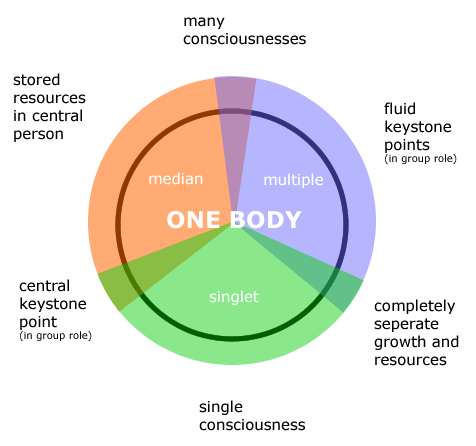
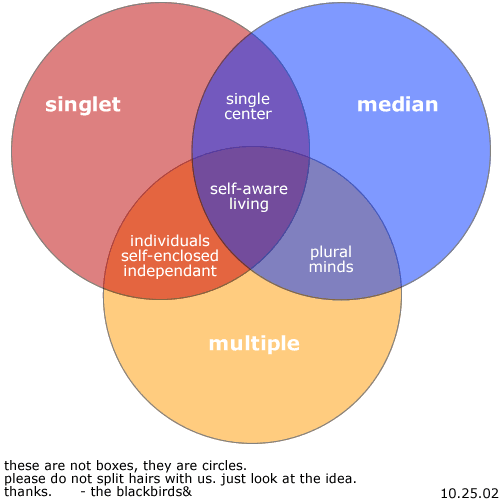
by Lucas and Malik of the [Blackbirds](http://www.karitas.net/blackbirds/)


[[Median]] ~Astraea 8 – Note that in both diagrams, they mean for the experiences described to be fluid, not static — you might move between various states at different times of your life — and accounts for groups who feel they are both median _and_ multiple, or median _and_ singlet, etc. (Blackbirds^Lucas & Malik)>)
[[memory dysfunction]] ~Hornstein & Putnam 5 (1992). = [[psychogenic amnesia]], [[fugue]]
[[Merge]] ~Astraea 1 – See [integration](http://astraeasweb.net/plural/glossary.html#integration). (Psychiatric)
[[Merge]] ~Dark Personality 1 – See integration.
[[derealization, distinguish dissociative individuals (i.e., DID) from both ordinary and patients with other forms of psychopathology]] ~Waller, Putnam, & Carlson, (1996). 3.1 DISSOCIATION: DESCRIPTION AND DIAGNOSIS.
[[Mid-Continuum]] ~Astraea 1 – See [Median](http://astraeasweb.net/plural/glossary.html#median). (Vicki(s))
[[Mid-Continuum]] ~Dark Personality 1 – Being somewhere on the spectrum between multiple and singlet. Since many people feel the idea of a continuum to be inaccurate, many are seeking a new term instead of mid-continuum.>)
[[Mind Control]] ~Dark Personality 1 – A process used by some groups and individuals to control or program other people. Often seen with victims of Satanic Ritual Abuse and abbreviated as “MC.”
Anne’s Master Definitions 3-11-22 at 1-30PM
Page 89 of 128
[[mind of the young child naturally fractionates prior to the development of the ability to process complex or contradictory experiences (e.g., compartmentalizing content into positive versus negative, good versus bad)]] ~Harter (1998), Putnam (1991).%3E) The [[mind of the young child naturally fractionates prior to the development of the ability to process complex or contradictory experiences (e.g., compartmentalizing content into positive versus negative, good versus bad)]] ~Harter (1998), Putnam (1991). 3.2.3 NORMATIVE DISSOCIATIVE PROCESSES by Carlson, Yates, Sroufe (2011). 3. Dissociation and Development of the Self. Dissociation and the Dissociative Disorders: DSM-V and Beyond. Dell and O’Neil Editors. Taylor and Francis. Kindle Edition. (pp. 43-46).
[[modifications to the facilitator development model are needed to maximize the impact of scale-up efforts]] ~Dublin, S., Abramovitz, R., Katz, L., & Layne, C. M. (2022). Training experienced mental health practitioners to deliver foundational trauma education: The core curriculum on childhood trauma. _Psychological Trauma: Theory, Research, Practice, and Policy._ Advance online publication. [Training](%3C[https://doi.org/10.1037/tra0001212](https://psycnet.apa.org/doi/10.1037/tra0001212)%3E) experienced mental health practitioners to deliver foundational trauma education: The core curriculum on childhood trauma.
[[modify the expression of disorder, and that contribute to the maintenance or desistance of developmental pathways and patterns]] ~Cicchetti, Tucker (1994), Gottlieb (1991), Rutter (1996b), Sameroff, Emde (1989). [[Beyond descriptive psychopathology and risk identification paradigms, developmental psychopathology encourages process-level analyses of experiences that probabilistically lead to disturbance]] 3.2.1 DISSOCIATION WITHIN THE FRAMEWORK OF DEVELOPMENTAL PSYCHOPATHOLOGY by Carlson, Yates, Sroufe (2011). Dissociation and the Dissociative Disorders: DSM-V and Beyond (pp. 41-42). Taylor and Francis. Kindle Edition
[[Monomind]] ~Dark Personality 1 – Self-evident- singleton
[[mood swings]] ~Hornstein & Putnam 1 (1992). [[affect regulation]] = [[depression]], [[mood swings]], [[feelings of isolation]]
[[most infant disorganization is not related to manifest pathological dissociation, but, retrospectively, most dissociation in later development can be traced to attachment disorganization in infancy]] ~Carlson, Yates, Sroufe (2011).However, the [[data reflect an asymmetrical relation between disorganization and dissociation…]] ~Carlson, Yates, Sroufe (2011). such that, prospectively, [[…most infant disorganization is not related to manifest pathological dissociation, but, retrospectively, most dissociation in later development can be traced to attachment disorganization in infancy]] ~Carlson, Yates, Sroufe (2011). 3.2.3 NORMATIVE DISSOCIATIVE PROCESSES by Carlson, Yates, Sroufe (2011). 3. Dissociation and Development of the Self. Dissociation and the Dissociative Disorders: DSM-V and Beyond. Dell and O’Neil Editors. Taylor and Francis. Kindle Edition. (pp. 43-46).
Anne’s Master Definitions 3-11-22 at 1-30PM
Page 90 of 128
[[motivational level, the child who has experienced responsive care holds positive expectations about relationships with others that motivate her-him to seek, derive pleasure from, and rely on interpersonal connections]] ~Thompson (2006). At the [[motivational level, the child who has experienced responsive care holds positive expectations about relationships with others that motivate her-him to seek, derive pleasure from, and rely on interpersonal connections]] 3.2.2 NORMATIVE SELF PROCESSES by Carlson, Yates, Sroufe (2011). 3. Dissociation and Development of the Self. Dissociation and the Dissociative Disorders: DSM-V and Beyond (p. 39). Taylor and Francis. Kindle Edition. (pp. 42-43).
[[Multifaceted self-consciousness – Depersonalization, shame, flow, and creativity in performing artists]] ~Thomson, P., & Jaque, S. V. (2021). Multifaceted self-consciousness: Depersonalization, shame, flow, and creativity in performing artists. _Psychology of Consciousness: Theory, Research, and Practice, 8_(4), 335–345. [https://doi.org/10.1037/cns0000228](https://psycnet.apa.org/doi/10.1037/cns0000228) Journal Article database: APA PsycArticles [See APA PsycNet Abstract
[[Multimethod assessment of pubertal timing and associations with internalizing psychopathology in early adolescent girls]] ~Barendse, M. E. A., Byrne, M. L., Flournoy, J. C., McNeilly, E. A., Guazzelli Williamson, V., Barrett, A.-M. Y., Chavez, S. J., Shirtcliff, E. A., Allen, N. B., & Pfeifer, J. H. (2022). Multimethod assessment of pubertal timing and associations with internalizing psychopathology in early adolescent girls. _Journal of Psychopathology and Clinical Science, 131_(1), 14–25. [https://doi.org/10.1037/abn0000721](https://psycnet.apa.org/doi/10.1037/abn0000721) Journal ArticleDatabase: APA PsycArticles [See APA PsycNet Abstract]
[[Multiple]] ~Dark Personality 1 – Two or more people who use the same body; The experience of sharing the body with others. It may or may not be associated with losing time, hearing voices, or having another world.
[[Multiple]] ~Plures 1 –
People don’t HAVE multiples; they ARE multiples or multiple systems.
[[multiple forms of maltreatment]] ~Coons 1 (1996); Hornstein & Putnam 3 (1992); Macfie, Cicchetti, & Toth 1 (2001) Malinosky-Rummel & Hoier 1 (1991); Ogawa et al. 3 (1997); Putnam, Helmers, & Trickett 1 (1993); Sanders & Giolas 1 (1991) [[Recent studies suggest trauma may lead]] to [[elevated levels of contemporaneous dissociation in childhood]]. [[Dissociative processes in childhood]] have been related to [[multiple forms of maltreatment]], including [[sexual abuse, physical abuse, and neglect]]
Anne’s Master Definitions 3-11-22 at 1-30PM
Page 91 of 128
[[multiple lines of research concerning the domain of dissociation and regulating rapid eye movement (REM) sleep]] ~Smith, D. M., & Terhune, D. B. (2022). Pedunculopontine-induced cortical decoupling as the neurophysiological locus of dissociation. _Psychological Review._ Advance online publication. [https://doi.org/10.1037/rev0000353](https://psycnet.apa.org/doi/10.1037/rev0000353) (See APA PsycNet Abstract)
[[Multiple, Multiplicity]] ~Astraea 1 – Two or more independent people who use the same body; the experience of sharing the body with others. It is included in plurality but implies more separation and independence of people than being [median](http://astraeasweb.net/plural/glossary.html#median). May or may not be associated with [losing time](http://astraeasweb.net/plural/glossary.html#timeloss), hearing voices, having an [other world](http://astraeasweb.net/plural/glossary.html#ow). Some abbreviate it as “multi,” and we’ve also heard “multi mind.”
[[Multiple, Multiplicity]] ~Astraea 2 – Some people refer to the persons in a multiple group or system as “multiples” (“I think I have multiples” “How many multiples do you have?”), but because of possible confusion we usually ask people to stick to “persons”, “people”, “group members” and so on. Most of the literature and discussions refer to a “multiple” either as the collective itself, the entire group within the shared body, or as the definition of the main front or person you first met (“Truddi Chase is a multiple.”) (General usage)
[[Multiple, Multiplicity]] ~Dark Personality 1 – The state of being multiple.
[[Multiple Personality Disorder]] ~Astraea 1 – [[Dissociative Identity Disorder]] – The older term [[multiple personality disorder]] (http://astraeasweb.net/plural/glossary.html#mpd) may fit multiples who are impaired because of communication and organization problems. Still, it is inappropriate for the many multiples with a working operating system to know how to work together harmoniously. If you are not disordered, and mainly if you have not been diagnosed with MPD or DID, it is unwise to refer to yourself as having MPD or DID. (Psychiatric)
[[Multiple Personality Disorder]] ~Astraea 2 – Before the recovered-memory movement and its subsequent scandals and lawsuits, anyone who was found in therapy to be multiple had MPD. The dominant culture has always defined more than one person in the body as a pathology. The most famous example of a person with MPD is [Sybil](http://www.astraeasweb.net/plural/controversy.html). Both MPD and DID are described as fragmentation of a single, pre-existing “whole” personality after a traumatic experience.
Anne’s Master Definitions 3-11-22 at 1-30PM
Page 92 of 128
[[Multiple Personality Disorder]] ~Dark Personality 1 – See Dissociative Identity Disorder.>)
[[Muse]] ~Plures 1 –
see **Soulbond**
## N
[[Natural Multiples]] ~Astraea 1 – Multiples, whose system came about as a natural part of their development, not as an outcome of abuse or trauma. Some natural multiples believe a neurological predisposition may be involved, but there has not been enough scientific study to say anything specific. (I first heard the term “natural multiples” and the concept from a psychiatrist correspondent.) On Tumblr, the term “endogenic” is often used.
[[Natural Multiples]] ~Dark Personality 1 – Multiples that developed naturally without being created by abuse and trauma.
[[negative experience in early childhood]] ~Kirby et al. 2 (1993); Van IJzendoorn & Schuengel 1 (1996); Zlotnick, Shea, Zakriski, et al. 1 (1995). Much of the [[research concerning trauma and dissociation has been retrospective]], [[focusing on relations between self-reported abuse in childhood]] and [[higher level of dissociation in adulthood]]. Several [[retrospective studies have found the severity of dissociation in adulthood]] to be [[related to the age of onset of trauma]], [[suggesting a particular vulnerability to the dissociative effects]] of [[negative experience in early childhood]]. ^rod592
[[Neo-shamanic]] ~Fuzzyjayling 1 – This practice involves, among other things, journeying into different worlds and speaking with their inhabitants. There is a lot more to it than that, but that’s the part most people know. This refers to an adaptation of shamanic practices from Aboriginal tribes and could be considered everything from a cultural appropriation on the terrible end to a valuable and enlightening practice on the good end. I prefer the term “neo-shamanism” because it describes the beneficial aspects of what is being talked about without implying that it is the original practice.
[[Non-affected was the most frequent category in natural catastrophes (48.9%), migration (45.9%), motor vehicle accidents (39.83%), and death threats (33.4%)]] ~Pérez-Sales, P., Vergara-Campos, M., Eiroa-Orosa, F. J., Olivos-Jara, P., Fernández-Liria, A., Barbero-Val, E., & Galán-Santamarina, A. (2022). Perceived resistance to experiences of trauma and crisis: A study comparing multiple life events. _Traumatology._
Anne’s Master Definitions 3-11-22 at 1-30PM
Page 93 of 128
Advanced online publication. https://doi.org/10.1037/trm0000339%5D(https://psycnet.apa.org/doi/10.1037/trm0000339) (See APA PsycNet Abstract)
[[normal behavior]] ~Putnam 1 (1997). The [[assignment of dissociative diagnoses]] particularly in childhood, [[requires familiarity with spectrums]] of both [[normal behavior]] (e.g., [[imaginative behavior]] , [[fantasy-reality boundaries]]) and [[disordered behavior]] (e.g., [[pathological dissociation]]).
[[normative dissociative processes]] ~Carlson, Yates, & Sroufe 13 (2011). The [[rest of the chapter provides an overview]] of:
(1) the [[organizational developmental perspective derived from the domain of developmental psychopathology]],
(2) [[normative processes in self-development]],
(3) [[normative dissociative processes]],
(4) [[dissociative developmental trajectories]],
(5) [[effects of dissociation on self-functioning]], and finally,
(6) [[diagnostic implications of a developmental approach]] to the [[study of dissociation]].
[[normative episodes such as daydreaming]] ~Putnam 1 (1991). At the [[level of process]], [[dissociative experiences range]] – [[along a continuum of severity]] – from [[short, often situation-dependent]], – [[normative episodes such as daydreaming]] – to [[prolonged or frequent episodes]] that [interfere with individual functioning]] to – [[profound disturbances in the organization]] and [[integration of – self, – cognitive, and -behavioral processes]] ~Annemarie does not believe personally in integration but can let go of the fact that others do believe in it.
[[normative processes]] ~Hornstein & Putnam 8, 1992; Putnam 1, 2000 may underlie [[dissociative states in early childhood]] (e.g., [[fantasy proneness]], [[hypnotizability]], [[behavioral state regulation]])
[[normative processes in self-development]] ~Carlson, Yates, & Sroufe 13 (2011). The [[rest of the chapter provides an overview]] of:
(1) the [[organizational developmental perspective derived from the domain of developmental psychopathology]],
(2) [[normative processes in self-development]],
(3) [[normative dissociative processes]],
Anne’s Master Definitions 3-11-22 at 1-30PM
Page 94 of 128
(4) [[dissociative developmental trajectories]],
(5) [[effects of dissociation on self-functioning]], and finally,
(6) [[diagnostic implications of a developmental approach]] to the [[study of dissociation]].
[[normative trajectory of dissociation or processes]] ~(Putnam 2 (1995). Despite [[considerable evidence connecting pathological dissociation with prior trauma]], little is known about the [[normative trajectory of dissociation or processes]] linking [[maltreatment and dissociation across development]].
[[Not Switching]] ~Dark Personality 1 – Most of the time, multiples do not switch overtly. Instead, they commonly experience internal switches where selves influence feelings and actions rather than coming “out” to take complete control of the body. This creates sensations like hearing words coming out of your mouth that do not belong to you, seeing the world as if you are taller or shorter, having someone else’s feelings and thoughts overlapping your own, and so on. This covert, behind-the-scenes action is usually hard for anyone outside to notice (although experienced therapists often say things like “Is there someone behind you right now?” sensing the hidden influence). For this reason, multiples can realistically go for decades with no one, including themselves, being aware of their MPD.
[[noted by 20th-century psychologists]], ~Carlson, Yates, & Sroufe 10 (2011). First [[noted by 20th-century psychologists]], [[dissociation and its developmental underpinnings]] have been a [[central focus of psychological inquiry]].
## O
[[Object-relations perspectives]] ~Winnicott 1 (1965, 1971). [[conceptualize the psychological phenomenon of dissociation]] in terms of [[internal dynamics]] whereby [[trauma causes the premature maturation of a “false” self]] that [[rigidifies and obscures]] more [[spontaneous, authentic experience (the “true” self)]].
[[Organization of the self grows from dyadic experience through recursive patterns of differentiation and integration, providing a framework for subsequent individual experience]] ~Sander (1975), Sroufe (1996). [[Organization of the self develops from dyadic experience through recursive patterns of differentiation and integration, providing a framework for subsequent individual experience]] 3.2.2 NORMATIVE SELF PROCESSES by Carlson, Yates, and Sroufe (2011). 3. Dissociation and Development of the Self. Dissociation and the Dissociative Disorders: DSM-V and Beyond (p. 39). Taylor and Francis. Kindle Edition. (pp. 42-43).
Anne’s Master Definitions 3-11-22 at 1-30PM
Page 95 of 128
[[organizational developmental perspective derived from the domain of developmental psychopathology]] ~Carlson, Yates, & Sroufe 13 (2011). The [[rest of the chapter provides an overview]] of:
(1) the [[organizational developmental perspective derived from the domain of developmental psychopathology]],
(2) [[normative processes in self-development]],
(3) [[normative dissociative processes]],
(4) [[dissociative developmental trajectories]],
(5) [[effects of dissociation on self-functioning]], and finally,
(6) [[diagnostic implications of a developmental approach]] to the [[study of dissociation]].
[[organizational perspective conceptualizes development as a series of qualitative reorganizations whereby earlier patterns of adaptation provide a framework for, and are transformed by, later adaptations]]
~Carlson, Yates, Sroufe (2011). The … 3.2.1 DISSOCIATION WITHIN THE FRAMEWORK OF DEVELOPMENTAL PSYCHOPATHOLOGY by Carlson, Yates, Sroufe (2011). Dissociation and the Dissociative Disorders: DSM-V and Beyond (pp. 41-42). Taylor and Francis. Kindle Edition.
[[organizational perspective of development incorporates core principles of developmental psychopathology within a theoretical framework that yields testable hypotheses about both typical and atypical development]] ~Cicchetti (2006), Sroufe (1979), Sroufe, Rutter (1984). An … 3.2.1 DISSOCIATION WITHIN THE FRAMEWORK OF DEVELOPMENTAL PSYCHOPATHOLOGY by Carlson, Yates, Sroufe (2011). Dissociation and the Dissociative Disorders: DSM-V and Beyond (pp. 41-42). Taylor and Francis. Kindle Edition.
[[Other World]] ~Astraea 1 – Also known as inner worlds and alternate realities. The subjective space experienced by members of a system. People who are not upfront often spend their time in a subjective world—also called an [imaginal](http://henrycorbinproject.blogspot.com/2009/06/literalizing-imaginal.html) () space or the “imaginal realm.” French scholar Henry Corbin discussed the imaginal as a region that exists alongside our everyday three-dimensional consciousness. His study of Sufi and Persian sacred texts suggests that there is a place in our imaginations where things are real — in the sense that a specific person is not imagining them but are images that have some integrity or existence on their own. Some Southeast Asia and Native American belief systems hold that what we think of as “the real world” is a reflection or shadow of another, even more, real world that we cannot perceive directly but only through such things as dreams, imagination, myths, psychedelic and spiritual experiences.

Anne’s Master Definitions 3-11-22 at 1-30PM
Page 96 of 128
[[Other world]] ~Astraea 2 – is not unique to multiples; medians and singlets can have them as well (cf. Singlet Austin Tappan Wright’s _Islandia_, Edith Wharton’s “Secret Garden” (described in her autobiography _Backward Glance), or the [Brontes’ Angria and Gondal](http://www.spring.net/yapp-bin/public/read/bronte/23) (the Brontes often adopted and “became” [fictive](http://astraeasweb.net/plural/glossary.html#fictive) or historical characters). Many people with such worlds resist calling them inner worlds or imaginary worlds because these worlds are not make-believe or fantasy to them but an emotional reality, an essential part of their lives. People familiar with [soulbonding](http://astraeasweb.net/plural/glossary.html#sb) refer to this realm as a soulscape since they feel they interact with their muses or introjects there. (General usage)
[[Other world]] ~Astraea 3 – Members of [Netdancer collective have a lot to say about personal worlds](http://astraeasweb.net/plural/netdancer.html)
[[Other world]] ~Astraea 4 -[More on personal worlds and gateway systems from Pagmies](http://pagmies.meeble.net/gateways.html)>)
[[Other World]] ~Dark Personality 1 – Also known as an “inner world.” This is the alternate reality where people in many multiple systems go when they are not out in the body. It should be noted that not all multiples have an ‘other world’ per se. And many are much more detailed, intricate, and significant than others.
[[Otherkin]] ~Astraea 1 – People who feel they do not possess human souls but are an animal, someone from another planet, or a supernatural spirit (like a fairy) born into a human body—a sort of changeling. Until communicating on the internet became common, such people were recognized and acknowledged in Western culture only by New Age and Theosophical doctrines, which referred to them as elemental spirits incarnating in human bodies or persons on a “deva” (angelic) evolution path. One work of fiction, Zilpha Keatley Snyder’s _[The Changeling](http://www.amazon.com/gp/product/B00A72713A/ref=as_li_ss_tl?ie=UTF8&camp=1789&creative=390957&creativeASIN=B00A72713A&linkCode=as2&tag=astraeaswebmulti)! [](http://www.assoc-amazon.com/e/ir?t=astraeaswebmulti&l=as2&o=1&a=B00A72713A)_ (1974), touched on this idea and introduced it to young children without heavy explanation. Online beliefs about otherkin are pagan or secular and partake of much more free thought, unencumbered by dogma.
[[Otherkin]] ~Astraea 2 – Many Indigenous cultures believe in otherkin in some form, especially that humans can have animal spirits or be related to animals.
[[Otherkin]] ~Astraea 3 – Some people in [multiple systems](http://astraeasweb.net/plural/glossary.html#system) may be otherkin. Often they are [walk-
Anne’s Master Definitions 3-11-22 at 1-30PM
Page 97 of 128
is](http://astraeasweb.net/plural/glossary.html#walkin). They may perceive themselves as having physical traits quite different from the body.
[[Otherkin]] ~Astraea 4 – These documents have been said to be helpful for some people — others find them confusing, your mileage may vary:
[Crisses’ Otherkin FAQ](http://www.astraeasweb.net/plural/cris-otherkinfaq.html)
[[Otherkin]] ~Dark Personality 1 – People in a multiple system who are not human. Often, they are walk-ins, claiming to be older than the body in which they live and having physical traits quite different from the body itself. Multiples are often hosts to otherkin.
[[Outsider]] ~Astraea 1 – Some multiples refer to any person outside their group with this term. Others say “out-system.”
[[Outsider]] ~Dark Personality 1 – Person outside the multiple system.
[[Overall, earlier pubertal timing was associated with increased internalizing psychopathology]] ~Barendse, M. E. A., Byrne, M. L., Flournoy, J. C., McNeilly, E. A., Guazzelli Williamson, V., Barrett, A.-M. Y., Chavez, S. J., Shirtcliff, E. A., Allen, N. B., & Pfeifer, J. H. (2022). Multimethod assessment of pubertal timing and associations with internalizing psychopathology in early adolescent girls. _Journal of Psychopathology and Clinical Science, 131_(1), 14–25. [https://doi.org/10.1037/abn0000721](https://psycnet.apa.org/doi/10.1037/abn0000721) Journal ArticleDatabase: APA PsycArticles [See APA PsycNet Abstract]
[[Overwhelming emotional experience (i.e., trauma) in childhood may merge normative dissociative propensities into rigid patterns of pathological dissociation]] ~Carlson, Yates, Sroufe (2011). Overwhelming emotional experience (i.e., trauma) in childhood may merge normative dissociative propensities into rigid patterns of pathological dissociation]] ~Carlson, Yates, Sroufe (2011). 3.2.3 NORMATIVE DISSOCIATIVE PROCESSES by Carlson, Yates, Sroufe (2011). 3. Dissociation and Development of the Self. Dissociation and the Dissociative Disorders: DSM-V and Beyond. Dell and O’Neil Editors. Taylor and Francis. Kindle Edition. (pp. 43-46).
## P
Anne’s Master Definitions 3-11-22 at 1-30PM
Page 98 of 128
[[Parallel Systems]] ~Astraea 1 – 1) Two independently existing groups coexisting in one body, with or without knowledge of one another. (Possibly Firewheel Vortex group)
[[Parallel Systems]] ~Astraea 2 – 2) A system experiencing parallel existence – one self-existing in multiple timelines, each experiencing a distinct possibility, but aware of one another even if unable to enter one another’s timelines. (Systemology group)
[[Parts]] ~Dark Personality 1 – Very derogatory term- kind of like ‘alters’ but seems to be bandied about a lot by people who say that they are DDNOS. They do not get the whole separate thing and can’t imagine it is accurate; it is more of the same as what they live.
[[Parts]] ~Plures 1 – **Fragment** and **Personality**
[[Pathological dissociation]] ~Carlson, Yates, & Sroufe 6 (2011) may reflect an [[absence of the normative decline]] of [[dissociative processes across development]] and/or an [[increase in individual (idiosyncratic) dissociation]].
[[pathological dissociation]] ~Putnam 1 (1997). The [[assignment of dissociative diagnoses]] particularly in childhood, [[requires familiarity with spectrums]] of both [[normal behavior]] (e.g., [[imaginative behavior]] , [[fantasy-reality boundaries]]) and [[disordered behavior]] (e.g., [[pathological dissociation]]).>)Pathological dissociation represents a profound distortion of core self-processes, such that development progresses toward greater complexity without complementary integration]] ~Carlson, Yates, Sroufe (2011).
[[Pathological dissociation represents a profound distortion of core self-processes such that development progresses toward greater complexity without complementary integration]] ~Carlson, Yates, Sroufe (2011). 3.2.3 NORMATIVE DISSOCIATIVE PROCESSES by Carlson, Yates, Sroufe (2011). 3. Dissociation and Development of the Self. Dissociation and the Dissociative Disorders: DSM-V and Beyond. Dell and O’Neil Editors. Taylor and Francis. Kindle Edition. (pp. 43-46).
[[Peanut Gallery]] ~Dark Personality 1 – I have often heard multiples refer to the ‘peanut gallery’. Of course, they speak of the peanut gallery within their head. This can be an actual issue….it can lead to someone conversing with themself’ while you do not know what they are talking about. I find it interesting to watch (although not always as fun to take part in).
Anne’s Master Definitions 3-11-22 at 1-30PM
Page 99 of 128
Pedunculopontine-induced cortical decoupling as the neurophysiological locus of dissociation ~Smith, D. M., & Terhune, D. B. (2022). Pedunculopontine-induced cortical decoupling as the neurophysiological locus of dissociation _Psychological Review._ Advance online publication. [https://doi.org/10.1037/rev0000353](https://psycnet.apa.org/doi/10.1037/rev0000353) (See APA PsycNet Abstract)
[[Pedunculopontine Nucleus and Laterodorsal Tegmental Nucleus determine similarity in the cortical connectivity profiles of wakefulness and REM sleep]] ~Smith, D. M., & Terhune, D. B. (2022). Pedunculopontine-induced cortical decoupling as the neurophysiological locus of dissociation. _Psychological Review._ Advance online publication. [https://doi.org/10.1037/rev0000353](https://psycnet.apa.org/doi/10.1037/rev0000353) (See APA PsycNet abstract)
[[perceived inconsistencies]] ~Carlson, Yates, & Sroufe 5 (2011). [[children, adolescents, and adults]] differ in their [[cognitive capacity]] to [[recognize discontinuities in their behavior]] or [[sense of awareness]], and in their [[subjective distress]] about any [[perceived inconsistencies]].
[[Performing artists are agents of their self-consciousness, and for performers with elevated depersonalization, their sense of self was also viewed as an estranged object]] ~Thomson, P., & Jaque, S. V. (2021). Multifaceted self-consciousness: Depersonalization, shame, flow, and creativity in performing artists. _Psychology of Consciousness: Theory, Research, and Practice, 8_(4), 335–345. [https://doi.org/10.1037/cns0000228](https://psycnet.apa.org/doi/10.1037/cns0000228) Journal ArticleDatabase: APA PsycArticles [See APA PsycNet Abstract]
[[periphery of the psychoanalytic tradition]] ~Janet 1 (1889). On the [[periphery of the psychoanalytic tradition]], [[~Janet 1 (1889) proposed]] that [[constitutional vulnerability]] [[interacts with extreme experience]] to [[foster cognitive-affective disintegration]].
[[Person, People]] ~Plures 1 – (or ‘colleagues’ or other terms that name people who are not in systems) _people_ is the best word for fully conscious members of multiple systems.
[[Personality]] ~Astraea 1 – A word formerly used to describe a person in a multiple group. Many multiples now resist calling members “personalities” and instead used the word in its more conventional sense to describe a person’s general character: i.e., ‘Daimon of the Anachronic Army has a dark personality,’ or ‘Amorpha^Ruka has a difficult personality to work with.’ (HEY!)
Anne’s Master Definitions 3-11-22 at 1-30PM
Page 100 of 128
[[Personality]] ~Astraea 2 -[Most of Plures’ glossary deals with alternative terms](http://www.exunoplures.info/stickyterms.html) for ‘personality’ or ‘alter’ and explains why many groups do not well receive those.>)
[[Personality]] ~Dark Personality 1 – A word used to describe a person in a multiple system. Many multiples are offended by this term, and it is used more by Outsiders than within the many communities. It is no longer used in the empowered multiple community in that capacity. It is now used as something a person in a system has. E.g.. “Daimon of the Anachronic Army has a dark personality.”
[[Personality]] ~Plures 1 –
The red-headed stepchild of ‘person.’ People have personalities, but personalities do not think for themselves. Do not call people in multiple systems personalities. That is just as bad, or even worse than, ‘alters.’ I have a personality. I am not a personality. It is a common pratfall, though. Everyone does it because of the ‘MPD’ name. The word ‘personality’ would be better for groups who are more median and see themselves as having several aspects or parts rather than having fully sentient people in there. Also see: **Alter**, **Ego state**
[[Personality state]] ~Plures 1 –
see **Alter**, **Personality**, **Ego state**
[[perspective of development]] ~(Putnam, 1995). Available [[data suggest that clinical dissociation]] [[represents more than the high end of a distribution of scores]]; – it [[reflects a deviation from normative development]] -that [[results in maladaptive behavior]] -that can be [[differentiated from normal behavior]]. – From the [[perspective of development]], – [[dissociation may be viewed as a continuum process]]; – at the [[level of diagnosis]], – [[dissociative phenomena may be categorical]]
[[Plural]] ~Astraea 1 – The state where two or more people share a body. Includes multiples and [medians](http://astraeasweb.net/plural/glossary.html#median). (Vicki(s))
[[Plural]] ~Plures 1 –
Anne’s Master Definitions 3-11-22 at 1-30PM
Page 101 of 128
Like ‘multiples,’ ‘plurals’ refers to the systems, not the individual members. Plurals are groups, not filled with plurals unless they are systems within systems.
Also see: **Multiples**
[[Plural, multiple]] ~Fuzzyjayling 1 – a state of having more than one person/consciousness in a body. We like the word “plural” because it feels more inclusive. (Some would draw a line from “multiple” to “multiple personality disorder,” which is not universally applicable to plural systems.) Note that “plural” may also refer to medians. (See link at the bottom.)
[[poor impulse control]] ~Hornstein & Putnam 7 (1992) [[behavioral disturbance]] = [[inattention]], [[poor impulse control]], [[self-harm]]
[[Positive adaptation is enabled by integrations of biological, socioemotional, cognitive, and symbolic capacities that promote the flexible negotiation of concurrent and future developmental issues]] ~Cicchetti (1993), Egeland, Carlson, Sroufe (1993), Sroufe (1989), Waters, Sroufe (1983). 3.2.1 DISSOCIATION WITHIN THE FRAMEWORK OF DEVELOPMENTAL PSYCHOPATHOLOGY by Carlson, Yates, Sroufe (2011). Dissociation and the Dissociative Disorders: DSM-V and Beyond (pp. 41-42). Taylor and Francis. Kindle Edition.
[[positive relationship between depersonalization and creative anxiety, distinct creative experience, and a sense that the creative experience moved beyond the personal]] ~Thomson, P., & Jaque, S. V. (2021). Multifaceted self-consciousness: Depersonalization, shame, flow, and creativity in performing artists. _Psychology of Consciousness: Theory, Research, and Practice, 8_(4), 335–345. [https://doi.org/10.1037/cns0000228](https://psycnet.apa.org/doi/10.1037/cns0000228) Journal ArticleDatabase: APA PsycArticles [See APA PsycNet Abstract]
[[Possession]] ~Astraea 1 – Control of the body by someone outside. It may be voluntary or involuntary, as in some religious ceremonies of Southeast Asia or the West Indies. In the 19th and early 20th centuries, mediums that let channeled spirits share their bodies, voluntary possession, were called having “multiple personalities.” Multiplicity is often confused with possession, although the Catholic Church has strict criteria for distinguishing the two. Some multiples believe in possession, and some do not. (General usage)
[[Possession]] ~Dark Personality 1 – When the body is controlled by some entity or person who did not originate in the body. Often seen as demons, these walk-ins are frequently just people within the multiple system who are unwanted – either by someone in the many systems itself or by outsiders.
Anne’s Master Definitions 3-11-22 at 1-30PM
Page 102 of 128
[[precipitates defense mechanisms, such as dissociation]] ~Freud 1 (1926). In later works, ~[[Freud 1 (1926) placed greater emphasis]] on [[environmental influences]] and their [[interaction with psychological processes]]. He suggested that [[trauma (i.e., extreme experiences of helplessness)]] [[precipitates defense mechanisms, such as dissociation]], to [[manage environmentally and psychologically induced anxiety]] and[[ avoid retraumatization]].
[[Preliminary support for this hypothesis has been shown in correlations between attachment disorganization measured in infancy and dissociative behaviors and experiences from middle childhood through adulthood]] ~Carlson (1998), Ogawa et al. (1997). [[Preliminary support for this hypothesis has been shown in correlations between attachment disorganization measured in infancy and dissociative behaviors and experiences from middle childhood through adulthood]] ~Carlson (1998), Ogawa et al. (1997). 3.2.3 NORMATIVE DISSOCIATIVE PROCESSES by Carlson, Yates, Sroufe (2011). 3. Dissociation and Development of the Self. Dissociation and the Dissociative Disorders: DSM-V and Beyond. Dell and O’Neil Editors. Taylor and Francis. Kindle Edition. (pp. 43-46).
[[preschool years, increasingly stable patterns of self-regulation or enduring aspects of the emerging personality emerge, and broad differences in developmental trajectories become apparent]] ~Kopp (1982) Kopp, Krakow, Vaughn, (1983), Schore (1994), Sroufe (1996). In the [[preschool years, increasingly stable patterns of self-regulation or enduring aspects of the emerging personality emerge, and broad differences in developmental trajectories become apparent]] 3.2.2 NORMATIVE SELF PROCESSES by Carlson, Yates, Sroufe (2011). 3. Dissociation and Development of the Self. Dissociation and the Dissociative Disorders: DSM-V and Beyond (p. 39). Taylor and Francis. Kindle Edition. (pp. 42-43).
[[presenting a hypothesis that the hippocampus and the default mode network play a significant role]] ~Rubinstein, D., & Lahad, M. (2022). _Traumatology._ Advance online publication. This study examines the role of imagination, playfulness, and creativity in healing or coping with trauma. https://doi.org/10.1037/trm0000376%5D(https://psycnet.apa.org/doi/10.1037/trm0000376) APA PsycNet Fantastic reality: The role of imagination, playfulness, and creativity in healing trauma (See APA PsychNet Abstract)
[[Presenting Self]] ~Astraea 1 – Otherwise known as the central front, your singlet facade, the person who most people think “you” are. It may or may not be the [core](http://astraeasweb.net/plural/core) or [host](http://astraeasweb.net/plural/host) but often passes for one. We had one correspondent refer to this as “base.”
[[prisoners related as colleagues, as professional equals, by engaging in healing activities such as composing effective therapeutic materials – featuring animals]] ~Bloom, T.,
Anne’s Master Definitions 3-11-22 at 1-30PM
Page 103 of 128
Serrano, B. R., & Bradshaw, G. A. (2021). In the company of animals: Accompaniment transforms prisoners into colleagues, teachers, and healers.
_The Humanistic Psychologist, 49_(4), 602–615. https://doi.org/10.1037/hum0000256%5D(https://psycnet.apa.org/doi/10.1037/hum0000256)%3E) Journal ArticleDatabase: APA PsycArticles [See APA PsycNet Abstract]
[[profound disturbances in the organization]] ~Putnam 1 (1991). At the [[level of process]], [[dissociative experiences range]] – [[along a continuum of severity]] – from [[short, often situation-dependent]], – [[normative episodes such as daydreaming]] – to [[prolonged or frequent episodes]] that [interfere with individual functioning]] to – [[profound disturbances in the organization]] and [[integration of – self, – cognitive, and -behavioral processes]] ~Annemarie does not believe personally in integration but can let go of the fact that others do believe in it.
[[prolonged or frequent episodes]] ~Putnam 1 (1991). At the [[level of process]], [[dissociative experiences range]] – [[along a continuum of severity]] – from [[short, often situation-dependent]], – [[normative episodes such as daydreaming]] – to [[prolonged or frequent episodes]] that [[separate from the normative continuum]] to – [[profound disturbances in the organization]] and [[integration of – self, – cognitive, and -behavioral processes]] ~Annemarie does not believe personally in integration, but can let go of the fact that others do believe in it.
[[prompting maladaptive social behaviors that can hinder the development and maintenance of relationships in dissociative people]] ~Chiu, C.-D., Ho, H. L., & Tollenaar, M. S. (2022). Relational self-evaluations in dissociation – Implicit self-rejection. Journal ArticleDatabase: APA PsycArticles. _Psychological Trauma: Theory, Research, Practice, and Policy, 14_(1), 99–106. [https://doi.org/10.1037/tra000101 [See abstract]
[[protect or maintain a sense of coherence that is the self]] ~Carlson, Yates, & Sroufe 12 (2011). Like [[Winnicott’s “false” self]], the [[caretaking aspect of the self-care system]] [[strives to protect the regressed self]], even [[becoming persecutory in the service of self-preservation]] and the [[avoidance of retraumatization]]. In this view, [[experience becomes traumatic]] when [[existing regulatory capacities are overwhelmed]] ([[because of developmental immaturity]], [[structural rigidity]], and [[lack of supportive emotional relationships]]), yet [[evolving systems]] strive to [[maintain or preserve existing organization]]. Thus, [[trauma does not shatter self-organization]]; [[internal processes shatter the organization]] to [[protect or maintain a sense of coherence that is the self]].
[[psychogenic amnesia]] ~Hornstein & Putnam 5 (1992). [[memory dysfunction]] = [[psychogenic amnesia]], [[fugue]]
Anne’s Master Definitions 3-11-22 at 1-30PM
Page 104 of 128
[[psychogenic numbing]] ~Hornstein & Putnam 4 (1992). [[autohypnotic phenomena]] = [[trances]], [[time distortions]], [[psychogenic ed 2numbing]]Untitled 2
[[psychological theory and data predict, attachment-based, trauma-informed, nature-grounded accompaniment provided foundational support for mutual transformation in both prisoner and psychologist]] ~Bloom, T., Serrano, B. R., & Bradshaw, G. A. (2021). In the company of animals: Accompaniment transforms prisoners into colleagues, teachers, and healers. _The Humanistic Psychologist, 49_(4), 602–615. https://doi.org/10.1037/hum0000256%5D(https://psycnet.apa.org/doi/10.1037/hum0000256)%3E) Journal ArticleDatabase: APA PsycArticles [See APA PsycNet Abstract]
[[psychosocial mechanisms, captured by timing measures of visible physical characteristics might be more meaningful determinants of internalizing psychopathology than biological ones in adolescent girls]] ~Barendse, M. E. A., Byrne, M. L., Flournoy, J. C., McNeilly, E. A., Guazzelli Williamson, V., Barrett, A.-M. Y., Chavez, S. J., Shirtcliff, E. A., Allen, N. B., & Pfeifer, J. H. (2022). Multi-method assessment of pubertal timing and associations with internalizing psychopathology in early adolescent girls. _Journal of Psychopathology and Clinical Science, 131_(1), 14–25. https://doi.org/10.1037/abn0000721%5D(https://psycnet.apa.org/doi/10.1037/abn0000721) Journal ArticleDatabase: APA PsycArticles [See APA PsycNet Abstract]
## Q
[[Quoigenic]] ~Astraea 1 – Short for “je ne sais quoi” (French for “I don’t know what”). It means “I don’t know how I got to be multiple” (and, often, “and I don’t care”). Or a group with several origins (e.g., trauma-split _and_ walk-ins), or “the heck with the labels.” It originated in Tumblr in 2016/7, and we have only seen it used there.
## R
[[range of emotional experience, including both positive (e.g., joy, love) and negative (e.g., anger, fear, grief) affects, plays a vital role in a human adaptation by promoting closeness in relationships]] ~Bowlby (1969/1982). The [[range of emotional experience, including both positive (e.g., joy, love) and negative (e.g., anger, fear, grief) affects, plays a vital role in a human adaptation by promoting closeness in relationships]] 3.2.2 NORMATIVE SELF PROCESSES by Carlson, Yates, Sroufe (2011). 3. Dissociation and Development of the Self. Dissociation and the Dissociative Disorders: DSM-V and Beyond (p. 39). Taylor and Francis. Kindle Edition. (pp. 42-43).
Anne’s Master Definitions 3-11-22 at 1-30PM
Page 105 of 128
[[recent prospective study]] ~Chu & Dill 1 (1990); Kirby, Chu, & Dill 1 (1993); Waldinger, Swett, Frank, & Miller 1 (1994) [[Empirical research has showed]] and in a [[recent prospective study]] Ogawa et al. 2 (1997) [[consistent associations between traumatic experience]] and [[biological and behavioral manifestations of dissociation]]. These [[relations appear to be moderated by the frequency of the trauma]] and the [[developmental status of the individual]] at the [[time of traumatic exposure]]. [[Level of dissociation]] has been [[related to chronicity and severity of trauma]] in [[retrospective self-report studies]].
[[Recent studies suggest trauma may lead]] ~Coons 1 (1996); Hornstein & Putnam 3 (1992); Macfie, Cicchetti, & Toth 1 (2001) Malinosky-Rummel & Hoier 1 (1991); Ogawa et al. 3 (1997); Putnam, Helmers, & Trickett 1 (1993); Sanders & Giolas 1 (1991) to [[elevated levels of contemporaneous dissociation in childhood]]. [[Dissociative processes in childhood]] have been related to [[multiple forms of maltreatment]], including [[sexual abuse, physical abuse, and neglect]]
[[Recognition of others as part of the regulation, of one’s actions as effective or ineffective in eliciting care, and of the self as the origin of experience are all part of the self-system]] ~Sroufe, Egeland, Carlson (1999). [[Recognition of others as part of the regulation, of one’s actions as effective or ineffective in eliciting care, and the self as the origin of experience are all part of the self-system]] 3.2.2 NORMATIVE SELF PROCESSES by Carlson, Yates, Sroufe (2011). 3. Dissociation and Development of the Self. Dissociation and the Dissociative Disorders: DSM-V and Beyond (p. 39). Taylor and Francis. Kindle Edition. (pp. 42-43).
[[recognize discontinuities in behavior]] ~Carlson, Yates, & Sroufe 5 (2011). [[children, adolescents, and adults]] differ in their [[cognitive capacity]] to [[recognize discontinuities in their behavior]] or [[sense of awareness]], and in their [[subjective distress]] about any [[perceived inconsistencies]].
[[recognizes five types of dissociative disorder]] ~Carlson, Yates, & Sroufe 8 (2011). [[Diagnostic and Statistical Manual of Mental Disorders (DSM-IV-TR]] ~Carlson, Yates, & Sroufe 8 (2011). [[American Psychiatric Association, 2000]])
[[recognizes five types of dissociative disorder]]: [[Dissociative Amnesia]], [[Dissociative Fugue]], [[Depersonalization Disorder]], [[Dissociative Identity Disorder (DID)]], and [[Dissociative Disorder Not Otherwise Specified (DDNOS)]]. [[Child and adolescent diagnoses include only DDNOS and DID]].
[[reflects a deviation from normative development]] ~(Putnam, 1995). Available [[data suggest that clinical dissociation]] [[represents more than the high end of a distribution of scores]]; – it [[reflects a deviation from normative development]] -that [[results in maladaptive behavior]] -that can be [[differentiated from normal behavior]]. – From the [[perspective of development]], – [[dissociation may be viewed as a continuum process]]; – at the [[level of diagnosis]], – [[dissociative phenomena may be categorical]]
Anne’s Master Definitions 3-11-22 at 1-30PM
Page 106 of 128
[[regardless of the ways of exposure, hardiness, specifically commitment, plays a crucial role in an individual’s transforming traumatic experiences into growth]] ~Altinsoy, F., & Aypay, A. (2021). _Psychological Trauma: Theory, Research, Practice, and Policy._ Advance online publication. [https://doi.org/10.1037/tra0001173](https://psycnet.apa.org/doi/10.1037/tra0001173) First PostingDatabase: APA PsycArticles [See APA PsycNet Abstract]
[[regressed infantile aspects of the self]] ~Kalsched 1 (1996). From a [[Jungian perspective]], Kalsched 1 (1996) describes this [[dissociative dynamic as a “dyadic self-care structure”]] that [[comprises both precocious caretaking]] and [[regressed infantile aspects of the self]].
[[regulation entails processes responsible for monitoring, evaluating, and changing arousal that enable individuals to function adaptively in the environment]] ~Cicchetti, Ganiban, Barnett (1991). Such [[regulation entails processes responsible for monitoring, evaluating, and changing arousal that enable individuals to function adaptively in the environment]] 3.2.2 NORMATIVE SELF PROCESSES by Carlson, Yates, Sroufe (2011). 3. Dissociation and Development of the Self. Dissociation and the Dissociative Disorders: DSM-V and Beyond (p. 39). Taylor and Francis. Kindle Edition. (pp. 42-43).
[[regulation of emotion lies at the core of early socioemotional experience]] ~Thompson (2006). The [[regulation of emotion lies at the core of early socioemotional experience]] 3.2.2 NORMATIVE SELF PROCESSES by Carlson, Yates, Sroufe (2011). 3. Dissociation and Development of the Self. Dissociation and the Dissociative Disorders: DSM-V and Beyond (p. 39). Taylor and Francis. Kindle Edition. (pp. 42-43).
[[rehabilitation of mentalizing capacity should be considered as a priority among these subjects to strengthen a reflective attitude further and to make them more responsible for their behavior]] ~Civilotti, C., Sciascia, C., Li Volsi, E., Rosato, M., Giampaolo, R., & Acquadro Maran, D. (2021). Cognitive mechanisms in a sample of detained stalkers: Evaluation of dissociative tendencies, impaired reflective function, and contemplative thought. _Psychology of Consciousness: Theory, Research, and Practice._ Advance online publication. [https://doi.org/10.1037/cns0000303](https://psycnet.apa.org/doi/10.1037/cns0000303). First PostingDatabase: APA PsycArticles [See APA PsycNet Abstract]
[[related to the age of onset of trauma]] ~Kirby et al. 2 (1993); Van IJzendoorn & Schuengel 1 (1996); Zlotnick, Shea, Zakriski, et al. 1 (1995). Much of the [[research concerning trauma and dissociation has been retrospective]], [[focusing on relations between self-reported abuse in childhood]] and [[higher levels of dissociation in adulthood]]. Several [[retrospective studies have found severity of dissociation in adulthood]] to be [[related to age of onset of trauma]], [[suggesting a particular vulnerability to the dissociative effects]] of [[negative experience in early childhood]]
Anne’s Master Definitions 3-11-22 at 1-30PM
Page 107 of 128
[[related to chronicity and severity of trauma]] ~Chu & Dill 1 (1990); Kirby, Chu, & Dill 1 (1993); Waldinger, Swett, Frank, & Miller 1 (1994) [[Empirical research has showed]] and in a [[recent prospective study]] Ogawa et al. 2 (1997) [[consistent associations between traumatic experience]] and [[biological and behavioral manifestations of dissociation]]. These [[relations appear to be moderated by the frequency of the trauma]] and the [[developmental status of the individual]] at the [[time of traumatic exposure]]. [[Level of dissociation]] has been [[related to chronicity and severity of trauma]] in [[retrospective self-report studies]].
[[Relational distortions result when emotions repeatedly cannot achieve their purpose, when they are persistently activated, or when their expression is blocked or punished]] ~Bowlby (1969/1982). [[Relational distortions result when emotions repeatedly cannot achieve their purpose, when they are persistently activated, or when their expression is blocked or punished] 3.2.2 NORMATIVE SELF PROCESSES by Carlson, Yates, Sroufe (2011). 3. Dissociation and Development of the Self. Dissociation and the Dissociative Disorders: DSM-V and Beyond (p. 39). Taylor and Francis. Kindle Edition. (pp. 42-43).
[[relational level, the child with a history of responsive care possesses capacities to apprehend the rules of social reciprocity and to establish and maintain genuine empathic connections with others]] ~Thompson (2006). Finally, at the [[relational level, the child with a history of responsive care possesses capacities to apprehend the rules of social reciprocity and to establish and maintain genuine empathic connections with others]] 3.2.2 NORMATIVE SELF PROCESSES by Carlson, Yates, Sroufe (2011). 3. Dissociation and Development of the Self. Dissociation and the Dissociative Disorders: DSM-V and Beyond (p. 39). Taylor and Francis. Kindle Edition. (pp. 42-43).
[[Relational self-evaluations in dissociation – Implicit self-rejection]] ~Chiu, C.-D., Ho, H. L., & Tollenaar, M. S. (2022). Relational self-evaluations in dissociation – Implicit self-rejection. Journal ArticleDatabase: APA PsycArticles. _Psychological Trauma: Theory, Research, Practice, and Policy, 14_(1), 99–106. [https://doi.org/10.1037/tra0001017](https://psycnet.apa.org/doi/10.1037/tra0001017) (See APA PsychNet Abstract)
[[relations appear to be moderated by the frequency of the trauma]] ~Chu & Dill 1 (1990); Kirby, Chu, & Dill 1 (1993); Waldinger, Swett, Frank, & Miller 1 (1994) [[Empirical research has showed]] and in a [[recent prospective study]] Ogawa et al. 2 (1997) [[consistent associations between traumatic experience]] and [[biological and behavioral manifestations of dissociation]]. These [[relations appear moderated by the frequency of the trauma]] and the [[developmental status of the individual]] at the [[time of traumatic exposure]]. [[Level of dissociation]] has been [[related to chronicity and severity of trauma]] in [[retrospective self-report studies]].
[[remainder of the chapter provides an overview]] ~Carlson, Yates, & Sroufe 13 (2011). The [[remainder of the chapter provides an overview]] of:
Anne’s Master Definitions 3-11-22 at 1-30PM
Page 108 of 128
(1) the [[organizational developmental perspective derived from the domain of developmental psychopathology]],
(2) [[normative processes in self-development]],
(3) [[normative dissociative processes]],
(4) [[dissociative developmental trajectories]],
(5) [[effects of dissociation on self-functioning]], and finally,
(6) [[diagnostic implications of a developmental approach]] to the [[study of dissociation]].
[[remote psychotherapies for youth (e.g., technology-based treatment) suggest it is acceptable, workable, and helpful in overcoming logistical barriers to treatment]] ~Venturo-Conerly, K. E., Fitzpatrick, O. M., Horn, R. L., Ugueto, A. M., & Weisz, J. R. (2021). Effectiveness of youth psychotherapy delivered remotely: A meta-analysis. _American Psychologist._ Advance online publication. https://doi.org/10.1037/amp0000816%5D(https://psycnet.apa.org/doi/10.1037/amp0000816) First PostingDatabase: APA PsycArticles [See APA PsycNet Abstract]
[[remote psychotherapies supported by therapeutic provider contact (.64) than for those accessed by youths, with only logistical support (.22)]] ~Venturo-Conerly, K. E., Fitzpatrick, O. M., Horn, R. L., Ugueto, A. M., & Weisz, J. R. (2021). Effectiveness of youth psychotherapy delivered remotely: A meta-analysis. _American Psychologist._ Advance online publication. https://doi.org/10.1037/amp0000816%5D(https://psycnet.apa.org/doi/10.1037/amp0000816) First PostingDatabase: APA PsycArticles [See APA PsycNet Abstract]
[[Repeated experiences of “fright without solution” contribute to a collapse in attentional and behavioral strategies for coping with distress]] ~Hesse and Main (2000), Main and Solomon (1990).[[Repeated experiences of “fright without solution” contribute to a collapse in attentional and behavioral strategies for coping with distress]] ~Hesse and Main (2000), Main and Solomon (1990). 3.2.3 NORMATIVE DISSOCIATIVE PROCESSES by Carlson, Yates, Sroufe (2011). 3. Dissociation and Development of the Self. Dissociation and the Dissociative Disorders: DSM-V and Beyond. Dell and O’Neil Editors. Taylor and Francis. Kindle Edition. (pp. 43-46).
[[repetition and anticipation of probable attack]] ~Perry, Pollard, Blakley, Baker, & Vigilante 1 (1995); Putnam 2 (1997); Terr 1 (1990, 1991, 1994) [[combined influence of experience (i.e., repeated trauma)]] [[Contemporary theories have integrated]] these early notions to suggest that the [[combined influence of experience (i.e., repeated trauma)]] and [[biological reorganization as a function of experience]] [[contribute to pathological dissociation]]. These theories propose that [[dissociation begins as an individual defense]] [[against unexpected overwhelming negative experience]]. The [[defensive pattern
Anne’s Master Definitions 3-11-22 at 1-30PM
Page 109 of 128
becomes entrenched]] as an [[automatic and uncontrollable response to stress]] with [[repetition and anticipation of probable attack]].
[[representations may include dysfunctional implicit self-evaluations]] ~Chiu, C.-D., Ho, H. L., & Tollenaar, M. S. (2022). Relational self-evaluations in dissociation – Implicit self-rejection. Journal ArticleDatabase: APA PsycArticles. _Psychological Trauma: Theory, Research, Practice, and Policy, 14_(1), 99–106. [https://doi.org/10.1037/tra0001017](https://psycnet.apa.org/doi/10.1037/tra0001017) (See APA PsychNet Abstract)
[[represents more than the high end of a distribution of scores]] ~(Putnam, 1995). Available [[data suggest that clinical dissociation]] [[represents more than the high end of a distribution of scores]]; – it [[reflects a deviation from normative development]] -that [[results in maladaptive behavior]] -that can be [[differentiated from normal behavior]]. – From the [[perspective of development]], – [[dissociation may be viewed as a continuum process]]; – at the [[level of diagnosis]], – [[dissociative phenomena may be categorical]]
[[requires familiarity with spectrums]] ~Putnam 1 (1997). The [[assignment of dissociative diagnoses]] particularly in childhood, [[requires familiarity with spectrums]] of both [[normal behavior]]](e.g., [[imaginative behavior]] , [[fantasy-reality boundaries]]) and
[[disordered behavior]] (e.g., [[pathological dissociation]]).
[[research concerning trauma and dissociation has been retrospective]] ~Kirby et al. 2 (1993); Van IJzendoorn & Schuengel 1 (1996); Zlotnick, Shea, Zakriski, et al. 1 (1995). Much of the [[research concerning trauma and dissociation has been retrospective]], [[focusing on relations between self-reported abuse in childhood]] and [[higher levels of dissociation in adulthood]]. Several [[retrospective studies have found severity of dissociation in adulthood]] to be [[related to age of onset of trauma]], [[suggesting a particular vulnerability to the dissociative effects]] of [[negative experience in early childhood]]
[[Resistant was never the most frequent category for any of the events studied]] ~Pérez-Sales, P., Vergara-Campos, M., Eiroa-Orosa, F. J., Olivos-Jara, P., Fernández-Liria, A., Barbero-Val, E., & Galán-Santamarina, A. (2022). Perceived resistance to experiences of trauma and crisis: A study comparing multiple life events. _Traumatology._ Advance online publication. https://doi.org/10.1037/trm0000339%5D(https://psycnet.apa.org/doi/10.1037/trm0000339) (See APA PsychNet Abstract)
Anne’s Master Definitions 3-11-22 at 1-30PM
Page 110 of 128
[[Responsive caregiving enables the infant to maintain an organization in internal arousal and external threat]] ~Bowlby (1969 and 1982), Winnicott (1965).[[Responsive caregiving enables the infant to maintain an organization in internal arousal and external threat]] ~Bowlby (1969 and 1982), Winnicott (1965).
3.2.3 NORMATIVE DISSOCIATIVE PROCESSES by Carlson, Yates, Sroufe (2011). 3. Dissociation and Development of the Self. Dissociation and the Dissociative Disorders: DSM-V and Beyond. Dell and O’Neil Editors. Taylor and Francis. Kindle Edition. (pp. 43-46).
[[results showed a significant inverse relationship between depersonalization and the flow states of sense of control, loss of self-consciousness, transformation of time, and autotelic]] ~Thomson, P., & Jaque, S. V. (2021). Multifaceted self-consciousness: Depersonalization, shame, flow, and creativity in performing artists. _Psychology of Consciousness: Theory, Research, and Practice, 8_(4), 335–345. [https://doi.org/10.1037/cns0000228](https://psycnet.apa.org/doi/10.1037/cns0000228) Journal ArticleDatabase: APA PsycArticles [See APA PsycNet Abstract]
[[results in maladaptive behavior]] ~(Putnam, 1995). Available [[data suggest that clinical dissociation]] [[represents more than the high end of a distribution of scores]]; – it [[reflects a deviation from normative development]] -that [[results in maladaptive behavior]] -that can be [[differentiated from normal behavior]]. – From the [[perspective of development]], – [[dissociation may be viewed as a continuum process]]; – at the [[level of diagnosis]], – [[dissociative phenomena may be categorical]]
[[results suggest that the perceived resistance indicator can provide insights into the narratives of resistance or vulnerability associated with extreme experiences]] ~Pérez-Sales, P., Vergara-Campos, M., Eiroa-Orosa, F. J., Olivos-Jara, P., Fernández-Liria, A., Barbero-Val, E., & Galán-Santamarina, A. (2022). Perceived resistance to experiences of trauma and crisis: A study comparing multiple life events. _Traumatology._ Advance online publication. https://doi.org/10.1037/trm0000339%5D(https://psycnet.apa.org/doi/10.1037/trm0000339)
[[retrospective self-report studies]] ~Chu & Dill 1 (1990); Kirby, Chu, & Dill 1 (1993); Waldinger, Swett, Frank, & Miller 1 (1994) [[Empirical research has showed]] and in a [[recent prospective study]] Ogawa et al. 2 (1997) [[consistent associations between traumatic experience]] and [[biological and behavioral manifestations of dissociation]]. These [[relations appear to be moderated by the frequency of the trauma]] and the [[developmental status of the individual]] at the [[time of traumatic exposure]]. [[Level of dissociation]] has been [[related to chronicity and severity of trauma]] in [[retrospective self-report studies]].
[[retrospective studies have found the severity of dissociation in adulthood]] ~Kirby et al. 2 (1993); Van IJzendoorn & Schuengel 1 (1996); Zlotnick, Shea, Zakriski, et al. 1 (1995). Much of the [[research
Anne’s Master Definitions 3-11-22 at 1-30PM
Page 111 of 128
concerning trauma and dissociation has been retrospective]], [[focusing on relations between self-reported abuse in childhood]] and a [[higher level of dissociation in adulthood]]. Several [[retrospective studies have found severity of dissociation in adulthood]] to be [[related to age of onset of trauma]], [[suggesting a particular vulnerability to the dissociative effects]] of [[negative experience in early childhood]]
[[revivification of traumatic experience]] ~Hornstein & Putnam 6 (1992) = [[flashbacks]], [[hallucinations]]
[[Riding Shotgun]] ~Dark Personality 1 – Sitting directly behind or alongside someone out front without being co-present or co-conscious.
[[rigidifies and obscures]] ~Winnicott 1 (1965, 1971). [[Object-relations perspectives]] [[conceptualize the psychological phenomenon of dissociation]] in terms of [[internal dynamics]] whereby [[trauma causes the premature maturation of a “false” self]] that [[rigidifies and obscures]] more [[spontaneous, authentic experience (the “true” self)]]
[[role of imagination in the treatment of posttraumatic stress disorder (PTSD)]] ~Rubinstein, D., & Lahad, M. (2022). _Traumatology._ Advance online publication. This study examines the role of imagination, playfulness, and creativity in healing or coping with trauma. https://doi.org/10.1037/trm0000376%5D(https://psycnet.apa.org/doi/10.1037/trm0000376) APA PsycNet Fantastic reality: The role of imagination, playfulness, and creativity in healing trauma (See APA PsychNet Abstract)
## S
[[Sadistic Ritual Abuse]] ~Dark Personality 2 – Psychological, sexual, and physical assault committed by one or more people according to a prescribed ritual, whose primary motive is to either fulfill a need to abuse others or to program the victim so that they can be precisely controlled in the future and also written as SRA.
[[same observable behavior (e.g., the child’s dependence on caregivers) may be viewed as adaptive at one point and maladaptive at another depending upon the individual’s developing capacities and environmental resources and demands]] ~Carlson, Yates, Sroufe (2011). The … 3.2.1 DISSOCIATION WITHIN THE FRAMEWORK OF DEVELOPMENTAL PSYCHOPATHOLOGY by Carlson, Yates, Sroufe (2011). Dissociation and the Dissociative Disorders: DSM-V and Beyond (pp. 41-42). Taylor and Francis. Kindle Edition.
Anne’s Master Definitions 3-11-22 at 1-30PM
Page 112 of 128
[[Satanic Ritual Abuse]] ~Dark Personality 1 – Psychological, sexual, and physical assault forced on an unwilling victim and committed by one or more Satanists according to a prescribed ritual, the primary aim of which is to fulfill the need to worship the Christian devil, Satan. They are also written as SRA.
[[Scenarios from the prison, along with the literature supporting how these transformative approaches may work, are presented, and discussed]] ~Bloom, T., Serrano, B. R., & Bradshaw, G. A. (2021). In the company of animals: Accompaniment transforms prisoners into colleagues, teachers, and healers. _The Humanistic Psychologist, 49_(4), 602–615. https://doi.org/10.1037/hum0000256%5D(https://psycnet.apa.org/doi/10.1037/hum0000256)%3E) Journal ArticleDatabase: APA PsycArticles [See APA PsycNet Abstract]
[[Schematic self-knowledge comprises internal representations]] ~Chiu, C.-D., Ho, H. L., & Tollenaar, M. S. (2022). Relational self-evaluations in dissociation – Implicit self-rejection. Journal ArticleDatabase: APA PsycArticles. _Psychological Trauma: Theory, Research, Practice, and Policy, 14_(1), 99–106. [https://doi.org/10.1037/tra0001017](https://psycnet.apa.org/doi/10.1037/tra0001017) (See APA PsychNet Abstract)
[[secondary (primarily cognitive) processes]] ~Carlson, Yates, & Sroufe 11 (2011). The [[false self is viewed as predominantly a mental construction]] in which [[secondary (primarily cognitive) processes]] are [[enlisted to ensure survival in unpredictable overwhelming conditions]].
[[SEE FAR CBT protocol is presented as a therapeutic integrative approach]] ~Rubinstein, D., & Lahad, M. (2022). _Traumatology._ Advance online publication. This study examines the role of imagination, playfulness, and creativity in healing or coping with trauma. https://doi.org/10.1037/trm0000376%5D(https://psycnet.apa.org/doi/10.1037/trm0000376) APA PsycNet Fantastic reality: The role of imagination, playfulness, and creativity in healing trauma
[[self-arises from an organized caregiving matrix (an organization that exists prior to the emergence of self) and has organizational significance for adaptation and experience]] ~Carlson, Yates, Sroufe (2011). The [[self-arises from an organized caregiving matrix (an organization that exists before the emergence of self) and has organizational significance for adaptation and experience]] 3.2.2 NORMATIVE SELF PROCESSES by Carlson, Yates, and Sroufe (2011). 3. Dissociation and Development of the Self. Dissociation and the Dissociative Disorders: DSM-V and Beyond (p. 39). Taylor and Francis. Kindle Edition. (pp. 42-43).
[[self-association with being rejected characterized individuals prone to dissociation]] ~Chiu, C.-D., Ho, H. L., & Tollenaar, M. S. (2022). Relational self-evaluations in dissociation – Implicit self-rejection. Journal
Anne’s Master Definitions 3-11-22 at 1-30PM
Page 113 of 128
ArticleDatabase: APA PsycArticles. _Psychological Trauma: Theory, Research, Practice, and Policy, 14_(1), 99–106. [https://doi.org/10.1037/tra0001017](https://psycnet.apa.org/doi/10.1037/tra0001017) [See Abstract]
[[Self-awareness is explored through the lens of depersonalization; it is a perceptual alienation from a subjective sense of self]] ~Thomson, P., & Jaque, S. V. (2021). Multifaceted self-consciousness: Depersonalization, shame, flow, and creativity in performing artists. _Psychology of Consciousness: Theory, Research, and Practice, 8_(4), 335–345. [https://doi.org/10.1037/cns0000228](https://psycnet.apa.org/doi/10.1037/cns0000228) Journal ArticleDatabase: APA PsycArticles [See APA PsycNet Abstract]
[[self develops, increasing capacities for representation and symbolization through language, play, and fantasy provide new avenues for managing affective experience]] ~Carlson and Sroufe (1995), Sroufe (1990a), Stern (1985). Typically, as the [[self develops, increasing capacities for representation and symbolization through language, play, and fantasy provide new avenues for managing affective experience]] ~Carlson and Sroufe (1995), Sroufe (1990a), Stern (1985). 3.2.3 NORMATIVE DISSOCIATIVE PROCESSES by Carlson, Yates, Sroufe (2011). 3. Dissociation and Development of the Self. Dissociation and the Dissociative Disorders: DSM-V and Beyond. Dell and O’Neil Editors. Taylor and Francis. Kindle Edition. (pp. 43-46).
[[self-organization progresses towards more flexible levels of complexity and integration regarding diverse aspects of experience]] ~Sroufe (1996). Typically, [[self-organization progresses towards more flexible levels of complexity and integration regarding diverse aspects of experience]]. ~Sroufe (1996). 3.2.3 NORMATIVE DISSOCIATIVE PROCESSES by Carlson, Yates, Sroufe (2011). 3. Dissociation and Development of the Self. Dissociation and the Dissociative Disorders: DSM-V and Beyond. Dell and O’Neil Editors. Taylor and Francis. Kindle Edition. (pp. 43-46).
[[self-harm]] ~Hornstein & Putnam 7 (1992) [[behavioral disturbance]] = [[inattention]], [[poor impulse control]], [[self-harm]]
[[sense of awareness]] ~Carlson, Yates, & Sroufe 5 (2011). [[children, adolescents, and adults]] differ in their [[cognitive capacity]] to [[recognize discontinuities in their behavior]] or [[sense of awareness]], and in their [[subjective distress]] about any [[perceived inconsistencies]].
[[separate from the normative continuum]] ~Carlson, Yates, & Sroufe 7 (2011). Dissociation has been characterized both as – a [[continuum of behavior]] and as – an [[extreme deviation from normality]] (i.e., – a [[taxon of psychopathology]] – [[separate from the normative continuum]]). Annemarie – {taxon} a
Anne’s Master Definitions 3-11-22 at 1-30PM
Page 114 of 128
group, entity, or formal system. Unabridged.merriam-webster.com OTHERWISE ‘abnormal’ here really sucks!
[[serendipitous discovery found that photographs of dogs and nonhuman forest animals opened communication between prisoner and non-prisoner]] ~Bloom, T., Serrano, B. R., & Bradshaw, G. A. (2021). In the company of animals: Accompaniment transforms prisoners into colleagues, teachers, and healers. _The Humanistic Psychologist, 49_(4), 602–615. https://doi.org/10.1037/hum0000256%5D(https://psycnet.apa.org/doi/10.1037/hum0000256)%3E) Journal ArticleDatabase: APA PsycArticles [See APA PsycNet Abstract]
[[sexual abuse, physical abuse, and neglect]] ~Coons 1 (1996); Hornstein & Putnam 3 (1992); Macfie, Cicchetti, & Toth 1 (2001) Malinosky-Rummel & Hoier 1 (1991); Ogawa et al. 3 (1997); Putnam, Helmers, & Trickett 1 (1993); Sanders & Giolas 1 (1991) [[Recent studies suggest trauma may lead]] to [[elevated levels of contemporaneous dissociation in childhood]]. [[Dissociative processes in childhood]] have been related to [[multiple forms of maltreatment]], including [[sexual abuse, physical abuse, and neglect]].
[[shape perceptions of how the self is related to one’s surroundings and other people]] ~Chiu, C.-D., Ho, H. L., & Tollenaar, M. S. (2022). Relational self-evaluations in dissociation – Implicit self-rejection. Journal ArticleDatabase: APA PsycArticles. _Psychological Trauma: Theory, Research, Practice, and Policy, 14_(1), 99–106. [https://doi.org/10.1037/tra0001017](https://psycnet.apa.org/doi/10.1037/tra0001017) (See APA PsychNet Abstract)
[[short, often situation-dependent]] ~Putnam 1 (1991). At the [[level of process]], [[dissociative experiences range]] – [[along a continuum of severity]] – from [[short, often situation-dependent]], – [[normative episodes such as daydreaming]] – to [[prolonged or frequent episodes]] that [interfere with individual functioning]] to – [[profound disturbances in the organization]] and [[integration of – self, – cognitive, and -behavioral processes]] ~Annemarie does not believe personally in integration but can let go of the fact that others do believe in it.
[[significant level of cognitive and perceptual fluidity is developmentally normative during this period; it remains unclear whether pathological dissociation can be diagnosed in early childhood]] ~Carlson, Yates, Sroufe (2011). Because [[significant level of cognitive and perceptual fluidity is developmentally normative during this period, it remains unclear whether pathological dissociation can be diagnosed in early childhood]] ~Carlson, Yates, Sroufe (2011). 3.2.3 NORMATIVE DISSOCIATIVE PROCESSES by Carlson, Yates, Sroufe (2011). 3. Dissociation and Development of the Self. Dissociation and the Dissociative Disorders: DSM-V and Beyond. Dell and O’Neil Editors. Taylor and Francis. Kindle Edition. (pp. 43-46).
Anne’s Master Definitions 3-11-22 at 1-30PM
Page 115 of 128
[[single developmental starting point may yield divergent outcomes (I., multi-finality), while unique patterns of early adaptation may converge on a single developmental endpoint]] ~equifinality, Cicchetti, Rogosch (1996). Thus, each … 3.2.1 DISSOCIATION WITHIN THE FRAMEWORK OF DEVELOPMENTAL PSYCHOPATHOLOGY by Carlson, Yates, Sroufe (2011). Dissociation and the Dissociative Disorders: DSM-V and Beyond (pp. 41-42). Taylor and Francis. Kindle Edition.
[[Singlet]] ~Dark Personality 1 – A person who does not share their body with anyone else or is not in a multiple system. Many find this term derogatory, so the term singletype was suggested as an alternative.
[[Singlet, Singleton]] ~Astraea 1 – A person who is the sole occupant of their body and not in a plural system. (A longtime singlet correspondent produced this one)
[[Singleton]] ~Dark Personality 1 – See singlet.
[[Singletype]] ~Dark Personality 1 – The more polite term for a person alone in their body. See singlet.
[Added: Lynn]
[[Soulbond]] ~Astraea 1 – A soulbond is a [fictive](http://astraeasweb.net/plural/glossary.html#fictive) or real person adopted into one’s mindspace. This term is used in this sense by a relatively small number of people on the internet after its invention in the mid-1990s. Originally, “soulbond” was a term in esoteric and occult writings and in romantic novels, where it meant a twin soul, one’s ideal mate, or simply a solid friendship lasting across many lifetimes rather than a relationship with a non-material friend. Fantasy literature and roleplaying games still use the term in this original sense.
[[Soulbond]] ~Astraea 2 – Some people use the word “soulbond” to describe images, avatars, or characters that do not have an independent life but are put on, like a mask or like a role in theater. A person of fictive origins in such a group might be called a fictive or just a person.
[[Soulbond]] ~Dark Personality 1 – A soulbond is an individual with roots in external literature, art, or mythology (for example, if one has a character from a play within one’s system). [end of addition]
[[Soulbond]] ~Plures 1 –
Anne’s Master Definitions 3-11-22 at 1-30PM
Page 116 of 128
Initially, people used the word ‘soulbond’ to define characters from media or original fiction who spoke to a ‘host’ as a creative muse for writing. Later, the definition of soulbonding expanded to include people from the media who spoke to the host but also came forward and talked to people outside the system, just as other members of multiple groups do. It can also apply to fictive system members (if there is a host), but there’s definite controversy over when and how the term should be used. It is not a wrong term for people who identify with it if you manage it with care.
[[Snarfplat]] ~Dark Personality 1 – See singlet. A facetious name for singlets, which caught on.
[[Split]] ~Dark Personality 1 – The act of one or more people in a multiple system creating a new person, either on purpose or by accident. She is considered by many in the community to be derogatory.
[[Splitting]] ~Astraea 1 – In MPD/DID classic, splitting is the act of creating new people or personalities from a [core self](http://astraeasweb.net/plural/glossary.html#core). The process is supposed to involve [dissociation](http://astraeasweb.net/plural/glossary.html#dissociation%22). (Psychiatric)
[[splitting]] ~Hornstein & Putnam 3 (1992). [[identity disruptions]] = [[splitting]], [[fragmentation]]
[[Splitting Time]] ~Dark Personality 1—Bedsharing is a way for some systems to describe their way of living to others —we split shifts or split time.
[[Spoiler]] ~Dark Personality 1 – Putting * in place of vowels of a word. E.g.. G*d instead of God. This is used on many lists and forums to avoid offending or triggering others.
[[spontaneous, authentic experience (the “true” self)]] ~Winnicott 1 (1965, 1971). [[Object-relations perspectives]] [[conceptualize the psychological phenomenon of dissociation]] in terms of [[internal dynamics]] whereby [[trauma causes the premature maturation of a “false” self]] that [[rigidifies and obscures]] more [[spontaneous, authentic experience (the “true” self)]]
[[SPuD]] ~Dark Personality 1 – See singlet. Stands for “Single Personality Disorder.” Some people find it offensive, and others do not.
Anne’s Master Definitions 3-11-22 at 1-30PM
Page 117 of 128
[[statistically controlling for adverse interpersonal experiences and for depression, anxiety, and self-esteem]] ~Chiu, C.-D., Ho, H. L., & Tollenaar, M. S. (2022). Relational self-evaluations in dissociation – Implicit self-rejection. Journal ArticleDatabase: APA PsycArticles. _Psychological Trauma: Theory, Research, Practice, and Policy, 14_(1), 99–106. [https://doi.org/10.1037/tra0001017](https://psycnet.apa.org/doi/10.1037/tra0001017) (See APA PsychNet Abstract)
A statistically significant change between pre and post-training measures for seven core facilitator skills]] ~Dublin, S., Abramovitz, R., Katz, L., & Layne, C. M. (2022). Training experienced mental health practitioners to deliver foundational trauma education: The core curriculum on childhood trauma. _Psychological Trauma: Theory, Research, Practice, and Policy._ Advance online publication. [Training](%3C[https://doi.org/10.1037/tra0001212](https://psycnet.apa.org/doi/10.1037/tra0001212)%3E) experienced mental health practitioners to deliver foundational trauma education: The core curriculum on childhood trauma.
[[story of traumatized adolescent elephants led to prisoners’ willingness to discuss their vulnerabilities]] ~Bloom, T., Serrano, B. R., & Bradshaw, G. A. (2021). In the company of animals: Accompaniment transforms prisoners into colleagues, teachers, and healers. _The Humanistic Psychologist, 49_(4), 602–615. https://doi.org/10.1037/hum0000256%5D(https://psycnet.apa.org/doi/10.1037/hum0000256)%3E) Journal ArticleDatabase: APA PsycArticles [See APA PsycNet Abstract]
[[strives to protect the regressed self]] ~Carlson, Yates, & Sroufe 12 (2011). Like [[Winnicott’s “false” self]], the [[caretaking aspect of the self-care system]] [[strives to protect the regressed self]], even [[becoming persecutory in the service of self-preservation]] and the [[avoidance of retraumatization]]. In this view, [[experience becomes traumatic] when [[existing regulatory capacities are overwhelmed]] ([[because of developmental immaturity]], [[structural rigidity]], and [[lack of supportive emotional relationships]]), yet [[evolving systems]] strive to [[maintain or preserve existing organization]]. Thus, [[trauma does not shatter self-organization]]; [[internal processes shatter the organization]] to [[protect or maintain a sense of coherence that is the self]].
[[strong emotional base, derived from a supportive caregiving relationship, provides a solid foundation for flexible and effective arousal modulation, impulse control, and adaptation to the demands of the environment]] ~Thompson (2006). A [[strong emotional base, derived from a supportive caregiving relationship, provides a solid foundation for flexible and effective arousal modulation, impulse control, and adaptation to the demands of the environment]] 3.2.2 NORMATIVE SELF PROCESSES by Carlson, Yates, Sroufe (2011). 3. Dissociation and Development of the Self. Dissociation and the Dissociative Disorders: DSM-V and Beyond (p. 39). Taylor and Francis. Kindle Edition. (pp. 42-43).
Anne’s Master Definitions 3-11-22 at 1-30PM
Page 118 of 128
[[structural rigidity]] ~Carlson, Yates, & Sroufe 12 (2011). Like [[Winnicott’s “false” self]], the [[caretaking aspect of the self-care system]] [[strives to protect the regressed self]], even [[becoming persecutory in the service of self-preservation]] and the [[avoidance of retraumatization]]. In this view, [[experience becomes traumatic]] when [[existing regulatory capacities are overwhelmed]] ([[because of developmental immaturity]], [[structural rigidity]], and [[lack of supportive emotional relationships]]), yet [[evolving systems]] strive to [[maintain or preserve existing organization]]. Thus, [[trauma does not shatter self-organization]]; [[internal processes shatter the organization]] to [[protect or maintain a sense of coherence that is the self]].
[[study aimed to assess the relationship between perceived physical life threat and perceived life impact with posttraumatic stress disorder symptomatology]] ~Pérez-Sales, P., Vergara-Campos, M., Eiroa-Orosa, F. J., Olivos-Jara, P., Fernández-Liria, A., Barbero-Val, E., & Galán-Santamarina, A. (2022). Perceived resistance to experiences of trauma and crisis: A study comparing multiple life events. _Traumatology._ Advance online publication. https://doi.org/10.1037/trm0000339%5D(https://psycnet.apa.org/doi/10.1037/trm0000339) (See APA PsychNet Abstract)
[[study of dissociation]] ~Carlson, Yates, & Sroufe 13 (2011). The [[remainder of the chapter provides an overview]] of:
(1) the [[organizational developmental perspective derived from the domain of developmental psychopathology]],
(2) [[normative processes in self-development]],
(3) [[normative dissociative processes]],
(4) [[dissociative developmental trajectories]],
(5) [[effects of dissociation on self-functioning]], and finally,
(6) [[diagnostic implications of a developmental approach]] to the [[study of dissociation]].
[[study of the origins and course of individual patterns of behavioral adaptation, developmental psychopathology provides a valuable framework for integrating diverse theoretical accounts of dissociative processes and the developing self]] ~Cicchetti, Toth (1997), Rutter (1996a), Sameroff (2000), Sroufe, Rutter (1984). As the … 3.2.1 DISSOCIATION WITHIN THE FRAMEWORK OF DEVELOPMENTAL PSYCHOPATHOLOGY by Carlson, Yates, Sroufe (2011). Dissociation and the Dissociative Disorders: DSM-V and Beyond (pp. 41-42). Taylor and Francis. Kindle Edition.
[[study tested the predictor roles of psychological hardiness, perceived stress, time passed through the traumatic event(s), and gender and age on posttraumatic growth in individuals who experienced traumatic events in different ways]] ~Altinsoy, F., & Aypay, A. (2021). _Psychological Trauma: Theory,
Anne’s Master Definitions 3-11-22 at 1-30PM
Page 119 of 128
Research, Practice, and Policy._ Advance online publication. [https://doi.org/10.1037/tra0001173](https://psycnet.apa.org/doi/10.1037/tra0001173) First PostingDatabase: APA PsycArticles [See APA PsycNet Abstract]
[[subjective distress]] ~Carlson, Yates, & Sroufe 5 (2011). [[children, adolescents, and adults]] differ in their [[cognitive capacity]] to [[recognize discontinuities in their behavior]] or [[sense of awareness]], and in there [[subjective distress]] about any [[perceived inconsistencies]].
[[Subjective perception is considered a key element in the prediction of resistant or vulnerable responses to trauma and crisis]]~Pérez-Sales, P., Vergara-Campos, M., Eiroa-Orosa, F. J., Olivos-Jara, P., Fernández-Liria, A., Barbero-Val, E., & Galán-Santamarina, A. (2022). Perceived resistance to experiences of trauma and crisis: A study comparing multiple life events. _Traumatology._ Advance online publication. [https://doi.org/10.1037/trm0000339](https://psycnet.apa.org/doi/10.1037/trm0000339) (See APA PsychNet Abstract)
[[suggesting a particular vulnerability to the dissociative effects]] ~Kirby et al. 2 (1993); Van IJzendoorn & Schuengel 1 (1996); Zlotnick, Shea, Zakriski, et al. 1 (1995). Much of the [[research concerning trauma and dissociation has been retrospective]], [[focusing on relations between self-reported abuse in childhood]] and [[higher levels of dissociation in adulthood]]. Several [[retrospective studies have found severity of dissociation in adulthood]] to be [[related to age of onset of trauma]], [[suggesting a particular vulnerability to the dissociative effects]] of [[negative experience in early childhood]]
[[support for the position that – pathological dissociation]] ~Ogawa, Sroufe, Weinfield, Carlson, & Egeland 1 (1997). In [[longitudinal study]] – the [[consistent strength with which discriminant functions]] [[distinguish clinical and normal subgroups]] provides [[support for the position that – pathological dissociation]] is [[distinct from normative dissociation]]
[[Survivor]] ~Astraea 1 – Colloquially, a person who has lived through any abuse or trauma (e.g., a war). The public usually reserves this word for more extreme experiences, such as rape or having been in a natural disaster, a terrorist attack, the Holocaust, etc. However, progressive researchers such as Dr. Alice Miller point out that stressors an adult would not consider traumatic may be experienced that way by a child, and vice versa.
[[Survivor]] ~Astraea 2 – Lesbian feminist author [Regan McClure](http://astraeasweb.net/plural/mcclure.html) says that people who have been through sexual or physical abuse, especially when young, should refer to themselves as **victims**, to reinforce psychologically that the abuser was responsible — instead of blaming the person it happened to.
Anne’s Master Definitions 3-11-22 at 1-30PM
Page 120 of 128
She cites several documented instances where an underage person reported being sexually abused only to be arrested for “lewd behavior.” (General usage)
[[Survivor]] ~Dark Personality 1 – A person who has been through abuse and trauma and is in the process of dealing with the aftereffects of said abuse/trauma. These people have moved beyond being victims and are on the road to healing.
[[Survivor Multiple]] ~Astraea 1 – A multiple system where one or more people in the [system](http://astraeasweb.net/plural/glossary.html#system) have survived abuse and trauma. Often, but not always, survivor multiples ascribe the origins of their system to the abuse.
[[Survivor Multiple]] ~Astraea 2 – many people — singlets, medians, and multiples — are survivors of abuse. This does not prevent their being [empowered](http://astraeasweb.net/plural/glossary.html#emp), productive, or valuable members of society; if they are plural, it does not mean their plurality was _caused_ by the abuse; it does not mean they have to be in therapy _for multiplicity_, although treatment may be beneficial for other aftereffects, such as delayed stress. (We first heard “survivor multiple” from the Anachronic Army.)
[[Survivor Multiple]] ~Dark Personality – A multiple system where one or many people in the system have survived abuse and trauma. Again, these systems have moved beyond being victims and are on the road to healing.
[[Switching]] ~Astraea 2 – Some people have written to us that their doctor has informed them that switching is the same thing as [[splitting]](http://astraeasweb.net/plural/glossary.html#splitting) and that any change in frontrunners means a new person is created. This is not supposed to be the way it accords to the mainstream view, but it is typical of what goes on behind the scenes in the psychiatric world; they’re making it up as they go along and not telling us, instead letting us believe that they have it all mapped out and know exactly what is going on at all times (sort of like George Lucas creating the _Star Wars_ sequels). (Psychiatric)
[[Switching]] ~Astraea 3 – Uncontrolled switching is not necessarily terrible if the system has protocols in place for continuous tracking of what is going on and shared skills. These things can be gained with practice.
[[Switching]] ~Dark Personality 1 – The act of one person in a multiple system going inside the system while another one comes to the front.
Anne’s Master Definitions 3-11-22 at 1-30PM
Page 121 of 128
[[Symbolic capacities (especially language) allow children to talk about feeling states, to share interpretations regarding the motivations, effects, and affects associated with behavior, and to clarify misinterpretations]] ~Bretherton, Fritz, Zahn-Waxler, Ridgeway (1986). [[Symbolic capacities (especially language) allow children to talk about feeling states, to share interpretations regarding the motivations, effects, and affects associated with behavior, and to clarify misinterpretations]] ~Bretherton, Fritz, Zahn-Waxler, Ridgeway (1986). 3.2.3 NORMATIVE DISSOCIATIVE PROCESSES by Carlson, Yates, Sroufe (2011). 3. Dissociation and Development of the Self. Dissociation and the Dissociative Disorders: DSM-V and Beyond. Dell and O’Neil Editors. Taylor and Francis. Kindle Edition. (pp. 43-46).
[[System]] ~Astraea 1 – A group of persons in one body. Also, the operating system by which a group governs itself.
[[System]] ~Astraea 2—Multiples have many names for this: group, collective, clan, household (or house), family, etc. (It may have originated with a few multiples writing for the amateur press; we first read it in an early MPD book.)
[[System]] ~Dark Personality 1 – An alternate term for a multiple that encompasses all those who make up that group rather than referring to an individual within that group. The following are alternatives to the term multiple: community, tribe, household, group, collective, house, clan.
[[System]] ~Fuzzyjayling 1 – a neutral term referring to a plural body. Or, more precisely, to the group that lives in it.
## T
[[taxon of psychopathology]] ~Carlson, Yates, & Sroufe 7 (2011). Dissociation has been characterized both as – a [[continuum of behavior]] and as – an [[extreme deviation from normality]] (i.e., – a [[taxon of psychopathology]] – [[separate from the normative continuum]]). Annemarie – {taxon} a group, entity, or formal system. Unabridged.merriam-webster.com OTHERWISE ‘abnormal’ here really sucks!
[[therapies involving attention–working memory training (–.18) than for those without (.60)]] ~Venturo-Conerly, K. E., Fitzpatrick, O. M., Horn, R. L., Ugueto, A. M., & Weisz, J. R. (2021). Effectiveness of youth psychotherapy delivered remotely: A meta-analysis. _American Psychologist._ Advance online
Anne’s Master Definitions 3-11-22 at 1-30PM
Page 122 of 128
publication. https://doi.org/10.1037/amp0000816%5D (https://psycnet.apa.org/doi/10.1037/amp0000816) First PostingDatabase: APA PsycArticles [See APA PsycNet Abstract]
[[This chapter aims to further our understanding of dissociation from such a perspective, wherein dissociative processes are inextricably linked to normative processes of self-development]] ~Carlson, Yates, Sroufe (2011). 3.2.1 DISSOCIATION WITHIN THE FRAMEWORK OF DEVELOPMENTAL PSYCHOPATHOLOGY by Carlson, Yates, Sroufe (2011). Dissociation and the Dissociative Disorders: DSM-V and Beyond (pp. 41-42). Taylor and Francis. Kindle Edition.
[[time distortions]] ~Hornstein & Putnam 4 (1992). [[autohypnotic phenomena]] = [[trances]], [[time distortions]], [[psychogenic numbing]]
[[time of traumatic exposure]] ~Chu & Dill 1 (1990); Kirby, Chu, & Dill 1 (1993); Waldinger, Swett, Frank, & Miller 1 (1994) [[Empirical research has showed]] and in a [[recent prospective study]] Ogawa et al. 2 (1997) [[consistent associations between traumatic experience]] and [[biological and behavioral manifestations of dissociation]]. These [[relations appear to be moderated by the frequency of the trauma]] and the [[developmental status of the individual]] at the [[time of traumatic exposure]]. [[Level of dissociation]] has been [[related to chronicity and severity of trauma]] in [[retrospective self-report studies]].
[[Timing based on hormone levels was not associated with internalizing psychopathology]] ~Barendse, M. E. A., Byrne, M. L., Flournoy, J. C., McNeilly, E. A., Guazzelli Williamson, V., Barrett, A.-M. Y., Chavez, S. J., Shirtcliff, E. A., Allen, N. B., & Pfeifer, J. H. (2022). Multi-method assessment of pubertal timing and associations with internalizing psychopathology in early adolescent girls. _Journal of Psychopathology and Clinical Science, 131_(1), 14–25. https://doi.org/10.1037/abn0000721%5D(https://psycnet.apa.org/doi/10.1037/abn0000721) Journal ArticleDatabase: APA PsycArticles [See APA PsycNet Abstract]
[[timing of early pubertal processes might be crucial for later risk of mental illness]] ~Barendse, M. E. A., Byrne, M. L., Flournoy, J. C., McNeilly, E. A., Guazzelli Williamson, V., Barrett, A.-M. Y., Chavez, S. J., Shirtcliff, E. A., Allen, N. B., & Pfeifer, J. H. (2022). Multimethod assessment of pubertal timing and associations with internalizing psychopathology in early adolescent girls. _Journal of Psychopathology and Clinical Science, 131_(1), 14–25. [https://doi.org/10.1037/abn0000721](https://psycnet.apa.org/doi/10.1037/abn0000721) Journal ArticleDatabase: APA PsycArticles [See APA PsycNet Abstract]
Anne’s Master Definitions 3-11-22 at 1-30PM
Page 123 of 128
[[toward or – away -from pathological dissociation]] ~Carlson, Yates, & Sroufe 9 (2011).However, [[critical questions concerning environmental and biological factors]] – that [[influence the developmental processes]] [[toward or – away -from pathological dissociation-]] remain.
[[Training experienced mental health practitioners to deliver foundational trauma education]] ~Dublin, S., Abramovitz, R., Katz, L., & Layne, C. M. (2022): The core curriculum on childhood trauma. Training experienced mental health practitioners to deliver foundational trauma education: The core curriculum on childhood trauma. _Psychological Trauma: Theory, Research, Practice, and Policy._ Advance online publication. [https://doi.org/10.1037/tra0001212](https://psycnet.apa.org/doi/10.1037/tra0001212) (See APA PsychNet Abstract)
[[trances]] ~Hornstein & Putnam 4 (1992). [[autohypnotic phenomena]] = [[trances]], [[time distortions]], [[psychogenic numbing]]
[[transactional experience in the caregiving environment may entrain excitatory and inhibitory neurological processes that underlie the child’s capacity for arousal modulation and socioemotional regulation]] ~Kraemer (1992), Schore (1994). Because [[interactive experiences are occurring in maturing biological systems]] ~Kraemer (1992), Schore (1994). [[transactional experience in the caregiving environment may entrain excitatory and inhibitory neurological processes that underlie the child’s capacity for arousal modulation and socioemotional regulation]] 3.2.2 NORMATIVE SELF PROCESSES by Carlson, Yates, Sroufe (2011). 3. Dissociation and Development of the Self. Dissociation and the Dissociative Disorders: DSM-V and Beyond (p. 39). Taylor and Francis. Kindle Edition. (pp. 42-43).
[[trauma (i.e., extreme experiences of helplessness)]] ~Freud 1 (1926). In later works, ~[[Freud 1 (1926) placed greater emphasis]] on [[environmental influences]] and their [[interaction with psychological processes]]. He suggested that [[trauma (i.e., extreme experiences of helplessness)]] [[precipitates defense mechanisms, such as dissociation]], to [[manage environmentally and psychologically induced anxiety]] and[[ avoid retraumatization]].
[[trauma does not shatter self-organization]] ~Carlson, Yates, & Sroufe 12 (2011). Like [[Winnicott’s “false” self]], the [[caretaking aspect of the self-care system]] [[strives to protect the regressed self]], even [[becoming persecutory in the service of self-preservation]] and the [[avoidance of retraumatization]]. In this view, [[experience becomes traumatic]] when [[existing regulatory capacities are overwhelmed]] ([[because of developmental immaturity]], [[structural rigidity]], and [[lack of supportive emotional relationships]]), yet [[evolving systems]] strive to [[maintain or preserve existing organization]]. Thus, [[trauma does not shatter self-organization]]; [[internal processes shatter the organization]] to [[protect or maintain a sense of coherence that is the self]].
Anne’s Master Definitions 3-11-22 at 1-30PM
Page 124 of 128
[[trauma causes the premature maturation of a “false” self]] ~Winnicott 1 (1965, 1971). [[Object-relations perspectives]] [[conceptualize the psychological phenomenon of dissociation]] in terms of [[internal dynamics]] whereby [[trauma causes the premature maturation of a “false” self]] that [[rigidifies and obscures]] more [[spontaneous, authentic experience (the “true” self)]]
[[trauma, the individual encounters a “speechless terror” processed in nonverbal or preverbal domains of experience]] ~Kafka ( 1969), Van der Kolk (1994). In [[trauma, the individual encounters a “speechless terror” processed nonverbal or preverbal domains of experience]] ~Kafka ( 1969), Van der Kolk (1994). 3.2.3 NORMATIVE DISSOCIATIVE PROCESSES by Carlson, Yates, Sroufe (2011). 3. Dissociation and Development of the Self. Dissociation and the Dissociative Disorders: DSM-V and Beyond. Dell and O’Neil Editors. Taylor and Francis. Kindle Edition. (pp. 43-46).
[[treatments with phone contact (.65) than for those without (.25), (c) more extensive for treatment of anxiety (.62) and conduct problems (.78) than ADHD (–.03)]] ~Venturo-Conerly, K. E., Fitzpatrick, O. M., Horn, R. L., Ugueto, A. M., & Weisz, J. R. (2021). Effectiveness of youth psychotherapy delivered remotely: A meta-analysis. _American Psychologist._ Advance online publication. https://doi.org/10.1037/amp0000816%5D(https://psycnet.apa.org/doi/10.1037/amp0000816) First PostingDatabase: APA PsycArticles [See APA PsycNet Abstract]
[[Trigger]] ~Astraea 1 – A sensory input or event that causes an instant and unavoidable reaction because of something with which it has been deeply associated in the past. Triggers can be associated with good and bad memories (the most famous example is probably the writer Marcel Proust describing the taste of [madeleine cake with lime-flower tea](http://www.foodreference.com/html/qmadeleine.html) triggering his memories of wonderful early childhood experiences with a kind aunt).
[[Trigger]] ~Astraea 2 – became a common term in studies on [post-traumatic stress disorder](http://en.wikipedia.org/wiki/Post-traumatic_stress_disorder) (delayed stress or Vietnam Veterans’ Syndrome). Following the publication of _Sybil_ in 1972, both professionals and the public started associating being multiple with having PTSD. Psychiatrists assumed all multiples had PTSD — even that multiplicity itself was a symptom of PTSD. Words such as trigger, flashback, etc., common to the language of PTSD support, were widely used by therapists in the 1980s and 1990s and thus by multiples in therapy who frequented computer bulletin boards and the Internet. Therefore, any time material was discussed online that might upset someone somewhere, it became netiquette to insert a “trigger warning” or “spoiler warning.” The word gained a comprehensive definition online, to where any negative emotion was characterized as “being triggered.”
Anne’s Master Definitions 3-11-22 at 1-30PM
Page 125 of 128
[[Trigger]] ~Astraea 3 – “Trigger warnings” for potentially upsetting material can best be compared to the “viewer discretion” disclosures on television — some people appreciate having them. In contrast, others feel they are unnecessary or even insulting. (Psychiatric)
[[Trigger]] ~Dark Personality 1 – An object, scent, sound, touch, or experience that causes something to happen in the system. It could either cause a specific person to come to the front, or it could cause the person at the front to react a certain way, going into anxiety attacks. However, memories stimulated by a trigger can be harmful or good.
[[Trigger Warning]] ~Dark Personality 1 – A warning placed in the title of an e-mail or post to let readers know that the content might trigger them.
## U
[[UIL]] ~Dark Personality 1 – Abbreviation for “using I loosely.” It is used when a post or conversation uses “I” or “me” throughout since switching pronouns from I to we might get confusing.
[[understand [Ann – Emotional Regulation (ER)] repertoires, or the patterns in which individuals report habitually using the multiple ER strategies available to them]] ~Pugach, C. P., & Wisco, B. E. (2021). Emotion regulation repertoires in trauma-exposed college students: Associations with PTSD symptoms, emotional awareness, and emotional clarity. _Psychological Trauma: Theory, Research, Practice, and Policy._ Advance online publication. [https://doi.org/10.1037/tra0001200](https://psycnet.apa.org/doi/10.1037/tra0001200) First PostingDatabase: APA PsycArticles [See APA PsycNet Abstract]
## V
[[Vulnerability to dissociative coping mechanisms is more likely in the absence of experiences of reliable support and self-efficacy]] ~Carlson, Yates, Sroufe (2011).[[Vulnerability to dissociative coping mechanisms is more likely in the absence of experiences of reliable support and self-efficacy]]. ~Carlson, Yates, Sroufe (2011). 3.2.3 NORMATIVE DISSOCIATIVE PROCESSES by Carlson, Yates, Sroufe (2011). 3. Dissociation and Development of the Self. Dissociation and the Dissociative Disorders: DSM-V and Beyond. Dell and O’Neil Editors. Taylor and Francis. Kindle Edition. (pp. 43-46).
Anne’s Master Definitions 3-11-22 at 1-30PM
Page 126 of 128
## W
[[Walk-in]] ~Astraea 2 – The definition of walk-in can be vague and hazy. People have used “walk-in” to mean channeled spirits, people you were in past lives, inhabitants of other worlds, [soulbonds](http://astraeasweb.net/plural/glossary.html#sb), or [fictives](http://astraeasweb.net/plural/glossary.html#fictive), or introjects, angels who come in to help, or just visitors — people who show up briefly in your group and then leave, or come and go. As with [possession](http://astraeasweb.net/plural/glossary.html#possession) and [fictives](http://astraeasweb.net/plural/glossary.html#fictive), some multiples believe in the reality of these things, and others do not. The only standard accepted definition is that the walk-in is not a split or aspect from a “main personality.” [More about the history and background of walk-ins here](http://en.wikipedia.org/wiki/Walk-in). (Spiritualism, popularized by Ruth Montgomery in the late 70s)
[[Walk-in]] ~Dark Personality 1 – A person in a multiple system that comes from outside the body. This might result from channeling, possession, or unexplained phenomena. Often, others in a system are walk-ins.
[[Winnicott’s “false” self]] ~Carlson, Yates, & Sroufe 12 (2011). Like [[Winnicott’s “false” self]], the [[caretaking aspect of the self-care system]] [[strives to protect the regressed self]], even [[becoming persecutory in the service of self-preservation]] and the [[avoidance of retraumatization]]. In this view, [[experience becomes traumatic] when [[existing regulatory capacities are overwhelmed]] ([[because of developmental immaturity]], [[structural rigidity]], and [[lack of supportive emotional relationships]]), yet [[evolving systems]] strive to [[maintain or preserve existing organization]]. Thus, [[trauma does not shatter self-organization]]; [[internal processes shatter the organization]] to [[protect or maintain a sense of coherence that is the self]].
[[Within an organizational developmental framework, core levels of self-competence derive from the quality of prior experience in the caregiving milieu and contribute to the negotiation of developmental issues at multiple, interactive levels]] ~Sroufe, Egeland, Carlson (1999). [[Within an organizational developmental framework, core levels of self-competence derive from the quality of early experience in the caregiving milieu and contribute to the negotiation of developmental issues at multiple, interactive levels]] 3.2.2 NORMATIVE SELF PROCESSES by Carlson, Yates, Sroufe (2011). 3. Dissociation and Development of the Self. Dissociation and the Dissociative Disorders: DSM-V and Beyond (p. 39). Taylor and Francis. Kindle Edition. (pp. 42-43).
[[Within the organizational model, adaptation is defined regarding the quality of integration among domains of functioning related to salient developmental issues and later adaptation]] ~Cicchetti (1989), Waters, Sroufe (1983). 3.2.1 DISSOCIATION WITHIN THE FRAMEWORK OF DEVELOPMENTAL
Anne’s Master Definitions 3-11-22 at 1-30PM
Page 127 of 128
PSYCHOPATHOLOGY by Carlson, Yates, Sroufe (2011). Dissociation and the Dissociative Disorders: DSM-V and Beyond (pp. 41-42). Taylor and Francis. Kindle Edition.
[[witnessing violence]] ~(Zlotnick, Shea, Pearlstein et al. 1, (1996). [[Dissociation in adulthood]] has also been related to [[experiences of loss in childhood]] and to [[witnessing violence]] (Zlotnick, Shea, Pearlstein, et al. 1, (1996).
## Y
[[Young children may be prone to dissociative processes as basic skills are gained and before transitions to additional levels of integrative organization]] ~Cole and Putnam (1992), Fischer and Ayoub (1994), Harter (1983). [[Young children may be prone to dissociative processes as basic skills are gained and before transitions to extra levels of integrative organization]] ~Cole and Putnam (1992), Fischer and Ayoub (1994), Harter (1983). 3.2.3 NORMATIVE DISSOCIATIVE PROCESSES by Carlson, Yates, Sroufe (2011) 3. Dissociation and Development of the Self. Dissociation and the Dissociative Disorders: DSM-V and Beyond. Dell and O’Neil Editors. Taylor and Francis. Kindle Edition. (pp. 43-46).
[[YUCK]] ~Dark Personality 1 – This sound that some multiples make when explaining for the thirty-third time that no one but us gets to describe our lives. We think that calling us a dissociative identity disorder is rude, and NO dissociation does not fit, since everyone dissociates. Still, NOT everyone gets to be multiple, and how can someone dissociate and ride shotgun simultaneously?
==References==
##### APA Dictionary
APA Dictionary of Psychology ~(https://dictionary.apa.org/) (2020). Over 25,000 authoritative entries across 90 subfields of psychology.
##### APA PsycNet
APA PsycNet ~https://psycnet.apa.org (2022). APA PsycNet – American Psychological Association.
Anne’s Master Definitions 3-11-22 at 1-30PM
Page 128 of 128
##### Astraea
[](<[_](http://astraeasweb.net/plural/glossary.html>😉
##### Dark Personality
[Dark Personalities] (http://web.archive.org/web/20090502202649/http://www.darkpersonalities.net/content/)
##### Dell & O’Neil
Dissociation and Dissociative Disorders: DSM-V and Beyond (Dell & O’Neil (2011). (https://www.amazon.com/Dissociation-Dissociative-Disorders-DSM-V-Beyond-ebook/dp/B004OBZX1W/ref=sr_1_1?crid=1OUYFKIQEFGCB&keywords=dell+%26+o%27neil&qid=1644359113&s=digital-text&sprefix=dell+%26+o%27neil%2Cdigital-text%2C73&sr=1-1
##### Fuzzyjayling
[What is plural magic?] (http://plural-magic.dreamwidth.org/3564.html) – also talks about system types.
##### Merriam-Webster
We also use _Merriam-Webster’s Unabridged Dictionary_, Merriam-Webster, https://unabridged.merriam-webster.com/unabridged/ Accessed 8 Feb. 2022[.] AND, _Merriam-Webster’s Medical Dictionary_, Merriam-Webster, https://unabridged.merriam-webster.com/medical/ Accessed 8 Feb. 2022.
##### Plures
[](http://www.exunoplures.org/main/articles/sticky-terms/)